2026-09-11
Contributors
The following people have contributed to this DSA science reference document:
Igor Andreoni (University of Maryland / NASA Goddard Space Flight Center)
Eduardo Bañados (Max Planck Heidelberg, MPIA)
Paz Beniamini (ARCO, Open University of Israel, George Washington University)
Michael Bietenholz (York University)
Henrik Beuther (Max Planck Heidelberg, MPIA)
Phil Bull (University of Manchester)
Ruby Byrne (California Institute of Technology)
Chris Carilli (National Radio Astronomy Observatory)
Poonam Chandra (National Radio Astronomy Observatory)
Tzu-Ching Chang (JPL/California Institute of Technology)
Scott Chapman (Dalhousie University)
Shami Chatterjee (Cornell University)
Yun-Ting Cheng (JPL/California Institute of Technology)
Susan Clark (Stanford University)
Liam Connor (California Institute of Technology)
David Cook (IPAC / California Institute of Technology)
Alessandra Corsi (Texas Tech University)
A. J. Cooper (University of Oxford)
Jim Cordes (Cornell University)
Jeremy Darling (University of Colorado Boulder)
Barnali Das (University of Delaware)
W.J.G. de Blok (ASTRON)
J. R. Dawson (Macquarie University, CSIRO Space & Astronomy)
Megan DeCesar (George Mason University
Thankful Cromartie (Vanderbilt University)
Dillon Z. Dong (National Radio Astronomy Observatory)
Kimberly L. Emig (National Radio Astronomy Observatory)
Deborah Good (University of Montana)
N. Gupta (Inter-University Centre for Astronomy and Astrophysics)
A. Hafner (The University of Sydney)
Gregg Hallinan (California Institute of Technology)
Chelsea E. Harris (Michigan State University)
Jeffrey Hazboun (Oregon State University)
Greg Hellbourg (California Institute of Technology)
George Helou (IPAC / California Institute of Technology)
Ryley Hill (University of British Columbia)
Anna Ho (Cornell University)
Assaf Horesh (Hebrew University of Jerusalem)
Natasha Hurley-Walker (International Centre for Radio Astronomy Research, Curtin University)
A. M. Jacob (Universität zu Köln)
David Kaplan (University of Wisconsin-Milwaukee)
Ryan Keenan (Max Planck Heidelberg, MPIA)
Sebastian Kiehlmann (FORTH)
Ralf Klessen (University of Heidelberg)
Eric Koch (Center for Astrophysics, CfA)
Mark Lacy (National Radio Astronomy Observatory)
Michael Lam (SETI)
Casey Law (California Institute of Technology)
T. Joseph W. Lazio (Jet Propulsion Laboratory, California Institute of Technology)
Adam Leroy (Ohio State University)
Ioannis Liodakis (Turku University)
Matthew L. Lister (Purdue University)
Tingting Liu (West Virginia University)
Christene Lynch (UNC-Asheville)
Fillipo Maccagni (INAF / Osservatorio astronomico di Cagliari
Nivedita Mahesh (California Institute of Technology)
Kiyoshi Masui (Massachusetts Institute of Technology
Allison Matthews (Carnegie Observatories)
Ness Mayker Chen (Ohio State University)
Joseph Mazzarella (IPAC / California Institute of Technology)
Daniele Michilli (Massachusetts Institute of Technology)
Steven Myers (National Radio Astronomy Observatory)
Elias Most (Princeton University)
Eric Murphy (National Radio Astronomy Observatory)
Marcel Neeleman (National Radio Astronomy Observatory)
Kristina Nyland (Naval Research Laboratory)
Stellar Koch Ocker (Cornell University)
Sam Ponnada (California Institute of Technology)
Dovi Poznanski (Tel Aviv University)
Scott M. Ransom (National Radio Astronomy Observatory / University of Virginia)
Vikram Ravi (California Institute of Technology)
Anthony Readhead (California Institute of Technology)
Hayley Roberts (University of Colorado)
Erik Rosolowsky (University of Alberta)
Michael Rugel (National Radio Astronomy Observatory / CfA)
Sumit K. Sarbadhicary (Ohio State University)
Pedro Salas (Green Bank Observatory)
Frank Schinzel (National Radio Astronomy Observatory)
Kritta Sharma (California Institute of Technology)
Myles Sherman (California Institute of Technology)
Genevieve Schroeder (Northwestern University)
Joseph Simon (University of Colorado)
Sophia Sosa (Rochester Institute of Technology)
Jeroen Stil (University of Calgary)
B. Svoboda (National Radio Astronomy Observatory)
J. Urquhart (University of Kent)
Tessa Vernstrom (ICRAR UWA)
Zorawar Wadiasingh (NASA GSFC / University of Maryland College Park)
Jordan Wagner (Ohio State University)
Fabian Walter (Max Planck Heidelberg, MPIA)
Ira Wassermann (Cornell University)
P.N. Wilkinson (Jodrell Bank Centre for Astrophysics)
Benjamin Winkel (Max Planck Bonn, MPIfR)
Olivia Young (Rochester Institute of Technology)
Bing Zhang (University of Nevada, Las Vegas)
1 Introduction
The DSA telescope (formerly DSA–2000, this name is sometimes still used throughout this document) is an innovative radio camera that will consist of 1650 6.15-m dishes operating at radio frequencies of 700 MHz to 2 GHz. It will serve diverse astronomy communities through the production of prompt, science-ready data products that will enable a host of scientific breakthroughs. The aim of this “Community Science Document” is to capture possible the large range of science cases for the DSA, along with the technical specifications necessary to enable them.
This document initially arose out of the “Scientific Frontiers and Synergies for the DSA-2000 Radio Camera” conference held from March 20-22, 2023, in Pasadena. The DSA Science Advisory Committee (SAC) asked each speaker to write up a two-page document summarizing their talk. The SAC provided a template to each speaker which included four sections: a summary of the science case, a description of the current state of the field, a discussion about DSA’s possible impact on the field, and the system requirements/desired additions to the baseline design necessary to achieve the science goals. There was an overwhelming positive response to this request, with all speakers at this meeting submitting two-page documents, some more than one. The SAC soon realized that there were some relevant science cases not covered at this meeting and solicited additional two-page documents from other community members. This is a living document, and community members are encouraged to submit addtional cases.
DSA science projects can be categorized into four main science areas: multi-messenger astronomy, the dynamic radio sky, the dark sector, and our cosmic history. The DSA is uniquely poised to make critical advances in all of these areas which directly map to goals identified in the Astro2020 Decadal Survey and are synergistic with new telescopes and facilities being planned at other wavelengths.
We present this material in seven chapters. The second chapter provides a project overview and a discussion of synergies with other telescopes and surveys. The third chapter explores how the DSA will probe properties of slow (e.g. timescales of hours or longer) transients, and the fourth chapter describes the advances in our understanding of fast transients that DSA will make possible. The fifth chapter details DSA’s role in pulsar timing, in particular for the detection and characterization of low-frequency gravitational waves. The sixth chapter explains how DSA will fulfill its critical science mission of detecting and characterizing high-frequency gravitational wave counterparts due to compact binary coalescences. The seventh chapter of this book describes the broad array of continuum science that DSA will make possible and the final eighth chapter will describe DSA’s spectral line science, both within the Milky Way and beyond.
2 Synergies and Techniques
2.1 The ngVLA and the DSA2000
C.L. Carilli, E.J. Murphy (NRAO)
The next Generation Very Large Array will replace the existing VLA and VLBA with a revolutionary facility with 10x higher sensitivity, covering 1 GHz to 116 GHz, achieving a resolution as high as 60 as, and a brightness temperature sensitivity of a few K at mas resolution. The ngVLA will be the primary radio facility for determining the physical processes driving transient, and other, cosmic phenomena discovered with the DSA2000 surveys, through high resolution, broad-band follow-up.
The next generation Very Large Array consists of 244 x 18m off-axis parabolic antennas distributed across the USA and Mexico (Selina & Murphy ngVLA memo 17, 2017). The array operates from 1 GHz to 116 GHz with a maximum bandwidth of GHz. The configuration has a Core of 114 antennas semi-randomly (inverse radially weighted density), extending to baselines of 4 km, centered at the current VLA site. From there, a 5 arm exponential Spiral of 54 antennas extends to baselines of 40 km. Beyond that are 30 Mid antennas, also in a 5 arm spiral extending into Mexico, to baselines of 1000 km. Lastly, the 30 LONG antennas are situated in 10 stations distributed from Hawaii to Puerto Rico, for baselines of 9000 km (Carilli et al. ngVLA memo 92). There is also a small, close-packed array of 19 x 6 m antennas, with maximum baseline of 60 m.
Figure 1 shows two axes of parameter space for the ngVLA relative to existing, and other future, facilities: sensitivity (area/T), and resolution. The ngVLA will have an order of magnitude better sensitivity than existing arrays operating in its frequency range. The ngVLA will also afford superb resolution: down to 60 as at 115 GHz. Coupled with the high frequency capabilities of ALMA 2030, operating up to almost 1 THz, and the low frequency capabilities of the SKA, operating down to at least 50 MHz, these facilities represent a powerful suite of telescopes to study cosmic phenomena into the mid-century.
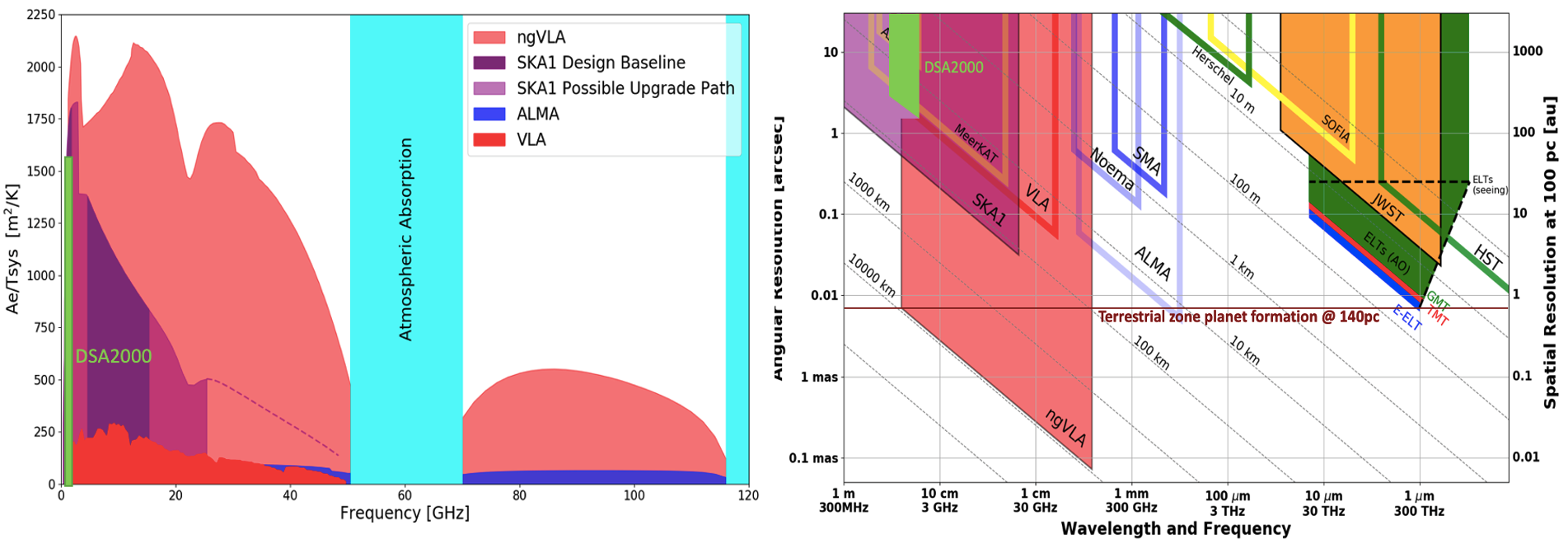
However, all of these facilities are limited in one respect: field of view (FoV). The ngVLA is primarily designed as a PI-proposal driven, ’point and shoot’ facility for detailed studies of specific targets. FoV is the parameter in which the DSA2000 really stands-out. The DSA2000 has an order of magnitude, or more, larger FoV than the ngVLA and SKA-mid. Coupled with it’s competitive sensitivity (Fig 1), and full polarization response, the DSA2000 represents the ideal array for synoptic wide-field surveys, with the potential to discover myriad new cosmic phenomena at low flux densities, down to millisecond timescales. However, simply obtaining a flux density at GHz is of limited information content. To characterize the discovered sources, and determine the physical processes driving new phenomena, broad-band, high resolution follow-up observations are required. That is where the ngVLA will play a key role.
The astronomical community has identified five key science goals for the ngVLA (see ngVLA memo 19):
-
Unveiling the Formation of Solar System Analogues on Terrestrial Scales
-
Probing the Initial Conditions for Planetary Systems and Life with Astrochemistry
-
Charting the Assembly, Structure, and Evolution of Galaxies Over Cosmic Time
-
Using Pulsars in the Galactic Center as Fundamental Tests of Gravity
-
Understanding the Formation and Evolution of Stellar and Supermassive BH’s in the Era of Multi-Messenger Astronomy
We briefly highlight a few of the obvious synergistic science programs that could be realized with combined DSA2000 surveys and ngVLA follow-up, starting with an important remind of the power of such follow-up to understand new physical phenomena.
The LIGO discovery of the first gravitatonal wave source, GW170817, opened a new window on the Universe, revealing gravitational radiation from merging M black holes (Abbott et al. PRL, 119, 161101). The follow-up identification of the electromagnetic counterpart was remarkably fast in the radio and the optical, isolating the source to a galaxy at 41 Mpc distance (Abbott et al. 2017, ApJL, 848, L12; Hjorth et al. 2017, ApJL, 848, L31; Hallinan et al. 2017, Science, 358, 1579). Broad-band radio monitoring found a turn-over in the radio light curve about 150 days after the merger, while mas-resolution imaging with the VLBA detected superluminal motion of the radio source. These radio observations provided the basis for a physical model in which the electromagnetic radiation arises from the formation of a relativistic jet during the merger, which expands initially through the circum-binary debris, and then emerges into the interstellar medium (Dobie et al. 2018; Mooley et al. 2018).
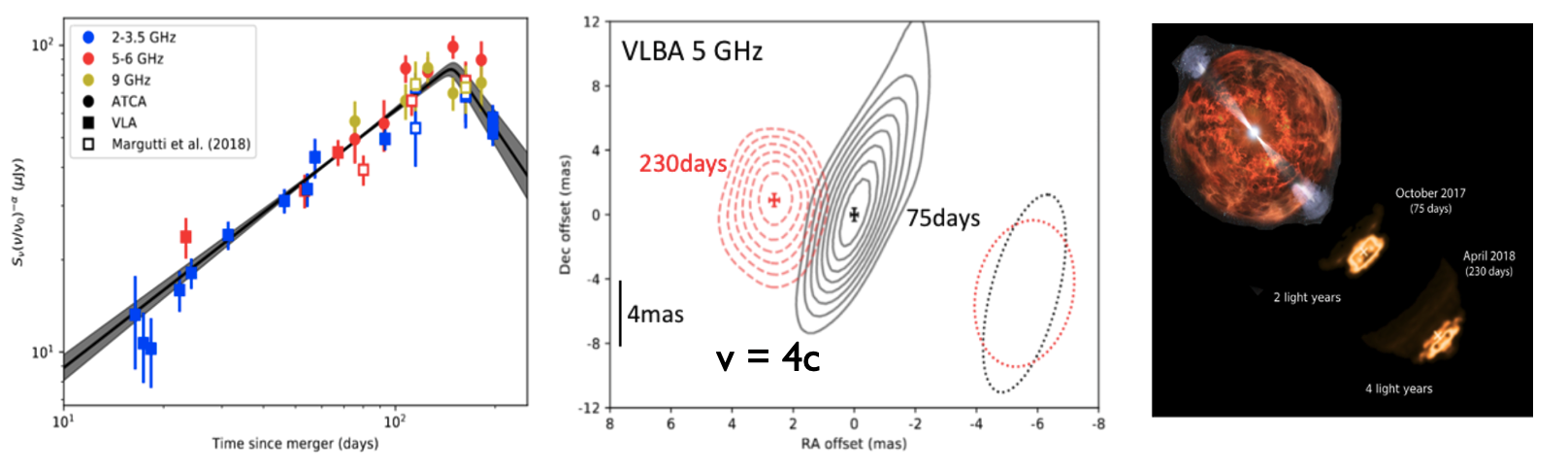
The case of GW170817 accentuates the fact that, while the discovery of new phenomena may occur through wide field surveys, understanding the physics of these sources requires high resolution, multi-band follow-up. The DSA2000 expects to target 10 to 20 LIGO events per year for EM identification. The ngVLA is well poised to perform the broad band, high resolution follow-up, from 1 GHz to 116 GHz, again down to 60 as resolution.
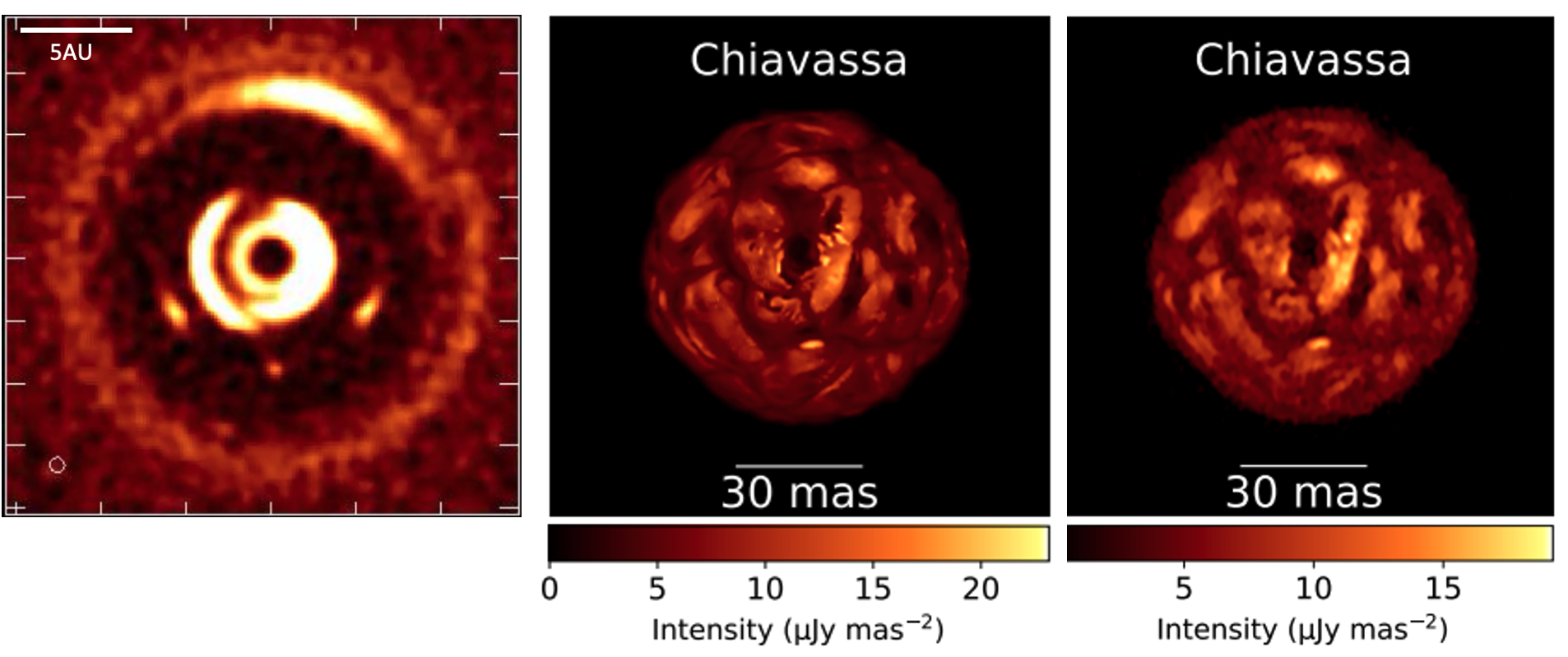
The discovery of thousands of exo-planets, hundreds in the ’habitable zone,’ has spurred renewed interest in the possibility of life outside the Solar system. Primary science drivers for the ngVLA include probing deep into ptoto-planetary dusty disks with sub-AU scale imaging of planet formation, potentially down to a few Earth masses, as well as the study of the pre-biotic molecules that provide the chemical initial conditions in forming planetary systems (McGuire et al. 2018, ASP, 7, 217 and 245; Ricci et al. 2018, ASP, 7, 147). The ngVLA will make ’movies’ of planet formation, showing the differential rotation of rings and gaps in dusty disks on sub-AU scales, as well as dust traps, and potentially even accretion onto the planets themselves (Fig. 3; ngVLA memos 6, 57, 68, 101).
In terms of end-of-life stellar evolution and enrichment of the ISM, the ngVLA will also provide exquisite movies of the ’boiling’ of stellar atmospheres in evolved massive stars (AGB and Red Supergiants), corresponding to the dominant events enriching the ISM with heavy elements (Fig. 3; ngVLA 66, 95).
Where does the DSA2000 fit into the hunt for habitable worlds? Answer: through determining the inhabitability of planets. The majority of terrestrial planets in the habitable zone will be found associated with M dwarf stars, simply because M dwarfs are the most common star. However, it is now well documented that M-dwarfs are extremely magnetically active, including strong millimeter flares, and auroral emission associated with large scale stellar dipole fields of a few thousand Gauss (eg. Howard et al. 2022, ApJ, 938, 103; Bastian et al. 2022, ApJ, 935, 99). Such extreme ’exospace weather’ will have severe deleterious effects on planetary atmospheres, and the subsequeny development of life, through strong magnetospheric interactions. The DSA2000 will provide the first true census of M dwarf radio activity, with the expectation of identifying flare events, stars through non-thermal coronal emission, and stars in thermal coronal emission. Determining the prevalence of extreme exospace weather has become a key term in the Drake equation, and hence in understanding the probability for the development of life outside the Solar system.
Another key science goal of the ngVLA is a precision measurement of the dense gas history of the Universe through observation of low order rotational transitions of CO back to within Gyr of the Big Bang (Decarli et al. 2018, ASP 7, 565). Molecular gas is the direct fuel for star formation in galaxies. Current surveys suggest a parallel rise and fall for the cosmic molecular gas density as is seen in the star formation rate history, although the errors are substantial (Walter et al. 2020, ApJ, 902, 111). The goal of the ngVLA is to provide an order of magnitude improvement in the measurement of the molecular gas content of galaxies back to cosmic reionization.
Where does the DSA2000 fit into the study of the history of baryons in galaxies? Answer: through the identification of galaxies in HI 21cm emission out to (or perhaps , if extended to 0.5 GHz). While not probing the earliest cosmic epochs, this redshift range does reach toward the peak epoch of cosmic star formation rate density (’cosmic high noon’), and in particular, covers the redshift range over which the cosmic star formation rate density declines by an order of magnitude – the epoch of ’cosmic demise’. The current constraints on the HI density over this time range are poor. Knowledge of the HI density evolution is crucial for understanding late-time accretion of gas onto galaxies from the IGM, to address the question: why is the star formation rate declining so dramatically to the current epoch (Walter et al. 2020)?
These are just a few of the obvious science synergies between the DSA2000 surveys and the ngVLA deep, high resolution follow-up. However, there remains one open issue: timing. The DSA2000 is expected to start full operations toward the end of 2026. The current ngVLA timeline has early science (defined as when the ngVLA capabilities exceed those of the current VLA and VLBA), beginning in late 2028, with steady increase in capabilities until full operations sometime in the middle of the next decade. Hence, for the first two or three years of DSA2000 operations, source radio follow-up will still rely on the VLA and VLBA.
2.2 Synergies with SPHEREx
Tzu-Ching Chang (JPL/Caltech), Yun-Ting Cheng (JPL/Caltech)
SPHEREx, the upcoming NASA MIDEX mission to be launched in 2025, will spectro-imagine the near-infrared all-sky at 6.2 spatial resolution in 102 wavelength channels over . This is comparable to DSA-2000 in terms of sky coverage, angular resolution and timeline, and we anticipate rich synergies between the two. We outline some synergy examples such as providing redshift verification and transient counterparts, as well as cross-correlation potentials for weak gravitational lensing and extragalactic background light decomposition that warrant further investigations.
SPHEREx1 will generate the first all-sky spectroscopic survey in the near-infrared over in 102 wavelength channels with a 6.2" spatial pixel, with a 5 point source sensitivity better than AB magnitude per wavelength channel ((Doré et al. 2014)). During its nominal two-year mission lifetime, SPHEREx will survey the full sky four times, with frequent visits to the two deep fields near the north and south ecliptic poles, each about 100 deg in size. From its low earth orbit SPHEREx will observe part of the deep fields every 86 minutes in a few colors, making the deep fields particularly synergistic for transient sciences when both DSA-2000 and SPHEREx are in operation.
SPHEREx will produce a rich dataset. In addition to providing 3D spectral images, SPHEREx is expected to measure the spectra of over one billion galaxies – 10 millions of which will have a redshift accuracy and more than 100 millions galaxies a redshift accuracy of . There will be 25,000 galaxy clusters, more than 100 million main sequence stars, more than 400 brown dwarfs, over one million Quasars and potentially 3-300 Quasars, to name a few discovery potentials ((Doré et al. 2016)). The data and catalogs will be released to the public at a fast pace: the spectral-image data that can be particular useful for transient sciences will be released two months after observation, and the source catalog will be released 8 months after the completion of the third all-sky survey. All these will enable rich synergistic multi-wavelength studies ((Doré et al. 2018)).
The DSA-2000 HI survey will detect galaxies out to with exquisite redshift accuracy. This unique dataset, in addition to mapping the neutral hydrogen distribution and evolution, has the potential to enhance the many sciences SPHEREx has to offer:
(1) For example, these HI galaxies can be cross-matched to SPHEREx sources and help verify and sharpen their redshifts derived from SPHEREx alone, which could improve the accuracy of the non-gaussianity parameter determination through large-scale clustering measurement, shedding light on the physics of inflation in the very early Universe.
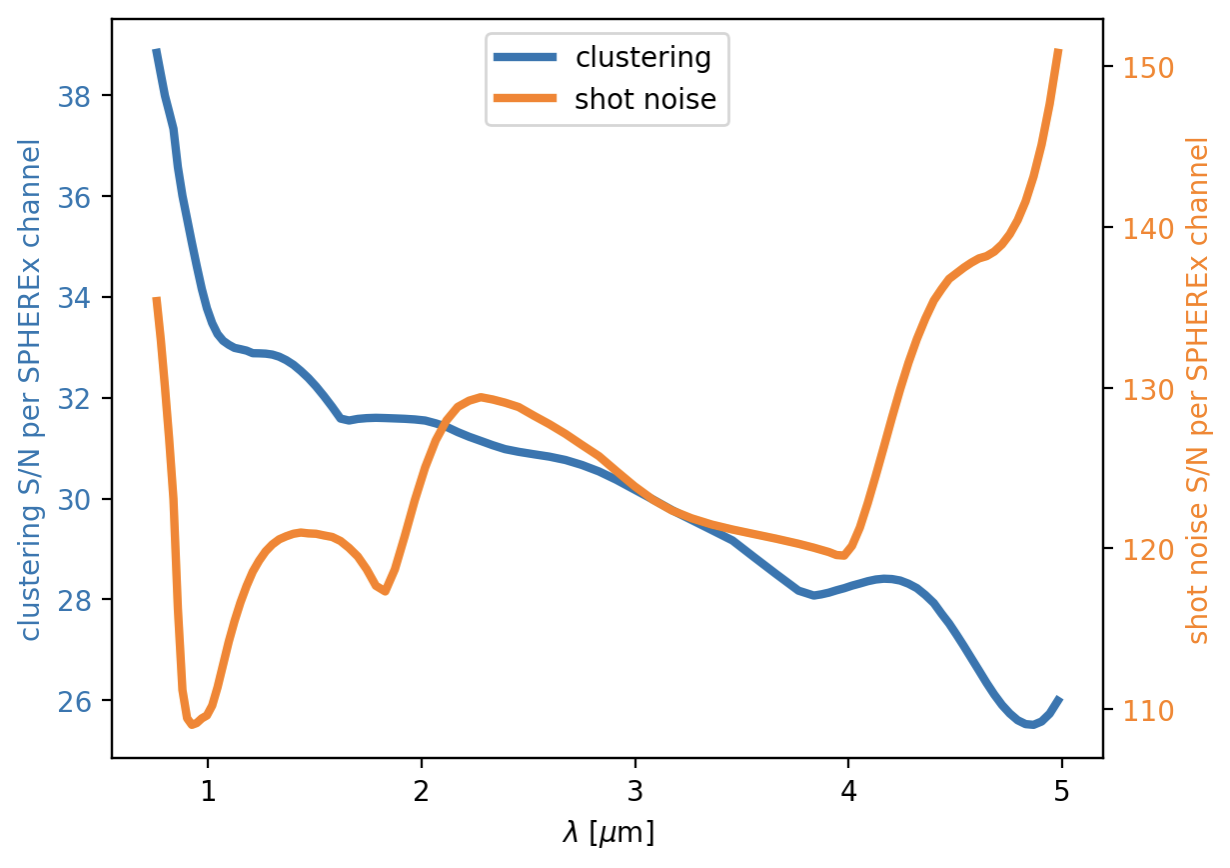
(2) Additionally, the HI galaxies are beacons of the underlying matter distribution, and can aid the redshift decomposition of the diffuse extragalatic background light measured by SPHEREx through tomographic cross-correlation (e.g., (Cheng and Chang 2022)). The large-scale clustering amplitude reveals the mean near-IR intensity associated with all sources of emission while the Poisson scale of such a cross-correlation can further reveal the near-IR properties of HI-hosting galaxies, which would be particularly interesting. A cross-correlation forecast between the DSA-2000 HI sample at and SPHEREx diffuse maps, following the formalism of (Cheng and Chang 2022), indicates that both the clustering and Poisson amplitudes can be detected at high significance across wavelength. Figure 1 shows a rough estimate of signal-to-noise (SNR) for the cross-correlation between DSA-2000 HI galaxies and SPHEREx all-sky diffuse maps in the linear clustering (blue) and Poisson (orange) shot noise regimes, assuming for the purpose of this estimation of HI sources reside between with a uniform redshift distribution. These measurements would help improve our understanding of galaxy formation and evolution.
The DSA-2000 radio continuum sources will be of great interest in cosmology as well. Tomographic cross-correlation between radio sources and SPHEREx galaxies can reveal the redshift distribution of radio sources through the redshift clustering technique ((Newman 2008; Ménard et al. 2013)), potentially out to high redshift. Furthermore, weak gravitational lensing, now an important observational technique for probing the growth and geometry of the universe, can be performed in cross-correlation using radio and near-infrared observations. This approach offers an effective mitigation of observational systematics that could otherwise bias the shear measurements, as systematics associated with each dataset are unlikely to correlate (e.g., (Harrison et al. 2016, 2020; Camera et al. 2017)). As the SPHEREx point-spread-function is undersampled, it would be difficult to derive shape measurement from SPHEREx alone, however, tomographic galaxy-galaxy lensing, using radio as lensing sources and SPHEREx galaxies as lenses as a function redshift, can in principle bring rich information about galaxy astrophysics and cosmology (e.g., (Demetroullas and Brown 2018)).
2.3 Vera C. Rubin Observatory and DSA-2000: A winning synergy to unveil populations of elusive transients
Igor Andreoni
The Vera C. Rubin Observatory in the optical and DSA-2000 in the radio are new world-class survey instruments that will enable the systematic exploration of large sky volumes. Synergies between Rubin and DSA-2000 can be particularly valuable to discover populations of rare transients that provide us with unique insights about the physics of compact objects. These include electromagnetic counterparts to gravitational-waves, “orphan" gamma-ray burst afterglows, and relativistic tidal disruption events. Here, the potential of a Rubin & DSA-2000 synergy is demonstrated using the work done by current optical surveys such as the Zwicky Transient Facility, multi-wavelength follow-up telescopes, and with simulations.
Some slow radio transients are counterparts to elusive fast optical/infrared transients. Phenomena at their origin of these transients include binary neutron star mergers, gamma-ray bursts (GRBs) and other types of relativistic mass ejection such as jetted tidal disruption events (TDEs). Neutron star mergers (i.e., binary neutron star and neutron star–black hole mergers, under some conditions) can be accompanied by bright multi-wavelength transient emission (B. Abbott et al. 2017). The optical/infrared counterpart, called “kilonova", raises and fades within a few days (e.g., (I. Andreoni et al. 2017; Arcavi, Hosseinzadeh, Howell, et al. 2017; Kasliwal et al. 2017a; Smartt et al. 2017)) and is largely powered by the decay of newly synthesized -process nuclei with high atomic number. A radio afterglow was also detected and has remained observable for years, explained by either a collimated ultrarelativistic jet (viewed off-axis) or a cocoon of mildly relativistic ejecta (e.g., (G. Hallinan, Corsi, et al. 2017a)). The optical kilonova associated with GW170817 was fainter, faster and reddened more quickly than typical supernovae. These properties and the intrinsic rarity of neutron star mergers in the nearby universe make kilonovae difficult to observe during regular operations of optical surveys and none has been found to date independently of gamma-ray of gravitational-wave triggers (e.g., (Igor Andreoni et al. 2021)). A few dozen kilonovae (e.g., (Igor Andreoni, Coughlin, Almualla, et al. 2022; Setzer et al. 2023)) are expected to be found serendipitously by Vera C. Rubin Observatory LSST ((Ivezić et al. 2019), located in Chile), which is coming online in 2025, thanks to its exceptional combination of wide field of view (9.6 deg) and depth ( 24.7 mag in 30s exposure time). Rubin is expected to find a large number of other fast transient classes, including for which the associated GRB went undetected, or where the Lorentz factor is too low () to produce a GRB in the so-called “dirty fireball" model ((Paczyński 1998)). Similarly to kilonovae, the optical emission from orphan afterglows can fade rapidly (but the evolution might be slower for off-axis GRBs) and is typically observable for only a few days. A radio afterglow, on the other hand, could remain bright for months or years. Systematic optical searches with the intermediate Palomar Transient Factory (iPTF) and Zwicky Transient Facility (ZTF; (Bellm et al. 2019)) surveys unveiled several afterglows without a detected GRB counterpart ((Cenko et al. 2015; Ho et al. 2020, 2022a; Igor Andreoni et al. 2021)), but confident dirty fireball or off-axis GRB candidates still need to be found (Ho et al. 2022a). A particularly exciting fast optical transient, named AT2022cmc, was recently discovered in ZTF data and was interpreted as the first jetted TDE found by an optical survey, in the form of a rapidly-fading transient ((Igor Andreoni, Coughlin, Perley, et al. 2022; Pasham et al. 2023)). An exceptionally bright radio transient was found associated with AT2022cmc ((Igor Andreoni, Coughlin, Perley, et al. 2022)), whose monitoring also showed rapid day-scale variability around 16GHz ((Rhodes et al. 2023)). A large population of jetted TDEs could be found in the near future by X-ray, optical, and radio surveys.
In summary, many fast (hours to days) optical transients will be found by Rubin Observatory. Their identification will consitute a big data problem, given that up to 10 million alerts will be generated every night, each one indicating the detection of a variable or transient source. DSA-2000 is also expected to find billion sources, many of which will be transients that need optical photometric and/or spectroscopic data to be classified.
The DSA-2000 all sky survey will be able to observe the peak of a transient similar to the radio counterpart to GW170817 out to Mpc. An association between a DSA-2000 radio transient and a Rubin kilonova candidate will provide invaluable information about the nature of the transient and the astrophysics of the source. Combined optical + radio detection of orphan afterglows and jetted TDEs with Rubin and DSA-2000 will also serve as a strong diagnosis tool for the fast and slow transients discovered in Rubin and DSA-2000 data, respectively. A synergy between Rubin and DSA-2000 will enable the building of sizable samples of rare transients that are largely out of reach for current facilities. Tools may be developed to facilitate Rubin + DSA-2000 source cross-matching and combined data analysis.
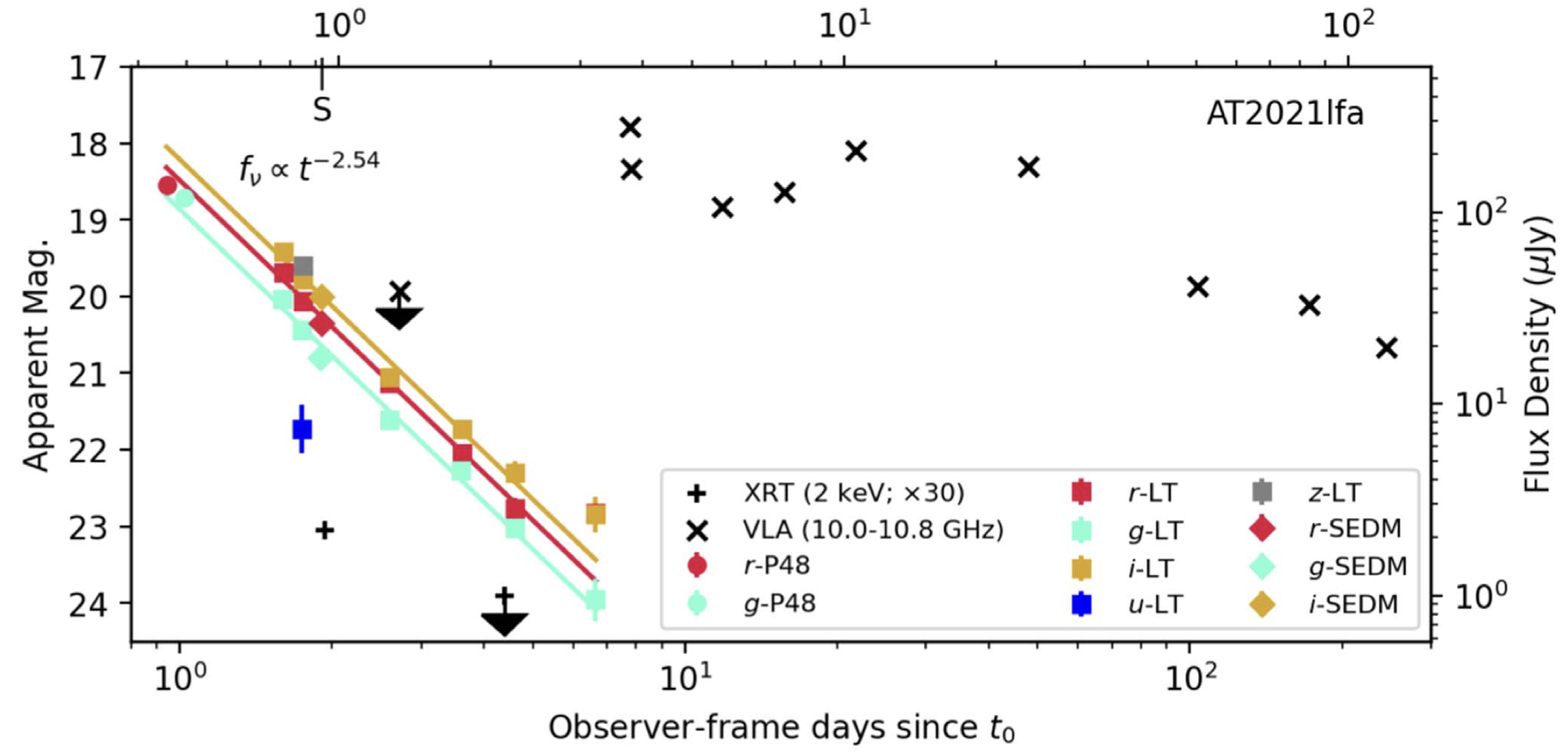
The current DSA-2000 baseline plan will open a great discovery space in the radio. The Rubin strategy will likely be based on a “rolling cadence" approach, in which the sky coverage will not be homogeneous by season. The survey footprint will be divided in bands that will be imaged more or less frequently depending on the season to obtain some well-sampled light curves. Self-absorption in relativistic transients could be high and a significant time delay between a fast optical transient and its becoming observable in the DSA-2000 band could be present and taken into account. It would be preferred if the DSA-2000 strategy takes into account when equatorial fields are surveyed by Rubin at higher cadence to maximize the detection of radio counterparts to fast optical transients.
| DSA-2000 baseline reference design | match to project | |
|---|---|---|
| Frequency band | 0.7–2.0 GHz | higher frequencies would be |
| less sensitive to self-absorption | ||
| Declinations | -31 | low Decs could be prioritized |
| if an inhomogeneous cadence is chosen | ||
| Cadence | 1 every 4 months | suggestion 1: higher cadence on |
| Rubin deep drilling fields; | ||
| suggestion 2: take Rubin’s rolling | ||
| cadence into account |
2.4 Deconvolution & superresolution with POLISH
Liam Connor
DSA-2000 in a new interferometric imaging regime due to the lack of visibility data and its densely sampled aperture. The former point means we require image-plane deconvolution and the latter suggests we can be ambitious in our image reconstruction, e.g. achieving super-resolution. We built a learning-based imaging algorithm that can deconvolve radio interferometric data and recover angular scales below the diffraction limit. POLISH is residual neural network that has been trained on a large sample of image pairs (dirty image and true sky image) such that it can learn deconvolution2. POLISH’s super-resolution will enable several key science cases, but could still be significantly improved with a focused effort by a GPU programmer or AI expert.
CLEAN has been used for decades as the de facto standard deconvolution algorithm in radio interferometry. The Cotton-Schwab algorithm is one the most prominent variants of CLEAN. It relies on ungridded visibility data for its iterative approach, to which the DSA-2000 will not have offline access. CLEAN is typically not able to achieve super-resolution due to its use of a “restoring beam”, but also because the algorithm is inherently bad at recovering high spatial frequencies. Bayesian-inspried methods, such as Regularized Maximum Likelihood (RML) can achieve super-resolution, but are slow, require visibilities, and often have a human in the loop.
In the past five or so years, there have been tremendous advances by the computer vision community in applying learning-based methods to inverse problems. This is particularly true for super-resolution, where efficient neural network architectures have been found for recovering high spatial frequencies. With POLISH, we have chosen to capitalize and build on those advances.
POLISH was designed specifically for the DSA-2000, since no other algorithm was 1) fully automated without a human in the loop 2) image-plane only 3) able to achieve super-resolution and 4) feed-forward and fast. As it happens, POLISH has proven to be a generic deconvolution algorithm as it has been applied to real VLA data as well as optical data for direct imaging exoplanets. We have published on POLISH and its weak lensing application3 and we have made the code available4.
POLISH requires image plane data and a well-understood PSF. As long as both are available, a model can be trained for deconvolution and super-resolution.
3 The Dynamic Radio Sky: Slow Transients
Summary: Slow Transients
Anna Y. Q. Ho (Cornell University; on behalf of the SAC)
The dynamic sky on timescales from days to years is only just beginning to be explored at radio wavelengths. In the past few years, a variety of transients have been discovered using VLA Sky Survey data, some of which may represent long-sought events (e.g., off-axis -ray burst afterglows, pulsar wind nebulae) and some of which may represent new and unexpected phenomena (e.g., the merger of a compact object and a massive star). The results from the past few years represent the tip of the iceberg of what will be revealed by the DSA-2000’s unprecedented depth (Section 2.1), and discoveries will benefit from machine learning classification and anomaly detection tools (Section 2.4).
One major theme in the following sections is the scientific benefit of an all-sky survey, which mitigates the selection bias inherent in targeted radio observations. DSA-2000 can reveal the statistics of radio emission in stellar explosions (supernovae; Section 2.3); magnetic flaring activity in low-mass stars (Section 2.7); and relativistic jetted phenomena such as tidal disruption events (Sections 2.1, 2.6), -ray bursts, and luminous fast blue optical transients (Sections 2.1, 2.7).
Another theme is the benefit of having DSA-2000 radio coverage overlapping with major surveys at other bands, including ongoing (e.g., ASAS-SN, ATLAS, ZTF) and future (the Vera Rubin Observatory’s Large Synoptic Survey Telescope, LS4) optical surveys. The overlap between DSA-2000 and LSST fields will enable studies of hot magnetic stars through their electron cyclotron maser emission (Section 2.2). In addition, the DSA-2000 coverage of the large numbers of supernovae discovered and classified by optical surveys (today the rate is approximately one per night) will enable large-scale systematic studies of supernova radio emission, which in turn gives insight into their progenitor channels and the role of binarity (Section 2.3). Interpreting DSA-2000 radio observations of relativistic transients requires overlap with surveys at other wavelengths, particularly high-energy (-ray, X-ray).
Finally, an additional recurring theme is that significant scientific advances in a variety of topics would be enable by adopting a wider variety of cadences, some faster (one every few days) and some slower, than the nominal one per four months plan. These topics include very early rapidly evolving emission from supernovae, which may be the key to understanding the link between -ray bursts and “normal” stellar explosions (Section 2.5); mysterious flares from tidal disruption events (Section 2.6) which may be related to the intermittent activity of a relativistic jet; and relativistic stellar explosions (the afterglows and cocoons of -ray bursts, and the mysterious “luminous fast blue optical transients” such as AT2018cow; Section 2.7).
3.1 The Dynamic Radio Sky in Unprecedented Depth
Dillon Z. Dong
The planned DSA 2000 Cadenced All Sky Survey (CASS) will obtain a 4 month cadence lightcurve over 16 epochs for every 1 GHz source brighter than a few Jy in the northern sky. The 2000 deg pulsar timing and 30 deg deep-drilling fields will sample smaller portions of the sky on faster timescales to similar per-epoch depths (and factors of a few deeper when stacked). Due to the large volume probed, CASS will dramatically increase the sample size of known transient classes, such as supernovae, gamma ray bursts, AGN outflows, tidal disruption events, flares from stars and compact objects. The pulsar timing and deep-drilling surveys will allow us to identify a subset of transients that evolve on faster timescales, including intrinsically lower-luminosity non-terminal transients from stellar-mass objects, as well as relativistic outflows. Each of the surveys will open the door for the serendipitous discovery of new transient classes which are inaccessible to present-day surveys due to their rarity. When combined with the diagnostic power of contextual data from multi-wavelength surveys (both time-domain and single epoch), the DSA 2000 will revolutionize our understanding of the dynamic radio sky.
Radio transients provide a window into the ever-changing behavior of universe’s relativistic particle accelerators. These ephemeral sources allow us to measure properties of the universe on angular scales smaller than milliarcseconds to microarcseconds, probing phenomena that are impractical to observe at scale (or impossible to observe at all) in any other way. To date, most of our knowledge of radio transients (aside from fast transients on timescales of milliseconds to hours such as fast radio bursts and stellar flares) has come from follow-up observations of transients first discovered at other wavelengths. Though follow-up detections yield valuable insights, they are fundamentally biased, as they require not only an early multiwavelength counterpart (which may not exist for some radio transient classes), but also a subjective decision to take a follow up observation. These biases can be addressed by searching for radio transients directly in radio surveys.
Over the past few decades, many surveys of ever increasing sensitivity and areal coverage have steadily increased our ability to detect radio transients without the need for prior detections at other wavelengths (see e.g., fig 2. of Lacy et al. 2020 for a summary). In the mid 2010s, the Caltech NRAO Stripe 82 Survey (CNSS; Mooley et al. 2016) finally reached a scale where transients are consistently being detected uncovering transients in a search of 300 deg at 3 GHz to a typical RMS of Jy (e.g., Anderson et al. 2019, Wolowska et al. 2021). This success helped motivate the VLA Sky Survey, which is using the same techniques to observe the entire 3 GHz northern sky (30,000 deg) to a depth of 140Jy (Lacy et al. 2020). In preliminary work, we have found that VLASS contains transients per epoch, a scale where direct detections now outnumber follow-up detections for the first time (Dong et al. 2023, in prep). This order-of-magnitude increase in scale has paved the save for both statistical samples of known transient classes and the discovery of new ones. Examples include a population of new jets launched from quasars (Nyland et al. 2020), a wide diversity of tidal disruption events (Somalwar et al. 2021, 2022, 2023abc in prep) and flaring stars (Ayala et al. 2023 in prep), a stellar explosion driven by the merger of a compact object and a massive star (Dong et al. 2021), and the emergence of an extremely enegetic new pulsar wind nebula (Dong & Hallinan 2023).
A number of other radio transient transient searches are also demonstrating that the sky is active at lower frequencies than VLASS. Though the LOTSS survey (a LOFAR 140 MHz survey reaching a depth of 95Jy; Shimwell et al. 2017, 2022) is not designed as a time-domain experiment, it is possible to reprocess the data to search for time variable phenomena. The first results have come in the form of candidate star-planet interactions (Vedantham et al. 2020, Callingham et al. 2021). The ASKAP/VAST survey (Murphy et al. 2013) is specifically designed as a time-domain survey that will produce 888 MHz lightcurves over a 10,000 deg area at at depth of Jy. A number of results have been released thus far, including the discovery of highly polarized emission from 33 stars (Pritchard et al. 2021), and an as-yet unidentified transient within 4 degrees of the Galactic center (Wang et al. 2021). The ThunderKAT survey is searching for transients commensally with other MeerKAT surveys and has found a number of Galactic transients, along with the discovery of a radio-lumnious neutron star with an ultra-long rotation period of 76s (Caleb et al. 2022). All of the above surveys are in their initial stages, and can reasonably be expected to continue the stream of new radio transient discoveries in the next few years.
The DSA 2000 CASS will be 2 orders of magnitude deeper than the present-day time-domain radio surveys described above, so it should be sensitive to transients in a volume 3 orders of magnitude larger. With this increase in scale, we will be sensitive to a sizable new parameter space, which may contain new transient populations that are too rare to be detectable in current surveys. The sample size of currently known transient classes should also go up in proportion to the volume, provided that we are able to identify them as such. This identification will be aided by the increase in contextual information from current and near-future sky surveys (e.g., the Rubin LSST, DESI, Roman, SPHEREx). Additionally, the DSA 2000 will provide its own context in many cases, through polarization measurements and the detection of radio recombination lines and the 21cm line (providing a redshift for extragalactic transients), and through the availability of lightcurves to measure the rise and fade time of transients. In order to interpret these lightcurves it will be essential to develop robust difference imaging techniques, methods to sharpen the localization of point sources in the presence of diffuse emission, and and to understand both the quiescent and variable emission from radio sources that will become detectable at 500 nJy depths. In addition to aiding in transient detection, this work will be scientifically fruitful for a number of fields. For instance, the vast population of scintillating radio sources can be used to map out the structure and turbulent fluctuations of the Galactic ISM. Finally, the deep all-sky image produced by CASS will serve as a reference epoch for any future 1 GHz observations (e.g. with the ngVLA), providing a boon to direct radio transient detection far into the future.
The DSA 2000’s baseline design is already well-suited for transient searches. However, there are a few modifications that we believe could substantially increase the scientific return. First, we suggest that the various surveys be observed in a way that provides significant coverage at a wide range of cadences (potentially logarithmically spaced). In CASS, this could be accomplished by observing fields out of order, while in the deep fields, we suggest grouping observations in a few bursts (to facilitate searches for longer timescale transients in stacked observations). Spacing epochs in this way will provide crucial diagnostic information for distinguishing fast-evolving transients from slower ones. This information can in turn be used to aid in multi-wavelength cross matching (since emitting regions of smaller physical size / lower luminosity will tend to evolve faster; Pietka et al. 2015). We particularly suggest that faster timescale epochs be observed in the Galactic plane. Second, if it is possible, we suggest that outriggers be built so that selected sources can be localized with higher precision. Current radio transient surveys are already encountering issues with false association probabilities. While DSA 2000 transients will have much better contextual information and will in some cases provide their own context, the number of transients that can be associated with multi-wavelength counterparts is still expected to be limited by the limited resolution and the sheer number of transients expected.
| DSA-2000 baseline reference design | match to project | |
|---|---|---|
| Spatial resolution | 3.5 | Ideally as fine as possible (with outriggers) |
| Cadence | 1 every 4 months | Ideally varied |
3.2 Systematically characterizing the binarity in stripped envelope supernovae progenitors
Poonam Chandra
Prior to explosion of a massive star as a supernova, stripping of mass from the outer layers of the star leads to varying amount of hydrogen and/or helium at the time of supernova explosion. Type IIb (very small amount of hydrogen) , Type Ib SNe (absence of hydrogen) and Type Ic SNe (absence of hydrogen and helium) are collectively called stripped-envelope supernovae (SESNe), and they together form a continuum with increasing amount of mass stripping of the progenitor star. Mechanism of stripping mass in SESNe is not clear, though consensus currently is that single stars may not be able to lose all of their H/He envelope and binarity may be important ((Meynet and Maeder 2005; Eldridge and Vink 2006)). In some cases archival images have shown surviving companion of the supernova progenitor star ((Gilkis and Arcavi 2022; Kilpatrick et al. 2021; Arcavi, Hosseinzadeh, Brown, et al. 2017)). However, these images only reflect the time stamp evidence of a binary companion, the evolution under the influence of binary and the binary separation are not possible to determine via these images. The binary companion’s interaction with supernova progenitor is likely to result in enhanced mass-loss and asymmetric, shell like or complex circumstellar medium, which can be best probed via radio bands. In some cases late time enhanced radio emission has been seen and has indicated the signatures of binary progenitors in some SESNe ((Poonam Chandra et al. 2020; Michael F. Bietenholz and Bartel 2017; Stroh et al. 2021a; Maeda et al. 2023)). Radio observations revealing late time enhancements is the best way to probe the evidence of binary companion and its effect on the supernova progenitor evolution, however, unpredictable due to uncertainty in binary separation and the resulting interaction. As described below, DSA2000 has potential to systematically characterize the binarity in SESNe.
Late time radio enhancements in SESNe have been seen on a timescale of a few months (e.g. SN 2014C, (Raffaella Margutti, Kamble, et al. 2017); SN 2018ivc, (Maeda et al. 2023)), to a few years (e.g. SN 2001em, (Chugai and Chevalier 2006)) to decades (e.g. SN 2001em, (Poonam Chandra et al. 2020); SN 1986J, (Michael F. Bietenholz and Bartel 2017)). Recently (Stroh et al. 2021a) revealed late time radio enhancements in 19 supernovae 1–60 years of age during VLASS first epoch observations. Thus it appears that the late time radio enhancements can be seen at unpredictable epochs. This uncertainty comes because epoch of radio enhancements due to dense circumstellar components created due to binarity greatly depends on the binary separation and the post binary interaction mass-loss rate. However, both are extremely difficult to predict. Ideally one needs to keep observing SESNe for several decades with a log cadence, which is highly impractical and demands unrealistic telescopes’ time. This has obviously not been possible and hence it has not been possible to conclusively indicate the role of binary companion in SESNe.
DSA2000 will survey the northern sky covering 30,000 sq-deg 16 times over the span of 5 years with a sensitivity of 2 Jy/beam per epoch. It is likely to cover hundreds if not thousands of stripped envelope supernovae at varied time scales and may reveal radio enhancements at different epochs. These time scales will correspond to thousands of years before the supernova explosion and thus will systematically characterize the binarity in supernovae progenitors of stripped envelope supernovae.
N/A
3.3 Fast Radio Supernovae
Assaf Horesh
While in some supernovae (SNe) the radio emission at low GHz frequencies evolves relatively slowly, some other SNe exhibit fast evolving radio emission. An example of such "fast" radio SNe is a sub type of Type Ic SNe, which may be the missing link between normal Type Ic SNe and relativistic ones. So far only a handful of such SNe have been discovered as they exhibit lower peak fluxes than normal Type Ic SNe and their radio emission fades away within a couple of weeks. DSA-2000 with its enhanced sensitivity can open up a window for probing this unexplored phase space of fast radio SNe, but it requires that the DSA-2000 will devote some of its observing time for high cadence observations.
Radio observations of supernovae (SNe) and other types of transient phenomena have been providing diagnostics not accesible in other wavelengths, over the last few decades. These diagnostics include: calorimetry, measuring outflow velocities and their temporal evolution, and mapping the circumstellar material (CSM) around SN progenitors (and hence tracing their mass-loss histories). This type of diagnostics have been employed also on stripped envelope supernovae.
Stripped envelope SNe are believed to originate from progenitor stars that have been stripped of most of their Hydrogen (Type Ib) and sometimes also of their Helium (Type Ic) envelopes. Radio observations are in good accord with the above description. As an example, in the case of PTF 13bvn (Cao, Kulkarni, Horesh et al. 2013), the radio analysis is consistent with the progenitor being a stripped compact Wolf-Rayet star. This matches the properties of the optical progenitor that have been identified, for the first time in the case of a Type Ib SN, in archival optical images. Radio observations of PTF 13bvn and other normal Type Ib/c SNe (e.g., SN 1994I, SN 2004cc) show that the fastest outflows from ordinary Type Ib/c SNe have velocities of c.
Radio diagnostics came to the fore also for stripped envelope supernovae associated with Gamma Ray Bursts (GRBs). The first example was SN 1998bw (a broad-lined Type Ic; Ic-BL), associated with the nearby, low-luminosity gamma-ray burst GRB 980425 (Galama et al. 1998). Radio observations established that the fastest moving ejecta were mildly relativistic and carried a significant amount of the explosion energy (Kulkarni et al. 1998). The same approach showed that SN 2009bb (Type Ic-BL) also had mildly relativistic ejecta and it has been reasonably argued that either SN 2009bb did not produce gamma-rays or that the associated GRB was likely not pointed towards us (or we missed detecting the gamma-rays; Soderberg et al. 2010). It is worth noting that in both cases the optical line features were very broad, i.e., c.
It turns out that Type Ic SNe with intermediate velocities (fast but not relativistic) do exist, but this population remained so far mostly unexplored. In the past, there have been only cases of “fast” radio SNe where Type Ib/c SNe have exhibited outflows with velocities that are in the range between ordinary and relativistic SNe Ib/c. A relatively recent example is PTF 12gzk, discovered by the Palomar Transient Factory (PTF) a few days after explosion at Mpc (Ben-Ami et a., 2012). The initial optical spectra exhibited high-velocity (but not broad) lines with velocities of km s. Our radio observations at GHz of PTF 12gzk, days after explosion revealed a fast fading radio emission (Horesh et al. 2013). This means that the radio emission optical depth has already dropped to low GHz frequencies early on. The radio emission became too faint to detect days after explosion. As we showed in Horesh et al. (2013), the SN ejecta was expanding at high velocity of c, a higher velocity than observed in ordinary SNe Ibc (see Figure 3.1). The radio data also indicated that the density of the CSM around the supernova is lower by a factor of than the CSM density around normal Type Ibc SNe.
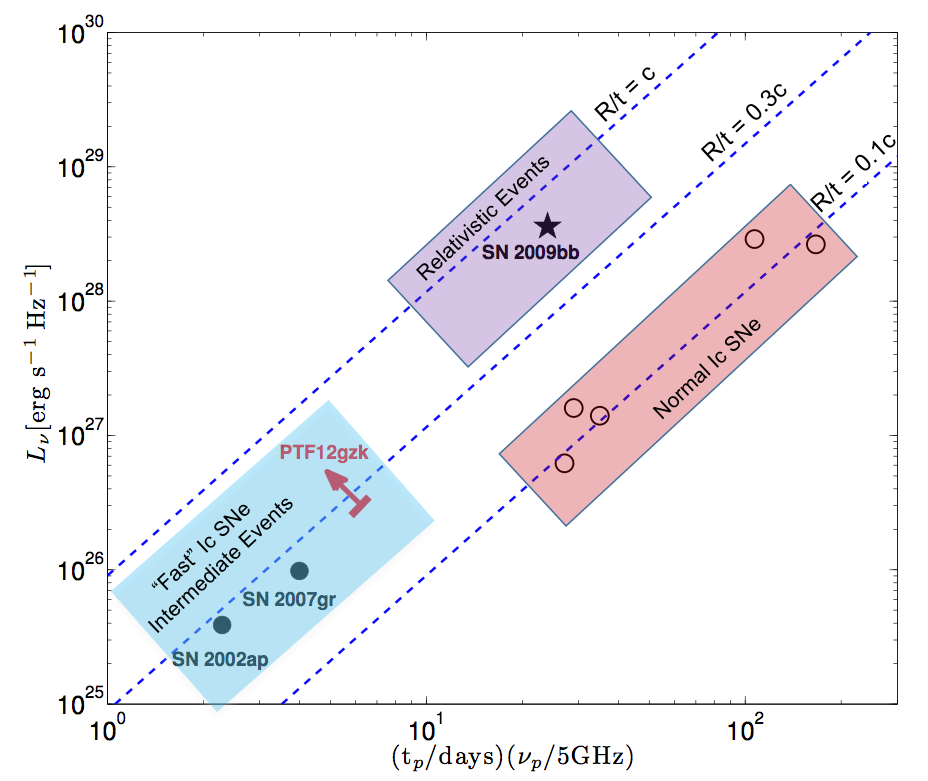
PTF 12gzk, however, is not the first of its kind (fast fading radio SNe, with intermediate shockwave velocities). In the past, SN 2002ap (Berger et al. 2002) and SN 2007gr (Soderberg et al. 2010) showed similar characteristics. The difference is that both of these SNe were detected in the radio within Mpc, using old radio facilities while the radio emission from PTF 12gzk was detected at a distance of Mpc using newly upgraded facilities. Both SN 2002ap and SN 2007gr had radio emission that evolved relatively fast, with SN 2002ap peaking at days (4.86 GHz) and SN 2007gr peaking at days (8.46 GHz), after explosion. The radio analysis by both Berger et al. (2002) and Soderberg et al. (2010) suggests shockwave velocities of c traveling in low-density CSM environments, similar to PTF 12gzk.
The above “fast” evolving radio events (i.e., SNe with weak radio emission peaking in the low GHz range only a few days after explosion and quickly fading) may represent the population of a missing link between ordinary and relativistic Type Ib/c SNe. DSA-2000, can possibly expand the detection horizon of such events and thus significantly boost the number to detected SNe of this type.
At less than a 100 Mpc, fast radio SNe seem to exhibit peak fluxes of a few tens of Jy. The enhanced sensitivity of the DSA-2000 will therefore increase the chances for discovering a growing number of such events. An attempt to carry out a survey to search for such events, may reveal a large population of events that remained unexplored so far.
In order to detect fast radio SNe, one has to carry out a high-cadence survey with a cadence of 3-4 days. It is therefore worth while to consider whether such an observing strategy can be implemented in the DSA-2000.
| DSA-2000 baseline reference design | match to project | |
|---|---|---|
| Cadence | 1 every 4 months | Requires a cadence of 3-4 days |
3.4 Characterizing the coherent radio emission from magnetic massive stars
Poonam Chandra & Barnali Das
Electron cyclotron maser emission (ECME) is a highly circularly polarized coherent emission, produced by mildly relativistic electrons with an unstable energy distribution, provided the local electron gyrofrequency is larger than the corresponding plasma frequency. ECME from a hot magnetic star was first discovered in 2000 ((Trigilio et al. 2000)). Since then, several other hot magnetic stars have been found to produce ECME (e.g. (P. Chandra et al. 2015); (Leto et al. 2019); (Das et al. 2022) etc.), and it has recently been speculated that this phenomenon might be ubiquitous amongst the hot magnetic stars population ((Das et al. 2022)). To describe these stars, (Das and Chandra 2021) introduced the term ‘Main-sequence Radio Pulse emitter’ (MRP). The distinctive characteristic of MRPs is the exhibition of a pair of oppositely circularly polarized radio pulses (produced by ECME) encompassing the magnetic nulls (the rotational phases when the stellar longitudinal magnetic field is zero) over a certain ranges of frequencies, typically up to a few GHz. This is a newly evolving field with potential applications to other contemporary fields such as coherent radio emission from ultra-cool dwarfs, brown dwarfs, and even exoplanet detection via star-planet interaction. The advantage of MRPs over other objects emitting ECME is that their magnetic fields are stable throughout their lifetimes, and also extremely well-characterized. However, to achieve these milestones, it is essential to fully understand the ECME phenomenon, and this process is currently at its infancy. As described below, DSA-2000 has huge potential to drastically transform this field.
Currently more than a dozen MRPs are known to emit ECME. While only one such star was known until the year 2015, this is still a very small sample size to infer the statistical properties of these objects. As ECME theoretically originates at magnetic nulls in the MRPs, the observations towards ECME search usually cover only magnetic stars with short rotation periods and around their magnetic nulls due to limited observing time available ((Das et al. 2022)). In the past this may have resulted in missing some MRPs showing ECME shifted from nulls due to propagation effects ((Das, Mondal, and Chandra 2020)), or from the long rotation period MRPs.
In addition, due to limited observational time on known MRPs, detailed understanding of their nature remains largely unknown. Whenever a MRP has been observed in detail,it has revealed surprises. For example, we have seen stellar orientation dependence of ECME properties (e.g. HD 133880, (Das, Chandra, and Wade 2020)), dramatically different spectra for right and left circularly polarized ECME (CU Vir, (Das and Chandra 2021)); both characteristics potentially reflecting the non-azimuthally symmetric plasma distribution in stellar magnetospheres. We have also witnessed transient ECME, disappearing ECME, giant ECME, possibly quadrupole component ECME in CU Vir ((Das and Chandra 2021)), none of which is well-understood. Hence it is likely that we have only scratched the surface of this phenomenon in MRPs.
Lastly only Galactic MRPs are known due to their limited optical brightness. However, there may be close by extra-galactic MRPs which may not be observed via traditional methods, but we may be able to see ECME emission from them.
DSA-2000 is going to carry out a survey of three LSST deep fields: XMM-LSS field, Extended Chandra deep field south and COSMOS fields. These three fields will be observed with daily cadence for 5 years. The sensitivity will be 100 nanoJy/beam and full stokes images will be provided. In addition, the NANOGrav collaboration is currently carrying out regular pulsar timing observations of about 80 pulsars. By the time DSA2000 comes online, they anticipate 200 pulsars suitable for pulsar timing observations. DSA2000 has 25% time reserved for these pulsars, which will be observed at weekly cadence and images of the FOV will be provided to the community.
As DS2000 FOV is 10 sq-deg, there are significant chances that the FOV may contain known or unknown MRPs. A quick search of the three deep fields did not result in a known MRP in the FOV. However, a search of around 35 pulsars observed by NANOGrav collaboration revealed presence of around a dozen magnetic massive stars and two known MRPs. The daily or weekly cadence full stokes images of the deep fields or NANOGrav fields, respectively, means we will be covering known/unknown MRPs in these fields several times at several rotational phases including nulls. This will open up a new parameter space and is likely to result in discovery of unknown Galactic/extragalactic MRPs, long period MRPs, MRPs whose ECME is shifted from nulls and enable characterize the evolution of ECME properties of MRPs as a function of time.
To meet our science goals, we require that full stokes images of three LSST deep fields: XMM-LSS field, Extended Chandra deep field south and COSMOS field as well as that of NANOGrav pulsars’ FOV be provided to the community.
| DSA-2000 baseline reference design | match to project | |
|---|---|---|
| Pointing | all sky | 3 LSST deep fields and 200 NANOGrav fields |
| Cadence | 1 every 4 months | daily to weekly for 3 LSST deep fields |
| and NANOGrav pulsar fields | ||
| need for additional modes | N/A | full stokes images of the above fields |
3.5 Probing Radio Emission from Low-Mass Stars with Circular Polarization Surveys
Christene Lynch (UNC-Asheville)
Radio flaring activity occurs in almost half of low-mass stars, the dominant population of stars in the Galaxy (White, Jackson, and Kundu 1989). Yet, the primary mechanism producing radio emission in these stars is currently unknown. Traditionally, attempts to understand radio emission from magnetically active stars have been made within the solar activity paradigm (Bastian 1990). However, low-frequency stellar emissions show properties dissimilar to the solar paradigm. In particular, there are few observations showing a direct correlation of low-frequency radio emissions with optical or X-ray activity in low-mass stars. Also, there are key differences in the observed flare properties (e.g. polarization, dynamic spectrum morphology) for solar and stellar low-frequency bursts. Recently, low-frequency radio observations of two late-type dwarf stars show that these objects can generate magnetic emissions similar to that of magnetic planets via large auroral current systems (Lynch et al. 2017; Zic et al. 2019) or solar-like emissions through electron acceleration possibly associated with coronal mass ejections (Zic et al. 2020). Future radio campaigns to detect and characterize the magnetic emissions of radio bright low-mass stars are required to determine whether solar-like or planetary-like emissions dominate in this population of stars. With recent advances in techniques to identify stellar emissions in large-scale surveys using polarization (e.g., (Lenc et al. 2018a; Pritchard et al. 2021, 2023)), we can now limit the number of false-positive matches in large-scale radio surveys, including those conducted by DSA-2000.
The majority of radio bright stellar objects have been detected using observational campaigns targeting objects with previously known magnetic activity (e.g., White, Jackson, and Kundu 1989; Villadsen and Hallinan 2019a). While targeted surveys can give some insight into the role of stellar parameters on the characteristics of stellar radio emission, they suffer from selection effects that compromise statistical correlations. There are also a few unbiased, volume-limited surveys for stellar radio emissions (e.g., Kimball et al. 2009). Unfortunately, these surveys are limited by the high surface density of background radio sources and resulted in many false-positive matches. However, the radio background is much less saturated in sources that emit highly circularly polarized light. Stellar emissions at low- frequencies (< 4 GHz) are dominated by highly circularly polarized coherent emission processes (Bastian 1990). Few other astronomical sources produce similarly polarized emissions, thus the polarization properties of stellar emissions can be used to uniquely identify stars in large full-polarization radio surveys.
The effectiveness of polarization searches was first demonstrated by (Lynch et al. 2017), who detected variable 154 MHz emissions from the low-mass star UV Ceti using stokes V imaging. This work led to the first all-sky circular polarization surveys at MHz (Lenc et al. 2018a) and GHz (Pritchard et al. 2021) frequencies which discovered new radio-bright objects. Recently there have been further surveys at radio frequencies which used polarization searches to identify new radio bright stars (Callingham et al. 2023; Vedantham et al. 2020) and to study time-domain properties, revealing flare repetition rates and properties (Pritchard et al. 2023).
The DSA-2000’s large survey speed and increased sensitivity over current radio survey instruments is ideal for discovering and characterising the radio star population. Using the Rapid Australian Square Kilometre Array Pathfinder (ASKAP) Continuum Survey (RACS), an all-sky survey of the radio sky south of =40, (Pritchard et al. 2021) placed constraints on the expected surface density of detectable radio stars at ASKAP sensitivities to be 9.6610deg. Assuming the population of stellar bursts is Euclidean, we can scale the ASKAP radio star density to DSA-2000 sensitivites. Doing this, we expect both the DSA-2000 all-sky and pulsar surveys to discover between 4-810 stars per observing epoch. The deep stare of the LSST fields is expected to reveal a factor of 10 less stars per epoch (10 stars). The DSA-2000 surveys will discover radio stars in numbers that are several orders of magnitude greater than the currently known population of radio stars. With this large population of radio stars we will start to be able to do population statistics and gain a better understanding of what types of stars are expected to produce detectable levels of radio emission.
From current all-sky transient surveys using the Australian Square Kilometre Array Pathfinder (ASKAP) we find that surveys with large-sky coverage and many repeats discover more stellar variable emission than observing strategies that involve deep stares on single fields (Pritchard et al. 2021). Further, the majority of the stars that are discovered with ASKAP are new detections and not repeat detections of the same set of stars (Pritchard et al. 2023). The current strategy of the DSA-2000 project already prioritizes a shallow, all-sky survey with 4 epochs planned. Additional epochs of the DSA-2000 all-sky survey will start to place constraints on how often the variability of radio stars is repeated.
A challenge for transient searches using the DSA-2000 survey products will be distinguishing exotic and rare transients from the fog of stellar bursts expected. Methods using polarization characteristics (Pritchard et al. 2021; Lenc et al. 2018a; Callingham et al. 2023), temporal properties (e.g., (Yuanming Wang et al. 2022)), multiwavelength data (Kimball et al. 2009), and spectral properties (Cavallaro et al. 2018) will be necessary to identify the more rare transients from radio stars and other polarized sources of interest like pulsars.
| DSA-2000 baseline reference design | match to project | |
|---|---|---|
| Cadence | 1 every 4 months | As many epochs as possible |
3.6 Delayed Radio Flares from Tidal Disruption Events
Assaf Horesh
The DSA-2000 superb sensitivity coupled with its all sky survey observing strategy may revolutionize the study of tidal disruption events (TDEs). Our recent discovery of delayed radio flares from TDEs shows the potential of exploring various times scales of months to years after stellar disruption (even in light of initial null-detections). Some of our findings though were made also thanks to performing high cadence (weekly) observations and we recommend that a small fraction of the DSA-2000 observing time will also be dedicated to a high-cadence survey, albeit with a shallower depth.
The observations of tidal disruptions events (TDEs), when a star is tidally disrupted when it passes too close to a supermassive black hole, continue to provide new unsolved puzzles. There are several complication in building a coherent physical picture of TDEs. For example, it appears as though at least some TDEs are capable of generating relativistic ejecta; the best such candidates have been discovered by their long-lasting, non-thermal high-energy emission (SwiftJ 1644+57: Bloom et al. 2011, Burrows et al. 2011; SwiftJ 2058+05: Cenko et al. 2011; SwiftJ 1112-82: Brown et al. 2015). In the case of SwiftJ 1644+57, radio observation were key to trace the high-velocity outflow (e.g., Zauderer et al. 2011; Berger et al. 2012, Cendes et al. 2014). Naturally, one may consider an unification scheme: perhaps all TDEs generate relativistic jets and we observe bright non-thermal emission for on-axis geometries and thermal UV/optical events for off-axis angles. Radio non-detections of several optical/UV TDE candidates (van Velzen et al. 2013; Arcavi et al. 2014; van Velzen et al. 2020; Alexander et al. 2020) challenge this picture. Adding to the confusion, is the discovery of early weak radio emission from several optically discovered TDEs (e.g., ASASSN-14li; Alexander et al. 2016), where the radio emission is found to be originating from a sub-relativistic outflow (rather than from a relativistic jet). The origin of the outflow is still unclear, but may be explained by an outflow from an accretion disk or as the unbound stellar debris. All of these recent findings suggest that not only that the nature of TDEs is still ambiguous but that it is also diverse.
We recently discovered that some thermal TDEs exhibit delayed radio flares, several months and years after optical discovery. Our group has now identified this new phenomenon in several cases (Three that are published: ASASSN-15oi; Horesh et al. 2021a; iPTF16fnl; Horesh et al. 2021b; AT 2019azh; Sfaradi et al. 2022) and additional events have now been observed by others as well (e.g., Perlmann et al. 2022; Cendes et al. 2022). As Figure 1 shows, in some cases no radio emission has been detected for several months (or longer) until bright radio flares emerged months and years later. In some other cases, while radio emission is detected initially, possibly originating from a sub-relativistic outflow as in ASASSN-14li, a significant excess in radio emission (appearing as a delayed flare) is observed at late-times.
In the case of ASASSN-15oi, we concluded that the standard scenario, in which an outflow is launched briefly after the stellar disruption, is unable to explain the combined temporal and spectral properties of the delayed flare. A possible explanation is that the flare is due to the delayed ejection of an outflow, perhaps following a transition in the super-massive black hole accretion state. Some delayed radio flares, however, may be due to off-axis jet emission (see Matsumoto & Piran 2022). In the case of AT 2018hyz (Cendes et al. 2022, and also Horesh et al. 2022), it was shown recently, that the delayed emissions (observed on a timescale of years) can be explained by such an off-axis jet model (Sfaradi et al. 2023). Recently, Cendes et al. (2023) found that a large fraction (close to ) of TDEs exhibit late-time re-brightening in the radio on a time scale of years.
While the case of ASASSN-15oi shows the importance of exploring various time scales, the case of AT 2019azh demonstrates the need for high-cadence observations. Our high-cadence weekly observations performed with the AMI radio telescope, revealed that while initially "regular" radio emission emerged from the event briefly after stellar disruption, it was followed by a delayed radio flare (Sfaradi et al. 2022). In contrast, sparse VLA data missed the complicated behavior of the radio emission completely. In this event our observations also showed for the first time that the delayed radio flare followed a delayed X-ray flare. We also note the resemblances to features observed in X-ray binaries, perhaps suggesting common underline physical processes.
The DSA-2000 will play a key role in creating a census of radio emission from TDEs, including delayed radio flares. While most standard follow-up radio observations today achieve a sensitivity of Jy rms, the design sensitivity of the DSA-2000 will help increase the detection horizon for radio emission from TDEs by a factor of on average. Moreover, since the DSA-2000 all-sky survey will span several timescales of months to years it will help systematically characterize delayed radio flares that turn on only at these late times.
Identifying transient sources at centers of galaxies is difficult, thus having better resolution will be very helpful. I recommend, if possible, to attempt achieving arcsecond (or below) resolution. In addition, one has to be careful with the array design so it will not be too core-heavy. Past experience shows that for point sources, core-heavy arrays were unable to reach the design sensitivity. A further recommendation is to examine the possibility to conduct a shallow high-cadence survey for transients using a small fraction of telescope time.
| DSA-2000 baseline reference design | match to project | |
|---|---|---|
| Spatial resolution | 3.5 | Preferably |
| Cadence | 1 every 4 months | + A high-cadence survey |
3.7 Relativistic Stellar Explosions
Anna Y. Q. Ho (Cornell University)
Relativistic stellar explosions are systems in which accretion or rotation of a newborn compact object drives a powerful outflow. For decades, the only firmly established example was long-duration gamma-ray bursts (GRBs), thought to represent the case in which black-hole accretion drives a narrow ultra-relativistic jet. However, in recent years the landscape has broadened dramatically, because discovery methods have expanded from solely gamma-ray satellites to include time-domain surveys at other wavelengths. The physical connections between emerging classes-GRBs, “orphan” afterglows, low-luminosity GRBs (LLGRBs), and luminous fast blue optical transients (LFBOTs)-are uncertain, but likely include differences in end-stage stellar evolution, compact-object accretion, and jet properties. By increasing the discovery rate of each of these classes by orders of magnitude, and providing low-frequency radio light curves spanning weeks to years post-explosion, DSA-2000 will help reveal their underlying physical connections.
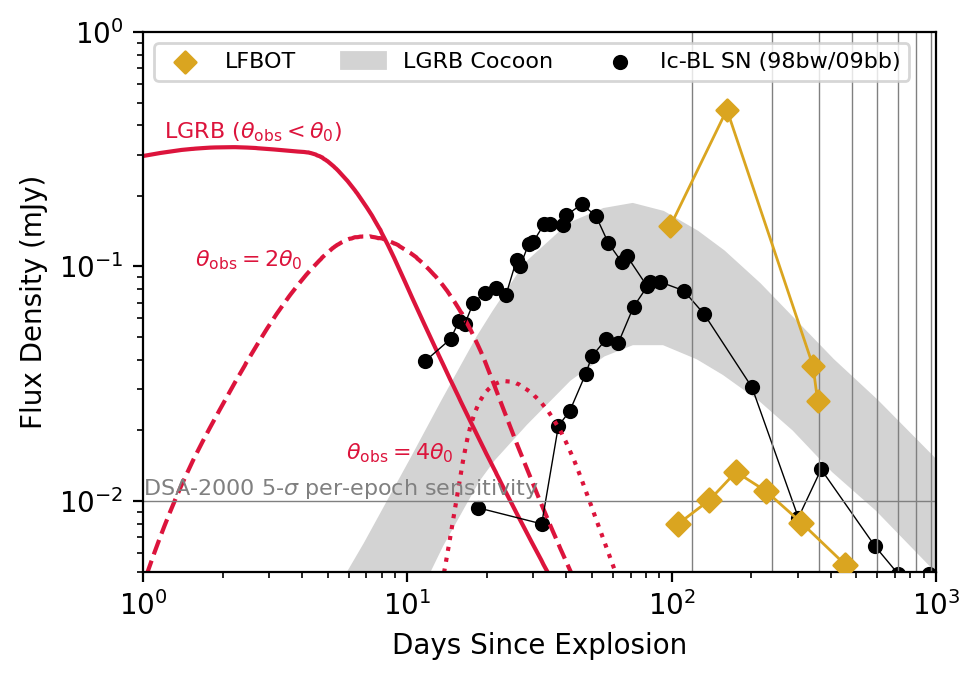
Off-axis “orphan” afterglows: Decades of off-axis LGRB searches have resulted in several candidates ((Cenko et al. 2013; Law et al. 2018; Ho et al. 2020, 2022b; Mooley et al. 2022)) but no confirmed discoveries. The low cadence of current surveys, the incomplete coverage of -ray satellites, and the lack of multiwavelength data makes it difficult to determine if a given event is truly off-axis. LLGRBs: In the nearby universe (), a half-dozen LLGRBs or relativistic Ic-BL SNe have been identified ((Bromberg, Nakar, and Piran 2011; Cano et al. 2017)). The LGRB-LLGRB connection is unclear due to the small number of well-studied events; suggestions including viewing angle ((Izzo et al. 2019)), jet “success” ((Nakar 2015)), and jet power ((Irwin and Chevalier 2016)). One possibility is that LLGRBs and relativistic SNe represent off-axis LGRB cocoon emission ((De Colle, Kumar, and Aguilera-Dena 2018; Izzo et al. 2019)). LFBOTs: The discovery of the transient AT2018cow ((Prentice et al. 2018)) and several similar events ((Coppejans et al. 2020; Ho et al. 2020; Perley et al. 2021; Yao et al. 2022)) established a new class of relativistic explosions dubbed LFBOTs ((Metzger 2022)). LFBOTs differ from LGRBs in several ways, including hydrogen-rich spectra (e.g., (Perley et al. 2019; R. Margutti et al. 2019)), low nickel masses (e.g., (Perley et al. 2021)), and a central engine duration of months rather than seconds (e.g., (Yao et al. 2022)). Only AT2018cow itself has a detailed low-frequency radio light curve ((Nayana and Chandra 2021)), and it is unclear to what extent LFBOT-like radio emission occurs among other types of transients (i.e., to what extent their current optical-based selection is biased).
DSA-2000 can increase the discovery rate of relativistic explosions outside the -ray band by orders of magnitude, and provide low-frequency radio light curves for years post-explosion. This data will help elucidate the physical connections between the above classes by (1) discovering the first confirmed off-axis LGRBs, measuring the GRB volumetric rate, and studying the cocoon properties of a jet produced by a collapsar; (2) measuring the volumetric rate of LLGRBs and their progenitor radius at the time of explosion; and (3) determining the diversity of LFBOT outflow properties.
| Class | |||||
| (% CC SN) | (erg s Hz) | (yr) | |||
| LGRB cocoon ( off-axis) | 0.01–0.1 | 5 | 0.4 | 10–100 | |
| LGRB cocoon ( off-axis) | 0.01–0.1 | 1 | 0.2 | 10–100 | |
| LGRB afterglow () | 0.01–0.1 | 1.1 | 7–70 | ||
| LGRB afterglow () | – | 1.1 | 30–300 | ||
| LGRB afterglow () | – | 1.0 | 90–900 | ||
| Relativistic Ic-BL SN | 0.01-0.1 | 0.2 | 10–100 | ||
| Radio-loud LFBOT | 0.01– | – | 0.06–0.5 | 0.6–2000 |
As shown in Figure 1, the current DSA-2000 cadence is well suited for LFBOT observations, but is too slow to resolve the light curves of LGRBs and LLGRBs, on- or off-axis. A faster cadence of 1 week, even over a smaller area of sky (or with less sensitivity), would enable these faster phenomena to be discovered.
3.8 Anomaly detection & unsupervised learning for DSA-2000
Dovi Poznanski
In my talk I argued that unsupervised machine learning tools are a necessary addition to our arsenal as we generate larger and larger datasets. These can no longer be examined by experts by eye to identify outliers, either astrophysical or instrumental. The same family of tools can also help us discover new relations in complex multidimensional data, beyond the ones that are already known.
Since these tasks of ’metric learning’ or outlier detection are loosely defined, there is no optimal choice nor optimal results, and there is a variety of algorithms that each could potentially uncover a different aspect. With traditional ML algorithms these choices begin with ’feature selection’, the crafting of informative input data to the algorithm (e.g., by measuring emission line properties in spectra, or the period of a variable star), and continue with the algorithm used and its hyper-parameters (e.g., the number of trees used in a Random Forest).
Deep algorithms supposedly circumvent that, as they have shown tremendous success at various tasks while being fed the raw ’pixel’ data. While this is true, the choice of the architecture of the network, its components, determine the symmetries and properties an algorithm can naturally ignore or learn. For example, convolutional neural networks are excellent at image classification tasks, because they effectively look for patterns anywhere in the image via convolution, and a cat is a cat, no matter where it appears in the image. The opposite is true for language, where the order of words does indeed matter, which (partly and superficially) explains the success of Transformer based architectures (the T in the now infamous ChatGPT) that learn and maintain the order of words.
I discussed efforts by my group and others in the community to first apply what we think would be the most informative algorithm to various datasets, analyze the results ourselves, but then also create interactive visualizations of the learned products, in order to allow astronomers in the relevant sub-field access to these views.
In the specific context of DSA-2000 one will need to define the most interesting ’spaces’ where to apply these techniques. At what level of the data analysis and interpretation. For example, ML can be applied on light curves from the deep fields, or on cross-matched sources between DSA and other surveys.
3.9 Type Ia Supernova Progenitors through Circumstellar Environments
Chelsea E. Harris
Some Type Ia supernovae (SNe Ia) show evidence of circumstellar material (CSM), primarily in the form of an optical interaction shock which should have a radio counterpart. However, the CSM around SNe Ia seen so far has been essentially anything but the low-density wind that was expected from progenitor theory. The intrinsic rarity of SNe Ia with CSM, combined with the unknown density and location of the CSM (which may be intrinsically random) makes it difficult to design targeted radio campaigns to detect these shocks. Instead, an all-sky survey like DSA-2000 is the best strategy for successfully detecting radio emission from SNe Ia, though this science program benefits significantly from having a real-time alert stream that utilizes optical surveys like LSST.
Radio observations of Type Ia supernovae (SNe Ia) are used to study their circumstellar media (CSM) – via synchrotron radiation emitted from the blast wave formed by ejecta-CSM interaction – in order to determine their stellar progenitors. In the symbiotic “single-degenerate” scenario, SNe Ia are the explosions of carbon-oxygen white dwarfs that have accreted mass from the wind of a red giant (RG) companion, approached the Chandrasekhar limit, and ignited runaway thermonuclear burning ((Iben and Tutukov 1984)). Since this is a relatively dense wind – compared to other single-degenerate companions, like main sequence stars – historically, the focus of radio observations has been to distinguish whether SNe Ia are surrounded by RG winds. Radio emission from the interaction of an SN Ia with an RG wind has never been observed, from which (Chomiuk et al. 2016) limit symbiotic RG companions to of SNe Ia.
However, at optical wavelengths, the presence of CSM has been indicated by a variety of observations for at least some SNe Ia, but the CSM properties are diverse. (1) SN IIn-like: SNe with significant optical shock emission at all times and an underlying SN Ia (specifically, 91T/99aa-like) spectrum, indicating interaction with an extremely dense, wind-like CSM. (2) Early Excess: SNe Ia with excess optical emission in the first days post-explosion, indicating interaction with a compact CSM. (3) Delayed Interaction: SNe Ia with excess optical emission appearing months post-explosion, indicating interaction with a detached CSM. (4) Narrow Absorption: SNe Ia with time-variable or blueshifted narrow absorption features from distant CSM (ejecta-CSM interaction not seen). However, predicting the radio signal to design a targeted search is difficult: the radio light curve reflects the shock evolution, the shock evolution reflects the CSM density profile, and the CSM density profile is not known a priori. The existence of various optical interaction groups indicates that we should be prepared for a range of radio light curve properties. We are therefore at a point where we have moved far beyond the confines of RG winds and into an exciting realm of ignorance that is ripe for discovery.
Fortunately, all SN Ia CSM groups besides the Early Excess can have late-time interaction that should evolve slowly (due to a long hydrodynamical timescale) and increase the detection window. Indeed, an SN Ia, SN 2020eyj, has now been detected at radio wavelengths with a 5.1 GHz luminosity of at and days post-explosion ((Kool et al. 2023)). SN 2020eyj belongs to the Delayed Interaction CSM group, and is the first example of an SN Ia with helium-rich, hydrogen-poor CSM. It is worth noting that radio observations are typically not requested at such late phases, because wind models of interaction peak much earlier. This demonstrates how the non-detection-riddled, wind-focused history of SN Ia radio observations may be introducing bias into this field when we are dependent on triggered observations for deep limits.
SNe Ia show much more complex behavior in their CSM than anticipated from progenitor models. An all-sky radio survey is powerful for SNe Ia because, with a slew of non-detections in the history of the field, it is difficult to justify deep, large-sample, multiple-epoch, disruptive observing campaigns – however, this is exactly where the discovery potential is for SNe Ia. DSA-2000 will achieve competitive limits with observations, reaching out to . DSA-2000 will sample the environment at multiple radii “for free” (at 120-day intervals) and probe out to for many events due to its 5-year lifespan, which is critical because we do not know the location or extent of SN Ia CSM a priori. When we consider using DSA-2000 and LSST together, the potential is easily illustrated. The LSST Main survey will observe SNe Ia per year (with a signal-to-noise ratio at maximum light of and two filters), and will be within 200 Mpc, per the expected redshift distribution ((LSST Science Collaboration et al. 2009)). Then, in five years of DSA-2000 CASS, even if only half the sky area overlaps between the two surveys, we will still have observations down to for SNe Ia – the current sample size is ! The currently planned cadence of DSA-2000 is roughly one per 120 days, and expected interaction signals can be visible for a much shorter time than this; however, the shear number of SNe Ia in DSA-2000+LSST still makes it a competitive survey. For example, DSA-2000+LSST may observe SNe Ia down to , which can detect a wind (low density RG wind) for days. There is only a 1/3 chance of each SN being observed at the right time, but is still events compared to the current sample size of about one dozen ((Harris et al. 2023))!
To optimize the potential of DSA-2000 for SN Ia science, its data stream needs to be connected to public optical surveys (like LSST) so that detected radio transients can be matched to SNe in real time. If this is done, it will enable timely follow-up with other radio instruments to (a) characterize the shape of the radio SED, (b) follow the radio evolution with higher-cadence observations, and (c) obtain the spatial resolution needed to confirm an association with the SN Ia. If DSA-2000 data are not monitored in conjunction with optical surveys in real time, then their power will be primarily statistical. Spatial resolution will likely be an issue with using the DSA-2000 dataset to study SNe Ia, especially out to Mpc.
| DSA-2000 baseline reference design | match to project | |
|---|---|---|
| Spatial resolution | 3.5 | need higher res |
3.10 Supernovae
Michael F. Bietenhholz
Core collapse supernova (SNe; Types Ib, Ic and II) represent the endpoint of almost all massive stars. They are responsible for both, chemical enhancement of, and the injection of a substantial amount of energy into, the ISM. The synchrotron emission from SNe can uniquely probe the SN explosion mechanism, the SN’s environment, and the properties of the black holes (BH) and neutron stars (NS) born in the explosions. The SN shock interacts with the mass lost by the star before it exploded, and the radio emission gives a very valuable probe into the important, but poorly-understood, mass-loss from massive stars. Radio emsisson from SNe allows us to address many questions, including (i) What are the properties of the eruptive mass-loss episodes in the years prior to explosion that are not predicted or explained by our current understanding of massive star evolution? (ii) What progenitor star properties lead to central engines powerful enough to drive relativistic outflows? (iii) What are the properties of these young (years to decades old) NSs and BHs?
So far, radio observations have almost exclusively been obtained from SNe that were first detected optically. However, optical observations do not catch all SNe: two notable examples which were first detected in the radio rather than optically are SN 2008iz at 3.8 Mpc (e.g., (Brunthaler et al. 2010)) and SN 1986J at 10 Mpc (e.g., (M. F. Bietenholz and Bartel 2017)). Even in our own Galaxy, the likely most recent SN, about 100 yr ago, was not optically detected, but the resulting remnant has been identified in radio ((T. Murphy, Gaensler, and Chatterjee 2008)). The radio observations of SNe are very incomplete beyond 20 Mpc.
Clearly, for a complete census of SNe, especially in dusty environments near the centers of galaxies, radio observations are necessary. DSA-2000, with its complete sky coverage and high sensitivity, will be an ideal vehicle to detect radio supernovae in an unbiased fashion.
Furthermore, most SNe are only observed in the radio for a relatively short period after the explosion, and often with poor temporal coverage. There have a few cases of SNe observed to re-brighten in radio at late time, but in most cases, such late-time emission would not be seen. Some examples of this were caught by chance in the Very Large Array Sky Survey (VLASS; (Stroh et al. 2021b)). DSA-2000, unlike VLASS, would provie regularly sampled lightcurves for such events, allowing a complete history of their behaviour to be determined, as well as providing much more complete temporal coverage for detecting them in the first place. Both the resolution and sensitivity of DSA-2000 will be superior to those obtainable with MeerKAT (e.g., (Fender et al. 2016)) and ASKAP (e.g., (Tara Murphy et al. 2021)), making it DSA-2000 better suited for radio observations of SNe.
By examining the majority of the existing radio observations of SNe, including many non-detections, (M. F. Bietenholz et al. 2021) showed that the median of the peak radio spectral luminosity, , of SNe was5 erg s Hz. The 2 Jy sensitivity of DSA-2000 will allow a detection of this median out to 50 Mpc, and DSA-2000’s 3.5 resolution will be sufficient in most cases to isolate the supernova from its host galaxy. Importantly, DSA-2000 would be able to detect also many SNe from the half of the population below this median , about which little is known, although we do have the prominent example of SN 1987A with at early times of 1% of the median value (it decayed initially, but rose to above these values after the age of 25 yr).
DSA-2000 will therefore provide an unprecedented census on the radio emission of SNe, much more complete, unbiased, and regularly sampled than the ad-hoc observations that are currently available, and will almost certainly find new and interesting types of radio SNe, and provide a much better understanding of the radio emission of the whole population of SNe.
3.11 Long-period radio transients
Natasha Hurley-Walker (International Centre for Radio Astronomy Research, Curtin University)
A new class of periodic radio transients currently challenges our understanding of radio emission from compact stellar remnants. As they repeat on 20-minute timescales, the short integration times of most wide-area sky surveys have so far yielded only a handful of examples. Their emission is not well-explained by known physical theories. The DSA-2000 will have the sensitivity and imaging quality to detect orders of magnitude more of these sources than current surveys, enabling a true understanding of their physical nature, and how they connect to stellar evolution and death, and whether they are progenitors of Fast Radio Bursts.
Recent radio-frequency surveys have uncovered a population of long-period radio transients ((Hurley-Walker et al. 2022, 2023)). These produce pulsed emission with durations of seconds to minutes, which is usually highly linearly polarised, indicating the presence of ordered magnetic fields. These pulses are periodic on timescales of minutes to hours, and can exist within short activity windows or persist for decades. The mechanism to generate the emission is unclear, but the transients are generally interpreted to be rotating magnetic compact objects, producing a beam of continuous emission, which crosses the line-of-sight of the observer with a periodicity equal to the rotation rate, similar to pulsars.
Unlike pulsars, they cannot be spin-down powered, as they have radio luminosities greater than their spin-down luminosities, and lie below the pulsar “death lines” (Fig 3.2). While ultra-long period magnetars (ULPMs) are a potential explanation (e.g. for a source with s discovered by (Caleb et al. 2022)), it is unclear how some sources can have persistent radio emission for decades, implying a constant source of magnetic energy, which should disrupt the neutron star crust – yet also generate no detectable X-ray emission. If they are ULPMs, they could be candidate progenitors for Fast Radio Bursts ((Paz Beniamini, Wadiasingh, and Metzger 2020; P. Beniamini et al. 2023)). Other explanations include Ar Sco-type systems (although such systems have 1000 lower radio luminosities and different polarisation properties; see (Pelisoli et al. 2023)), isolated white dwarf pulsars ((J. I. Katz 2022)), and even exotic objects like quark stars. As yet there is no consistent physical explanation for the discovered sources, making them an exciting class that could yield novel astrophysics.
With only a handful of known objects, each of which has different activity windows, periodicity, pulse width, and duty cycle, it is difficult to draw conclusions about whether these are a single diverse class, or two or more new types of object. Finding more examples will enable multi-wavelength follow-up toward nearby objects that could be expected to have detectable optical and/or X-ray counterparts, a more complete view of their radio polarisation behaviour that would illuminate their emission mechanism, as well as population-level analyses that examine their distribution throughout the Galaxy, range of periodicities, duty cycles etc. All of these would help determine their true physical nature. The sensitivity of DSA-2000 may enable, for the first time, detection of these sources outside the Milky Way.
The DSA-2000 will observe over a frequency range germane to the detection of these objects, which have largely been discovered and followed up at 200 MHz–1.4 GHz, above which their spectra become steep and making them difficult to detect; this frequency range also yields relatively low scattering, increasing the volume into the Galaxy over which they may be detected. Large sky coverage is necessary to detect many examples in an unbiased way. A declination limit of includes the Galactic centre and over 50% of the expected population, if they have a similar distribution throughout our Galaxy to pulsars. 3.5” resolution will yield sub-arcsecond position precision for reasonable S/N sources, more than sufficient for optical cross-matching (e.g. with Gaia). Polarization is essential for understanding the emission mechanism and at 2 MHz, the DSA-2000 will be able to successfully measure linear polarisation for sources with rotation measures expected for the Galactic population rad m. A cadence of one sky every four months is very well suited to some sources that are seen to be active over a few months ((Hurley-Walker et al. 2022), Caleb et al. in prep).
Field-of-view is the ultimate enabler for detecting extremely rare sources, and this is where the DSA-2000 will be the ideal transient-hunting machine. If, as with many other astrophysical objects, there is a power-law distribution to the luminosities of the sources, with many more faint than bright, DSA-2000’s exquisite sensitivity will enable the detection of at least two orders of magnitude more sources than current surveys such as VAST.
The repeated all-sky survey using wideband continuum imaging can be processed effectively for these transients – first by subtracting a continuum sky model, and then forming dirty images at a time resolution appropriate for the available computing – ideally . Various filters may be employed, e.g. a fast and simple search for high-significance peaks, matched filtering, or machine learning. The excellent -coverage of the DSA-2000 will ensure highly Gaussian noise and a minimum of false positives. The effective integration time per epoch of 15 minutes is also well-suited to capturing sources with these 20-minute periodicities, and repeated epochs will increase the chances of detecting sources with higher periods still. This data will likely yield many other interesting transient and variable sources.
No additional system requirements are needed. Computationally, dirty images of each 10–15-minute observation will need to be formed on 1–10 s cadences and rapidly searched for transients. This is computationally feasible already with such systems running on ASKAP ((Yuanming Wang et al. 2023)), LOFAR (de Ruiter et al. in preparation), and the MWA (Hurley-Walker et al. in preparation).
| DSA-2000 baseline reference design | match to project | |
|---|---|---|
| Desired mode: | Imaging on 1-s timescales |
4 The Dynamic Radio Sky: Fast Transients
Summary: Fast Transients
Shami Chatterjee and Bing Zhang (on behalf of the SAC)
The time domain has been a frontier for discovery in astronomy, as exemplified by “fast” radio transients, which are loosely defined as the subset of transient phenomena where pulse dispersion by the interstellar (and intergalactic) plasma is relevant. The discovery of pulsars in 1967 kicked off a gold rush as radio surveys identified more extreme examples and enabled their use as astrophysical laboratories for a broad range of applications, from probing the equation of state for ultra-dense matter, to mapping the Galactic distribution of the interstellar plasma, and much more. Intermittent pulsars, rotating radio transients (RRATs), and transient radio pulsations from magnetars all served to emphasize the expansiveness of the discovery frontier.
Fast Radio Bursts (FRBs) have been one of the most exciting finds on this frontier in the last two decades. These millisecond-duration radio flashes showed pulse dispersion measures (DM , where is the electron density along the line of sight) consistent with their origin in distant galaxies, implying very high intrinsic luminosities, while the event rates, inferred from the handful found in archival radio survey observations, were truly prodigious (10,000 events/day all over the sky beamed towards us, depending on telescope sensitivity and band; up to for the physical rate density). Narrow beaming angles could be invoked to reduce the total energy budget, but at the cost of multiplying the event rate by large factors. The identification of repeating sources, the localization of sources to specific host galaxies at measured redshifts, a large expansion of the sample especially with CHIME and ASKAP surveys, and the identification of a Galactic analog, have all served to tame the torrent of theoretical models. Magnetars are now widely considered the most plausible sources for these bursts.
The scientific interest in FRBs broadly relates to (i) the physics of their engines, and (ii) their utility as probes of their propagation paths. The luminosities and short durations of FRBs require their origin in extremely coherent processes. Magnetars are currently the leading candidate for their engines, although FRBs might originate in their magnetospheres (“near” models) or from their interactions with their surrounding nebulae (“far” models). However, many other mechanisms (some of them invoking novel physics, and some suggesting multi-messenger connections) also remain viable. Meanwhile, the propagation, pulse dispersion, and scattering of these FRBs offers a unique probe of the environment in the host galaxy, intervening galaxy clusters, and the intergalactic and circumgalactic media. Early analyses already show consistency with the expected baryon density of the universe, and tomographic maps of the intergalactic medium (IGM) and galaxy clusters will open up a wide range of cosmological applications. A large sample of well-localized FRBs with redshift measurements will probe large scale structure, the reionization history of the local universe, magnetic fields in the IGM, dark matter, and the Hubble constant and other cosmological parameters, as well as constraining fundamental physics such as the speed of the photon and the weak equivalence principle.
In order to realize the full scientific potential of FRBs (and fast transients in general), we require both a large sample of sources, and their distances, from localization to host galaxies. These pose two very different sets of requirements: finding a large sample requires a large field of view and maximizing time on sky, while accurate localization (at sub-arcsecond precision for reliable host identifications) requires high angular resolution during the few-milliseconds burst duration. Combining both of these poses a massive computational and data-management challenge, further exacerbated by the need to search over many trial values of DM. With interferometric imaging arrays like the DSA-2000, two complementary approaches can be explored: imaging the sky at high spatial resolution and on short timescales using visibilities de-dispersed over a range of trial DM values; or creating synthesized beams to tile the field of view and searching each beam over a time-DM grid.
There are rich scientific rewards for tackling this massive computational challenge, as demonstrated by the explosive growth of interest in FRBs and their scientific applications. Meanwhile, the recent discoveries of ultra-long period (minute-scale) magnetars and of sub-microsecond “ultra” fast radio bursts suggest that there is a lot more to find in the fast radio transient sky. The future is bright!
4.1 FRB searches with DSA-2000
Liam Connor, Vikram Ravi, Casey Law, Myles Sherman
The DSA-2000 can detect and localize as many as 10,000 fast radio bursts (FRBs) per year, nearly doubling the present sample in its first two days on sky. Searching the full 2000-antenna array in real time will bear significant computational costs and host-galaxy follow-up will require exploiting upcoming optical/IR surveys such as DESI, Euclid, SPHEREx and Rubin/LSST. Such a large sample of localized FRBs with a deep redshift distribution will allow us finally to realize the goal of FRB cosmology.
The engines powering FRBs at extragalactic distances, and the means by which the bursts are emitted, remain little understood. FRB dispersion measures (DMs) and other propagation effects such as Faraday rotation promise are exquisite probes of the total contents and physical conditions of baryons around and in between galaxies, which are otherwise difficult to observe in their entirety.
CHIME/FRB currently leads the world in total FRB detection rate, but without sufficient localization precision to identify host galaxies ((CHIME/FRB Collaboration et al. 2021)). In its five years on sky, this has produced more than 4000 bursts, most of which are once-off detections with 10 arcmin precision. The most significant scientific impact of that sample was in identifying outliers that could be studied in more detail. For example, the large detection rate has enabled the identification of a repeating sources.6 A few of these have been localized by other interferometers to individual host galaxies, and sometimes regions within hosts, revealing a diversity of host environments from dense star-forming regions ((Chatterjee et al. 2017)) to globular clusters ((Kirsten et al. 2022)). Detailed studies of the radio bursts from repeating sources have found highly interesting and suggestive patterns, including quasi-periodicities of burst rate ((Chime/Frb Collaboration et al. 2020a)), and order unity variations in rotation measure (RM; (Anna-Thomas et al. 2023)). Between 2018 and 2022, the Australian SKA Pathfinder Telescope (ASKAP) was the premiere FRB localization engine ((Gordon et al. 2023)), identifying between 5–10 events per year. Major results from the 20 published ASKAP localizations include the first insights into the FRB host-galaxy population, and an empirically derived relation between redshift and dispersion measure ((Macquart et al. 2020)).
In the past 18 months, the DSA-110 has taken its place as the world leader in FRB localization and host-galaxy identification. It has now tripled the sample of FRBs with arcsecond localization precision during commissioning with 48 core antennas and 15 outrigger antennas at OVRO. Soon it will complete its deployment of the remaining core antennas, leading to a boost in sensitivity and -higher detection rate. Major new results include the stringent constraints on the baryon content of the Milky Way halo ((Ravi et al. 2023)), the first FRBs in galaxy clusters ((Connor et al. 2023)), a surprising population of FRBs in massive hosts ((Law et al. 2023)), and a census of the polarization properties of FRBs, including the association of RM with the host-galaxy interstellar medium ((Sherman, Connor, Ravi, Law, Chen, Catha, et al. 2023; Sherman, Connor, Ravi, Law, Chen, Sharma, et al. 2023)).
To understand DSA-2000’s impact on FRBs, we need to forecast its detection rate and the redshift distribution of those detections. Starting with a simple extrapolation, we can scale the rate from the DSA-110 to that of DSA-2000. During commissioning with 48 core antennas, DSA-110 detected roughly one FRB per week. Assuming Euclidean source counts () and ignoring the larger bandwidth of DSA-2000 for now, this gives a detection rate of 280 FRBs per week or 15,000 per year. A more sophisticated approach can be found in Connor & Ravi (2023), which accounts for the wide-bandwidth and sub-Euclidean source counts at 10 mJy ms level bursts. Using this method and assuming we can use the full array, that also gives per year. It was also found that the improved sensitivity of DSA-2000 leads to a significantly deeper redshift distribution of sources. The DSA-2000 will be the premiere instrument for the use of FRBs as probes of cosmic baryon evolution.
Within the Astro2020 priority science area “Unveiling the Hidden Drivers of Galaxy Growth”, large samples of DMs towards localized FRBs were noted as a “powerful new probe” of baryon contents around and in between galaxies (see also (Ravi et al. 2019)). FRB data inform poorly constrained models of galactic feedback, and can break an important degeneracy in using kinetic Sunyaev-Zeldovich measurements as a cosmological probe. Together with observations of large-scale structure from DESI, SPHEREx, Euclid, and Rubin, the DSA-2000 FRB sample will trace the spatial distribution of ionized cosmic baryons, and the ionization history of the intergalactic medium including the process of helium reionization. The DSA-2000 sensitivity enables the discovery of strongly lensed FRBs, where accurate time-delays and mass modeling using wave-optics effects are of great promise in Hubble constant measurements.
As a baseline, localized FRBs are required to realize the science goals above, including, e.g., a detection of FRB-DESI cross-correlation ((Madhavacheril et al. 2019)), the detection of strongly lensed events ((Connor and Ravi 2023a)), and tomography of the baryon distribution ((Ravi et al. 2019) and references therein). Science goals related to FRB sources and emission are considered secondary in specifying the required number of detections, but are important in defining the data products associated with each FRB. The formal baseline science requirement for the fast time-domain system of the DSA-2000 is for a fast-transient search on 1–1000 ms timescales between DMs of 0– pc cm, with sensitivity over the full primary beam equivalent to the full observing band. It is additionally required that full-polarization, full-band, post-PFB voltage data be available for each detected FRB, specifically for gravitational lensing, emission-mechanism, and propagation-effect (scattering, Faraday rotation) science.
In practice, several optimizations will be made to achieve (and surpass) the required FRB detection rate. For example, for a fixed number of beams uniformly sampling the sky, excluding data above a certain cutoff frequency does not significantly affect the detection rate. We anticipate forming approximately beams and processing approximately 20 gigasamples per second per GPU of intensity data for the fast-transient search.
4.2 Fast radio bursts
Kiyoshi Masui
DSA-2000 will be one of the world’s premier FRB detectors in the late 20’s but the technical challenges of the search, especially the computational cost, are significant.
Fast radio bursts (FRBs) are millisecond-duration broadband flashes of radio light coming from cosmological distances. The short timescale implies a compact-object origin, although the precise identities of the progenitors and emission mechanism remains unknown.
The Canadian Hydrogen Intensity Mapping Experiment Fast Radio Burst (CHIME/FRB) Instrument is the worlds premier FRB detector, with a detection rate of a few per day. This capability has provided key clues as to the nature of FRBs, including the joint CHIME/FRB–STARE2 detection of an FRB from a galactic magnetar. VLBI followup of repeating FRBs has localized them to a diversity of environments, including sources just outside star forming regions, and to a globular cluster in the halo of M81.
The CHIME/FRB is currently being augmented with VLBI Outriggers—three smaller copies of the CHIME telescope that will be distributed accross North America. These Outriggers will work in tandem with CHIME to localize most CHIME-detected FRBs to 50 milliarcsecond precision.
Beyond their interest as a high-energy astrophysical phenomena, FRBs are promising cosmological probe. The observed dispersion of FRBs provides a precise measurement of the column density of free electrons along the line of sight, which in turn traces the diffuse baryon distribution of the intergalactic medium (IGM). The distribution of the baryons on megaparsec scales is high uncertain since it is hypersensitive to feedback processes in galaxy evolution. By cross-correlating the dispersion of background FRBs with the number density of foreground galaxies, it is possible to measure the free-electron–galaxy cross-power spectrum, which will be a key input for understanding and calibrating feedback models.
DSA-2000, along with CHORD (the Canadian Hydrogen Observatory and Radio-transient Detector) will be the next-generation FRB detectors after CHIME. Of these, DSA-2000 will have more collecting area and thus be sensitive to fainter, statistically more distant bursts, while CHORD will have better localization precision with its VLBI Outriggers. FRB detections with these instruments could approach sources, providing an exquisite dataset for cosmological applications.
The naive computational cost of the DSA-2000 FRB search is extreme. FRB searches are usually dominated by the cost to dedisperse the data. Brute force dedispersers that are used in most searches have a cost scaling as , however the newer "tree" algorithms (which are employed by CHIME) scale as . Ignoring the logarithmic factor, the search cost is thus roughly proportional to the input data size.
Critically the factors , , and are not independent. For a given time resolution and target search DM (i.e. the maximum DM for which your search is optimized) the frequency resolution is set by the requirement that the intra-channel dispersion does not wash out the signal and dilute the time resolution. One consequence of this is that the cost to search at higher time resolutions scales as . Another consequence is that, because the dispersion delay is proportional to the optimal frequency resolution is frequency dependent and proportional to . Lower frequencies are much more expensive to search than higher ones. Alternately, frequency dependent time resolution can be similarly optimal.
The central challenge for DSA is the large number of required search beams due the non-compact array configuration, compounded by the large fractional bandwidth. To fully tile the DSA-2000 FOV at the bottom of the band, using a pixel spacing set by the resolution at the top of the band requires 50 million pixels. With 1 ms time resolution and 10k spectral channels, the total data rate is 5e14 samples/second. Codes currently in use can dedisperse 1e9 samples/s per GPU (2110.03482). A code under development at the Perimeter Institute by Kendrick Smith and Eric Schnetter for use with CHORD can dedisperse 1e10 samples/s/GPU. However, even with such a code, the DSA search remains unfeasible by approximately an order of magnitude.
One route making the search feasible is smart placement of the search pixels. The pixel spacing is set by the resolution at 2 GHz, where the field of view is only 1/9 that at 700 MHz. Thus, with location-dependent spatial resolution there is opportunity for a speedup of a factor of a few. Further savings are possible if you are willing to bisect the search band into two sub bands, with a small sacrifice in S/N for FRBs that span the full observing band.
Independent of the search, having a good calibration of the selection effects of the ultimate system is critical for both FRB population studies and cosmological applications. In such complicated systems and in the presence of RFI, the most accurate and feasible method for calibrating these effects is a synthetic signal injection system (2206.14079). A continuously operating system that injects at least (preferably many more) synthetic FRBs into the realtime pipeline daily should be a key requirement for DSA-2000’s FRB search.
4.3 Characterizing Host Galaxies of Fast Radio Bursts
Kritti Sharma, on behalf of the DSA-2000 Team
The stellar population in the neighborhood of extragalactic transients and their delay-time distributions provide critical insight into their progenitor physics. Historically, such statistical endeavors have played a crucial role in unveiling the nature of progenitors of several transients, such as gamma-ray bursts and supernovae. The venture of characterizing host galaxies of Fast Radio Bursts (FRBs) is essential to disentangle the proposed spectrum of formation channels, ranging from young magnetars formed during core-collapse supernovae to binary neutron star mergers in early-type galaxies. The major challenge in achieving this goal is to obtain their sub-arcsecond localizations. The Deep Synoptic Array-2000 (DSA-2000) aims to bridge this gap by enabling precision localizations with sustained, high-speed monitoring at an FRB discovery rate of 2,000/year.
The studies of fast radio burst (FRB) host galaxies, enabled by arcsecond-scale localization by modern radio interferometers, have attempted to solve the longstanding mystery of these energetic, short-duration enigmatic explosions (Gordon et al. 2023; Bhandari et al. 2022a; Mannings et al. 2021; Heintz et al. 2020). The major conclusions from such studies have been actively incorporated into proposed progenitor models (Petroff et al. 2022, 2019). For example, the association of FRB 20121102 with a dwarf, rapidly star-forming galaxy, and a persistent radio source suggested a young magnetar progenitor (Tendulkar et al. 2017; Chatterjee et al. 2017; Kulkarni et al. 2015). However, the discovery of a repeating FRB 20200120E associated with a globular cluster of M81 indicated that the progenitor was formed in a compact binary coalescence event (Kirsten et al. 2022; Bhardwaj et al. 2021). The diagnostics, such as inferred local environments, galaxy types, and accurately derived physical properties of a large sample of host associations, can help disentangle the proposed progenitor theories and differentiate FRBs from other extragalactic transients (Petroff et al., 2022). These studies can determine if FRBs may be formed via one or multiple progenitor channels since FRBs have been found in a spectrum of environments, including dwarf galaxies (Bassa et al. 2017; Bhandari et al. 2022b), spiral galaxies (Mannings et al. 2021; Fong et al. 2021; Tendulkar et al. 2021; Marcote et al. 2020), elliptical galaxy (Sharma et al. 2023), globular cluster (Kirsten et al. 2022; Bhardwaj et al. 2021) and galaxy clusters (Connor et al. 2023, Sharma et al. 2023). The existing sample of host galaxies of FRBs suggests that they are generally starforming (Gordon et al. 2023). The distribution of stellar properties of FRB hosts has been found to be inconsistent with that of long gamma-ray bursts and superluminous supernovae, with a probable analogy with magnetars formed in core-collapse supernovae (Bochenek et al. 2021; Piro et al. 2021).
The existing sample of FRB hosts comprises of only 32 FRBs, which is not enough to draw any meaningful conclusions about the entire population and infer the properties of their sources to define their progenitor models. DSA-2000 will act as an FRB discovery and herald the era of sub-arcsecond scale FRB localizations. This will enable us to identify the stellar populations associated with the FRB progenitors and hence nail down their sources. Furthermore, the star formation histories of their host galaxies, obtained through stellar population modeling of their host galaxies while leveraging archival data and available state-of-the-art observing instruments, will help constrain their delay-time distribution. This delay-time distribution will serve as a critical clue about the age of their progenitors. DSA-110, which was built as a prototype of the DSA-2000, has discovered and localized 30+ FRBs during the first year of its commissioning phase. Our sample of FRBs, together with the published sample, indicates that although FRBs are usually star-forming, they might as well originate from old stellar populations in elliptical galaxies (Sharma et al. 2023). Our preliminary constraints on the delay-time distribution suggest a striking similarity with short Gamma Ray Bursts and Core-Collapse Supernovae originating in interacting binary systems. The magnified sample size with DSA-2000 will help us answer the question of progenitors.
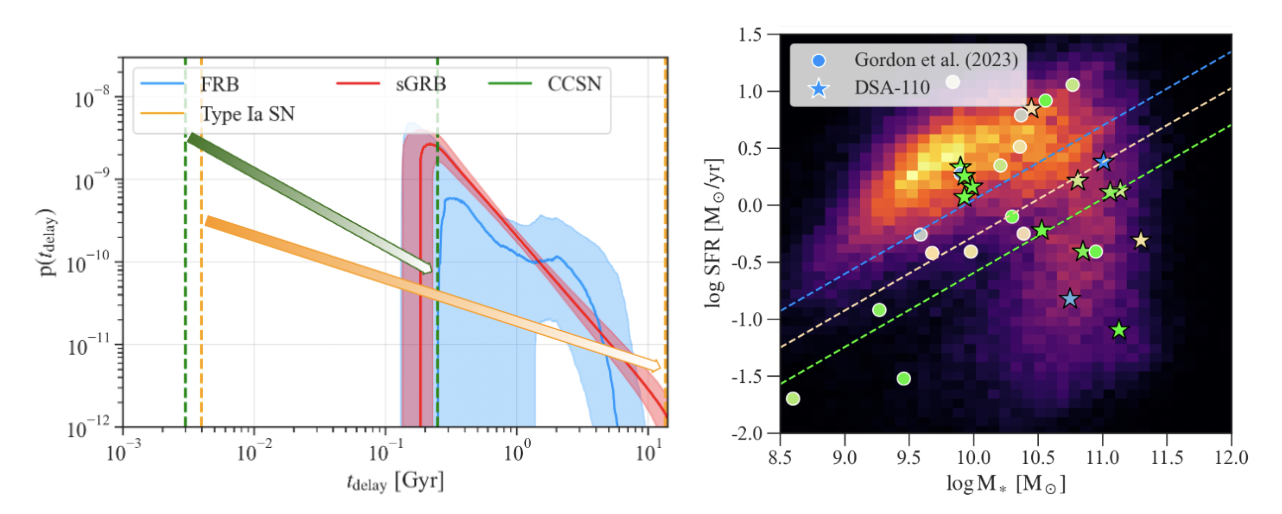
The existing system design is optimal for FRB science aimed in this particular science case.
4.4 Localizing Fast Radio Burst Sources Relative to Their Host Galaxies and Probing Cosmic Plasmas Using Radio Propagation Effects
James M. Cordes, Stella Koch Ocker, Shami Chatterjee, Cornell University
The fast radio burst (FRB) phenomenon offers a unique probe of cosmic plasmas along with the extreme physics of their sources. Current planning for radio arrays aims to localize large numbers of FRBs with sub-arcsecond precision yielding galaxy associations and redshifts through optical followup. Radio propagation effects (dispersion, scattering, scintillation, and Faraday rotation) provide the basis for constraining the locations of FRB sources and the interstellar media of their host galaxies, including circumsource environments. Radio scattering can indicate whether a source is embedded in or is in front of or behind the interstellar plasma of the host galaxy. For cases where interferometric localizations are infeasible or not precise enough to allow unique host identifications, radio scattering in concert with an analysis of the dispersion measure inventory (Milky Way, intergalactic medium, and host galaxy) provides coarse redshift estimates that can at least narrow the list of candidate galaxy associations. FRBs emitted at redshifts also sample the halos of intervening galaxies and galaxy clusters with the full suite of propagation tools.
DSA-2000 can provide a complete ensemble of observables for realizing this program for understanding both the large scale distribution of ionized gas in the universe and the pecularities of host galaxies and circumsource environments. DSA-2000 can also provide a synoptic view of a large sample of FRB sources via multiple passes made with the sky survey and especially in the fields centered on millisecond pulsars, which will be revisited monthly as part of NANOGrav’s long-wavelength gravitational wave program.
A key aspect of understanding FRB populations is whether the sources are young (located in star forming regions) or old (possibly outside host galaxies due to velocity kicks or originating in globular clusters). Localizations to sub-galaxy scales are required for this kind of study but also for fulfilling the potential for diagnosing plasmas in the intergalactic medium (IGM) and circumgalactic media (CGMs) using radio propagation diagnostics and other multiwavelength observations.
Source redshifts and positions in/near galaxies: Chromatic time delays of FRBs provide dispersion measures (DMs), the integrated free electron density (dominated by non-relativistic electrons), while multipath scattering, which probes small scale ( AU) density fluctuations, is manifested in burst shapes and radio spectra. The line of sight inventory of DM for an FRB emitted at redshift includes Milky Way, IGM, and host-galaxy contributions while the scattering time is dominated by interstellar media in the MW and host galaxy,
Coarse redshift estimates based on DM are made by subtracting the MW contribution based on Galactic models and by assuming or estimating the host contribution (in the host frame). Early assumptions that is generally small (e.g. ) have become disfavored by cases with more than ten times larger (). Estimates for follow from Balmer-line measurements of localized FRBs and by considering the relation based on Galactic pulsar measurements. The latter provides the basis for improved redshift estimates based on both and because results to date indicate that scattering in host galaxies is reasonably well calibrated by that in the MW.
FRB localizations with DSA-2000 and other telescopes will provide large redshift/host galaxy samples. However, the FRB source’s position along the line of sight, which also matters for assessing any link to star forming regions, can be constrained by the scattering time , which depends strongly on geometric leveraging: is larger if the source is behind the galaxy and can be negligible if in front.
Circumsource and interstellar media: Some FRBs show spatially coincident ‘persistent radio sources’ and rapidly changing Faraday rotation and scattering indicative of circumsource plasmas at radii pc. Others show scattering clearly associated with the general ISM of the host galaxy. While temporal variations can signify source proximity, a detailed scattering/scintillation analysis can provide constraining distance offsets. Several FRBs display distinguishable scattering from both the MW (as scintillation frequency structure with ) and the host (as pulse broadening, ). Excessive host scattering can suppress MW scintillation by decreasing the coherence of the radiation incident on the MW. Manifestation of MW scintillation requires for a source distance in Gpc and screen distances = 1 kpc and = 1 kpc from the source and observer, respectively. The presence of MW scintillations and an estimate for the path length yields an upper bound on . Application to FRB 20190950, for instance, yields kpc (Ocker et al. 2022, Ap.J., 321).
Methods that employ these analyses are required to extract maximal information about FRB sources, their host galaxies, and plasmas along the entire line of sight, whether or not FRBs are localized to host galaxies with measured redshifts.
DSA-2000 can provide all of the necessary observables (sans redshifts): spectro-temporal properties and polarization of bursts along with interferometric localizations. Burst dynamic spectra provide any information about scintillation structure (whether from the MW or host galaxy) and high time resolution burst profiles are needed to detect scattering broadening. Large samples of FRBs along different lines of sight are needed for addressing cosmic variance of the IGM and CGMs and interstellar variance of hosts. They are also needed for understanding the potential diversity of FRB source types. The multiple passes made in the synoptic sky survey and in high-cadence pulsar timing array observations allow investigation of dynamic changes in the circumsource environments of a large number of repeating FRBs. With FRB source detections with a sizable fraction of localizaions of both one-off FRBs and repeating FRBs (%), DSA-2000 will be a premier instrument for the science of cosmic plasmas and the source probes that are needed for that science.
Commensal capabilities for FRB detections are required to exploit multiple sky passes. Time and frequency resolutions better than 100 s and kHz are needed with full Stokes parameters and in some cases flexible analysis afforded by buffered voltage data would be extremely valuable for measuring the finest scale scattering effects, which can be sub-s in duration.
| DSA-2000 baseline reference design | match to project | |
|---|---|---|
| Polarization | IQUV for 2 MHz channels, | Higher resolution needed for |
| scintillations and burst substructure studies. | ||
| Voltage data availability ideal | ||
| I only for all other channels | Ditto | |
| continuum channels | 605 channels, 0.7-2.0 GHz, 2.15 MHz resolution | |
| Cadence | 1 every 4 months | Higher cadence or scheduled observations |
| for long term FRB activity periodicities. | ||
| Fields centered on MSPs for PTA/GW | ||
| obs are ideal. |
4.5 The No-Spin Zone for Fast Radio Bursts: Real or Only Apparent?
James M. Cordes, Shami Chatterjee, Ira Wasserman, Cornell University
In many respects, FRBs are similar to single pulsar pulses, though there are blatant differences in their dynamic spectra and, most strikingly, in the absence of any signature of rapid rotation in dense burst sequences that would be expected if the source is a rotating compact object. Given that some FRBs appear to originate from young magnetar-like objects and that Galactic magnetars show occasional spans of periodic emission with s, there is a clear disconnect between the properties of the FRB and Galactic magnetar populations. Two plausible explanations are that the extreme conditions in and near FRB sources cause emission that is intrinsically aperiodic or that rapid periodicites are masked by other processes.
A large sample of bursts, many from repeating FRBs, that DSA-2000 and other telescopes can provide is required to understand FRB populations and their relation to older magnetars. Since periodicity detection (or its absence) is a key part of this program, adequate dwell times on individual FRBs are needed. Fortunately, DSA-2000 can provide these through commensal data acquisition.
Compact objects, especially young magnetar-like objects, are a focus of attention in many (but not all) FRB source models. It is natural to then expect see a signature of rapid rotation like that seen in pulsars and magnetars. What is seen, however, are the following:
-
Uncommon bursts with sub-second or sub-ms quasi periodicities are seen in a few cases but the vast majority of burst sequences show no hint of a rapid periodicity.
-
Long-periodic activity windows with 16 and 160 d periods have been seen for two FRB sources.
Expecting a manifestation of rapid spin follows naturally for two reasons: (1) Narrow millisecond bursts require compact emission regions that are known to arise from spinning compact objects; and (2) Precession and orbital motion are among the many candidate processes for long-period activity windows. Any precession, whether free (from a dynamic inertia tensor) or forced (binary interaction) of course requires a spin vector.
The absence of periodicities can be accounted for by two broad classes of explanation:
-
Emission is from well outside the magnetosphere (light cylinder), perhaps from multiple sites, with no inherent periodicity tied to the spin of a central engine.
-
Emission inside the magnetosphere:
-
Multiple regions that emit independently, covering all of spin phase with sporadic emission from each region (e.g. poles of a multipolar magnetic field).
-
Emission tied to spin phase that is delayed stochastically by propagation effects from circumsource plasma (refraction, reflections, absorption), including that associated with any binary companion.
-
Precession can exacerbate 1. and 2. but needs to occur with a short period to decohere burst sequences of an hour or less.
-
If there is evolution from an FRB phase to a magnetar phase with radio periodicities, explanation A would imply a state change from an external (to the magnetosphere) process to an internal one. However, explanations B1-3 suggest a smooth evolutionary sequence that could be identified in large FRB samples. Distinguishing between A and B translates into a search for any ‘missing link’ type FRBs that would comprise evidence for B-type explanations.
Large samples of repeating FRBs with adequate dwell times can be provided by DSA-2000, primarily through commensal sampling during pointings for the sky survey and pulsar timing array observations. This aspect of FRB science does not require good localizations but repeating FRBs that are localized and have optical followup to yield Balmer lines and redshifts will provide complementary information about linkage to star forming regions or not
Repeat bursts are sometimes seen with rates as high as 100 hr. Dwell times need to be long enough to capture or more bursts in a given pointing (10 to 30 minutes) for a periodicity analysis. Time and frequency resolutions in the baseline reference design are adequate.
| DSA-2000 baseline reference design | match to project | |
|---|---|---|
| Cadence | 1 every 4 months | Longer dwell times useful. |
| Cadence not critical except for | ||
| FRBs showing long periodic windows | ||
| (weeks to months) |
4.6 Detecting strongly lensed fast radio bursts
Daniele Michilli
Strong lensing cosmography, i.e. measuring the delay between multiple images of a variable source that is strongly lensed, is a promising technique to measure properties of the universe such as the Hubble constant other than providing information about the lens itself ((Treu, Suyu, and Marshall 2022)). Fast radio bursts (FRBs) could improve the results of strong lensing cosmography by orders of magnitude ((Z.-X. Li et al. 2018)). However, detecting strongly lensed FRBs is challenging due to the rarity of the phenomenon and the necessity to detect at least two images of the same burst separated by days. Here, an observing strategy with DSA-2000 is suggested to detect strongly lensed FRBs and enable their use for cosmography experiments.
Traditionally, AGNs have been used as lensed sources in cosmography experiments but their slow variability limits the measurement precision ((Treu, Suyu, and Marshall 2022)). Efforts are ongoing to use supernovae and gamma-ray bursts instead but they also have intrinsic limitations that affect the results ((Treu, Suyu, and Marshall 2022)). On the other hand, FRBs are ideal sources for this study ((Z.-X. Li et al. 2018)). With only strongly lensed FRBs, the Hubble constant could be measured with a precision comparable to Planck ((Z.-X. Li et al. 2018)), possibly independently on any lens model if an FRB repeats ((Wucknitz, Spitler, and Pen 2021)).
Currently, no lensed FRB has been detected, nor it is expected with current facilities ((Connor and Ravi 2023b)). Discovering a strongly lensed FRB requires the detection of a large number of FRBs at high redshift, only possible with a large field of view (FoV) together with a high sensitivity that current telescopes lack. In addition, at least two images of the same FRBs must be detected to measure their delay and these images will be separated by days. Currently, and for several years, the FoV of sensitive telescopes only covers a tiny fraction of the sky, making it highly improbable to detect both images blindly ((Connor and Ravi 2023b)). The following strategy is proposed to overcome this last challenge.
A lensed FRB will be identified by its association with a galaxy known to be lensed. Models of the lensed system will inform us of the expected delay of the additional images. Observing the FRB location around their expected arrival time will then allow us to detect them and refine the delay with great accuracy. This strategy requires precise localization of FRBs and a large catalog of lensed galaxies. The latter will become available within the next years when upcoming surveys such as Euclid and LSST will discover lensed galaxies ((Collett 2015)), while DSA-2000 could even increase this number ((Connor et al. 2022)).
While strong lensing is a rare phenomenon, the large number of FRBs expected to be detected by DSA-2000 implies that a few strongly lensed FRBs could be detected each year. Moreover, the telescope’s high sensitivity will allow us to find a distant population of FRBs, which have a higher chance to be lensed. The telescope’s capability to precisely localize FRBs and its ability to track a sky position make DSA-2000 a perfect match for this project.
For the blind search of the first lensed image of an FRB, no additional requirements are necessary on top of the general FRB blind search. A localization would allow us to distinguish whether the FRB comes from the background galaxy or the lens. A larger uncertainty would not prevent the project but would introduce many FRBs that may or may not be lensed with an increased challenge for following all of them up. If it will not be possible to search the whole telescope’s FoV at maximum sensitivity for FRBs, it may be possible to form beams in the direction of cataloged lenses in the FoV. A deg implies cataloged lenses visible at any given time, with a similar number of simultaneous beams necessary to track them.
Lens models will provide a time of arrival of the second FRB image with an uncertainty of day. Given its lower magnification factor, the large sensitivity offered by DSA-2000 would be ideal to detect it. In fact, DSA-2000 could also be used to target the second image of lensed FRBs detected by other instruments such as CHORD. Given the large uncertainty on the time of arrival, it would be ideal to use DSA-2000 to observe the same source for as long as possible during a day. It is expected that this will occur at most a few () times per year.
| DSA-2000 baseline reference design | match to project | |
|---|---|---|
| Spatial resolution | 3.5 |
4.7 Pulsar Searching Forecasts for the DSA-2000
Myles Sherman, Vikram Ravi, Casey Law, Liam Connor, Jim Cordes
The DSA-2000 will implement a novel pulsar search strategy which leverages the continuum Cadenced All-Sky Survey (CASS) to target beams containing unresolved sources without optical associations. Using this method, the search can be carried out with high resolution (0.1 ms) and a comparable sensitivity to the Arecibo telescope (SEFD = 2.5 Jy). The cadenced nature of the search ( month epochs) will give the DSA-2000 a unique sensitivity to time-variable and accelerated pulsar binaries; population synthesis indicates the array could increase the known pulsar population by , which will have an immediate impact on the capabilities of Pulsar Timing Arrays (PTA) and dense equation of state (EOS) experiments.
The Australia Telescope National Facility (ATNF) catalog currently holds 565 millisecond pulsars (MSPs) and 2760 canonical pulsars, 24 of which have neutron star binary companions and none of which have black hole companions. The majority of pulsars in the ATNF catalog, roughly , were detected by the Arecibo and Parkes Telescopes, which have System Equivalent Flux Densities (SEFD) of 2.3 Jy and 28.6 Jy respectively (e.g. (Parent et al. 2022), (R. Manchester et al. 1996)). Since the collapse of Arecibo, its sensitivity has not been recovered by comparable surveys. In comparison, the Green Bank Telescope has contributed 261 discoveries, while surveys by the Giant Metrewave Radio Telescope (GMRT), Effelsburg 100m Radio Telescope, Molonglo Observatory Synthesis Telescope (MOST), and Jodrell Bank Observatory have discovered a combined 291 ((Bhattacharyya et al. 2016),(Barr et al. 2013),(RN Manchester et al. 1978), (Stovall et al. 2014)). The most recent boon to single-telescope pulsar searching has been the Five-hundred meter Aperture Spherical Telescope (FAST), operating at L-band and detecting a total of 262 pulsars through its first four years of operation ((Han et al. 2021), (Cruces et al. 2021)).
The continued rise of radio interferometry has offered a new path to recovering the sensitivity of Arecibo, as the effective SEFD scales inversely to the number of antennas. The MeerKAT array (1.4 GHz), precursor to the Square Kilometer Array (SKA) has thus far discovered 23 new pulsars through the first 3 years of its TRAPUM survey, while the Canadian High Intensity Mapping Experiment (CHIME) Pulsar Survey (600 MHz) has detected 28, through its first 5 years ((C. Clark et al. 2023),(Amiri et al. 2021)). The LOFAR array (135 MHz) has additionally detected 53 pulsars through its Tied-Array All-Sky (LOTAAS) survey ((Sanidas et al. 2019)). While these surveys do not match the sensitivity of Arecibo, they indicate the potential of large interferometers to detect more exotic species of pulsars like double-neutron stars, neutron-star black hole binaries, Redbacks, and Black Widows.
The DSA-2000’s large 31,000 square degree survey area, high time resolution down to 0.1ms, and Arecibo-like full-array SEFD = 2.5 Jy suggest it has the potential to significantly increase the number of known galactic pulsars through a dedicated periodicity search. The search will be commensal with the continuum Cadenced All-Sky Survey (CASS), and leverage its catalog of radio continuum sources in a novel search strategy. By removing any resolved continuum radio sources with optical or infrared associations through cross-referencing with existing catalogs (e.g. Pan-STARRS, Legacy Survey), the DSA-2000 will identify and search only a subset of beams per pointing likely to contain pulsars. By reducing the computational load in this way, the search can be conducted with higher resolution and full-array sensitivity. Population synthesis indicates that this survey method could detect 25,902 pulsars, or about 18% of the galactic population within the DSA-2000’s survey area; this would increase the known population by and additionally recover pulsars that a blind periodicity search is insensitive to. The cadenced month epochs additionally provide a unique sensitivity to time-variable pulsar systems affected by scintillation, nulling, or orbital modulation. Furthermore, the DSA-2000 will carry out an acceleration search, targeting sub-populations by varying the integration time and sampling time epoch-to-epoch. Increasing the population of MSPs will have significant impact on the timing efforts of Pulsar Timing Arrays (PTAs) and the efficacy of equation-of-state (EOS) experiments, while detection of exotic, accelerated binaries like Redbacks, Black Widows, and double-neutron stars will provide a more holistic view of pulsar formation channels.
The DSA-2000 can achieve this pulsar search with its 0.1 ms resolution and 134 kHz channels. It is likely that the search system will require a duplicated beamforming pipeline to allow for variation of relevant survey parameters. In addition, an initial 1 year epoch of the CASS with longer 45 minute pointings would be preferable before starting the 4 month epochs with 15 minute pointings in order to build up an initial catalog of continuum sources.
| DSA-2000 baseline reference design | match to project | |
|---|---|---|
| Declinations | -31 | good, ideally all-sky |
| need for additional modes | N/A | variable sampling rate, channelization |
4.8 Ultra-long period magnetars & magnetized mergers: A new population of neutron stars
Zorawar Wadiasingh, Alex Cooper, Paz Beniamini
Periodic windowing behavior, as (unexpectedly) discovered in some FRBs, is perhaps an important clue to the FRB radio mechanism or source requirements. Based on recent detections of candidate Galactic ultra-long period magnetars in radio surveys, a vast but as-yet undetected population of them likely exists, and implies they are much older than canonical magnetars. This bolsters the argument that they are related to periodically windowed FRBs. Future imaging radio surveys with DSA-2000 will likely discover many isolated ultra-long period magnetar candidates in our galaxy. Their existence and age also implies some will be involved in compact binary coalescences, e.g., neutron star-neutron star mergers. The large magnetic field of magnetars significantly enhances the orbitally-induced radio emission prior to merger. Such emission ought to be in principle discoverable due to dispersive delays of the radio emission, if localization and warning from high energy instruments or gravitational wave (GW) networks is promptly communicated to radio facilities. The radio horizon to such pre-merger emission is significantly larger than GW detectors and emission is expected in a large solid angle, meaning a small subset of apparently non-repeating FRBs may stem from compact object mergers. The pre-merger emission, if detected, also enables independent measurements of the merging neutron stars’ magnetic field strengths, and the relativistic inspiral orbital dynamics for fundamental physics constraints.
Recent studies have reported on discoveries of Galactic ultra-long period pulsars ((Caleb et al. 2022; Hurley-Walker et al. 2022, 2023)). These objects have periods of at least several tens and up to over a thousand seconds. They are likely highly-magnetized and magnetically-powered (i.e. magnetars) and could constitute the tip-of-the-iceberg for this new radio source class. The first discovery on a potential member of this class was reported by (Scott D. Hyman et al. 2005). However, it proved challenging to interpret and confirm the nature of the object at the time. The recent discoveries have been enabled by new radio transient surveys using imaging methods (as DSA-2000 will do), and rejection of prejudice (theoretical and observational) for sources beyond the conventional pulsar curvature pair cascade death line. Several recent developments demolished incorrect priors for sources beyond the radio death lines. First, theoretical arguments in 2019 by (Wadiasingh et al. 2020) favored longer-period magnetars as potential FRB sources. Observationally, periodically windowed FRB activity reported for FRB 20180916 by ((Chime/Frb Collaboration et al. 2020b)), and subsequent possible interpretation of this source as an ultra-long period magnetar (ULPM) occurred rapidly in early 2020 ((Paz Beniamini, Wadiasingh, and Metzger 2020)). These two developments, as well as the existence of a 6.67 hr spin period (radio-quiet) magnetar in supernova remnant RCW 103, reinvigorated image-domain radio transient searches for such objects within the Milky Way. Subsequently, three discoveries were reported within two years. (Hurley-Walker et al. 2022)’s object, in particular, attained 40-50 Jy flux densities when it was active, and would have been bright enough to be detected by Karl Jansky himself!
The nearby distances of these objects imply a large extant population numbering in the tens of thousands in our galaxy ((P. Beniamini et al. 2023)) whose detection horizon is vastly improved with DSA-2000 (see Fig. 4.1). (P. Beniamini et al. 2023) estimated DSA-2000 will detect at least hundreds of such objects. This may well prove to be overly conservative, and the true number in the next decade could exceed this by a large factor. The source densities detailed in (P. Beniamini et al. 2023) also imply older ages kyr for the objects, implying widespread survival of magnetar-like core magnetic fields, well beyond the typical (crustal) magnetic field decay timescales inferred for regular magnetars. This has exciting implications for precursor radio emission in binary neutron star mergers (see below).
There are several outstanding questions that DSA-2000 will help answer:
-
How many ULPMs are out there? How are they related to FRBs? Are they related to the Galactic center burper?
-
What is their Galactic latitude distribution? What are their inferred ages and active radio lifetimes? What is their dominant formation channel?
-
What is their period distribution?
-
What is the radio luminosity function of ULPMs?
-
Are there QPOs or spiky features in ULPM radio pulsations?
Precursor emission from compact object mergers involving at least one neutron star is predicted to arise from the magnetospheric interaction between merging components ((Most and Philippov 2022c)), as well as through resonant crust shattering ((Neill et al. 2022)). Magnetospheric interaction typically predicts emission profiles modulated by the orbital phase, allowing measurements of the equation of state of merging neutron stars complementary to gravitational waveforms. Although the evolutionary channel to produce theorized ultra-long period magnetars is uncertain, these sources may be much older than observed Galactic magnetars ((P. Beniamini et al. 2023)), and may represent a non-negligible fraction of merging neutron stars. Moreover, fast channels for neutron star mergers likely exist ((Paz Beniamini and Piran 2023)). Coherent radio counterparts in particular represent the most likely candidate for detections, owing to the sensitivity and field-of-view of radio telescopes. Searches for pre-merger radio emission have thus far been spearheaded by low-frequency radio telescopes, which can rapidly slew to targets, through triggered observations with MWA of sGRBs ((Tian et al. 2022)) and gravitational wave events ((Tian et al. 2023)) proving particularly constraining. The DSA-2000 FRB survey (along with the SKA), will be a leading instrument in blind searches for pre-merger coherent emission ((Cooper et al. 2023)), with an estimated detection rate of 15 pre-merger events per year for the stated surface magnetic field and radio efficient parameters (Fig. 4.2). Furthermore, the DSA-2000 horizon to pre-merger emission is 3.7 Gpc , ((Cooper et al. 2023)) meaning the detection of such emission could allow us to probe gravitational wave events at much larger distances than accessible with the current generation of gravitational wave detectors. These expressions assume a Poynting-flux like scaling for the radio luminosity; if a voltage-like scaling is realized (as observed in Galactic radio pulsars), the detection rate and horizon are modified, which may also be probed by DSA-2000.
For triggered observations, the relatively large field of view of DSA-2000 means gravitational wave event localization regions can be efficiently probed. This is particularly important as the median localization region for a five detector network (including LIGO India) is expected to be square degrees ((Corsi et al. 2019)). Pre-merger alerts are expected to be issued during the next gravitational wave observing run ((Magee and Borhanian 2022)). Despite the expectation that localizations will initially be poor, as they improve the field-of-view of DSA-2000 will be crucial for probing coherent radio emission produced shortly before the merger. An additional advantage of such detections would be the ability to obtain a sample of events with known redshifts and measured dispersion measures (DMs), that are independent of the FRB population. Considering the different environment of FRBs and BNS mergers, such a sample will enable to obtain a less biased estimate of the DM contributions of different host galaxy types and therefore improve our accuracy in modeling the contribution due to IGM propagation. This will enable to better utilize DM measurements for studying cosmology.
DSA-2000 will detect more ultra-long period magnetars and pulsars in our Galaxy, and help determine if they are related to FRBs. It will determine their source density, constrain their formation channel and ages. It will also determine whether they can be involved in compact binary coalescences via pre-merger precursor emission, and their delay time distribution. It will also determine if the horizon and rates exceed that of LVK, and if the radio luminosity scales as voltage or Poynting flux.
N/A
4.9 Search for Technosignatures with the DSA-2000
T. Joseph W. Lazio (Jet Propulsion Laboratory, California Institute of Technology), Greg Hellbourg (California Institute of Technology) & Vikram Ravi (California Institute of Technology)
For millennia, the question has been posed of whether there are other worlds inhabited by other sentient beings. Today, the number of known extrasolar planets numbers in the thousands, and a long-term goal posed by the Pathways to Discovery Decadal Survey is to characterize nearby extrasolar planets for signatures of biological activity, “biosignatures.” However, biosignatures cannot distinguish between a planet hosting single-celled organisms or an advanced civilization. The DSA-2000 will be able to conduct searches of nearby extrasolar planets for signatures of technology, “technosignatures,” indicative of a civilization with technology levels comparable to that of present-day humanity. More distant civilizations with greater energy uses also might be able to be discovered.
The radio frequency Search for Technosignatures aims at detecting extraterrestrial transmissions of artificial origin, and set limits to the development of intelligent life throughout the Universe. The search space spans 9 dimensions (Time, Frequency, Bandwidth, Sensitivity, Polarization , Space ) and has been sparsely explored over the past 60 years. While the effort has so far been unsuccessful, it benefits from a strong engagement from the astronomical community who values the importance of searching for unexpected or anomalous signals. Hundreds of observing programs have been conducted since its inception, each spanning a narrow subset of the large search space.
The DSA-2000 represents a unique opportunity to conduct a commensal search for technosignatures covering a large serching parameter space with no baseline reference design changes.
Sensitivity : Figure 4.3 demonstrates that the DSA-2000 could provide a powerful telescope for identifying technosignatures within the solar neighborhood, even at the native spectral resolution of 134 kHz.
Signal search : The program will search in real-time for energy sparsity on the 5 millions FRB search beams at a 1 ms / 134 kHz resolution for each pointing over the full 1300 MHz frequency span of the instrument. A tradeoff between spatial coverage and time resolution is possible using the pulsar search beams.
10 kpc survey : We additionally propose to conduct a targeted survey of a sample of objects located within 10 kpc from the Earh extracted from the Gaia catalog. This survey will use the idle pulsar timing voltage beams. Up to 4 voltage beams are available in each pointing, which allows up to 48,600=34,400 objectes to be surveyed at a high frequency resolution.
Cadence : The cadenced observing strategy that the DSA-2000 will follow is appropriate for the Search to distinguish technosignatures from terrestrial interference. It also supports the assessment of time structure of potential extra terrestrial transmissions.
RFI : The quiet radio environment simplifies the Search and reduces the false detection rate.
Offline search : The Search will also extend into the image domain to search for bright transmitters (pixels) cross-referenced with astronomical objects catalogs.
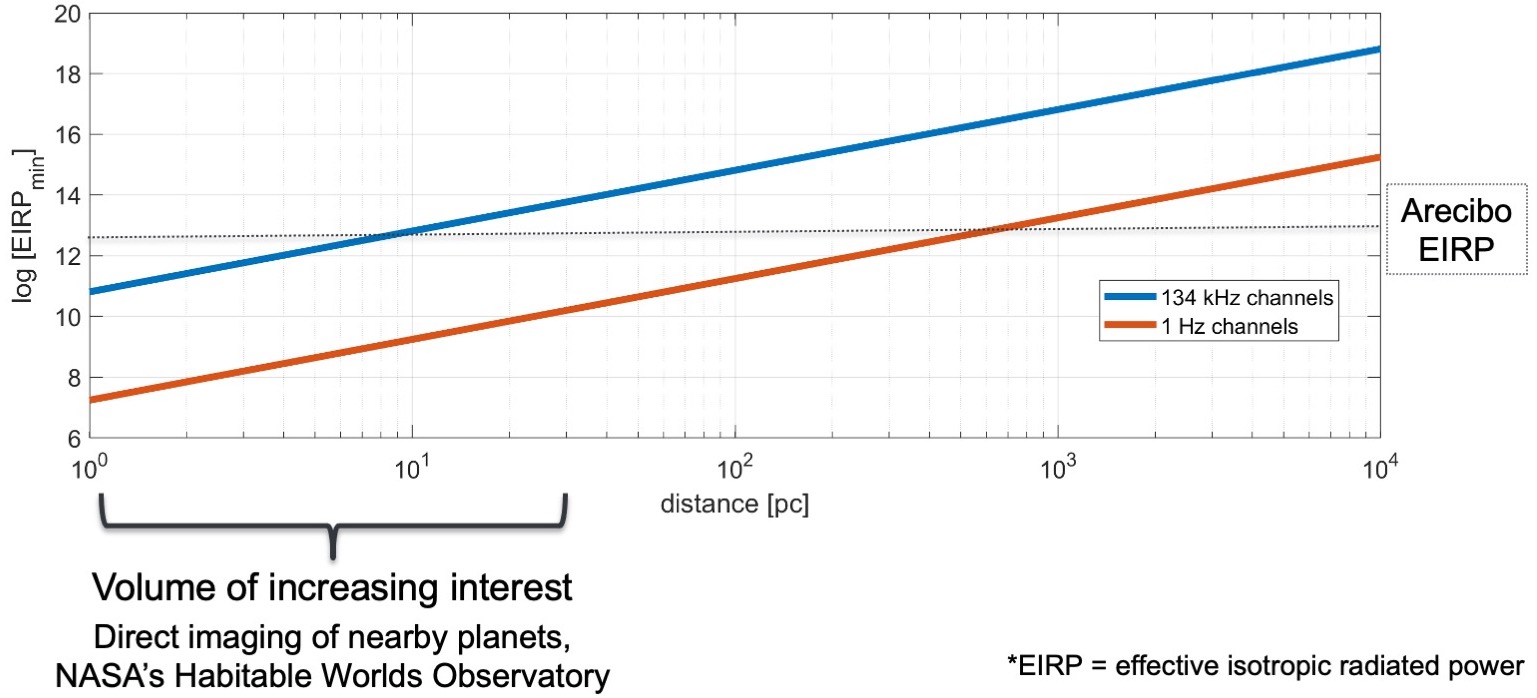
No addition to the baseline design is necessary to conduct the Search. The real-time beam data will be captured following a digital design similar FRB subsystem. Additional compute capabilities will be required to search the individual beams, for which the cost is under study and dependent on the selected search algorithms.
Offline image-base searches will operate on the raw survey data products and will not require additional capabilities.
5 Multi–Messenger Astronomy: Pulsar Timing
Summary: Pulsar Timing
Thankful Cromartie (on behalf of the SAC)
In the 55 years since their discovery, pulsars have gained recognition as indispensable probes of a wide range of astrophysics, including low-frequency gravitational waves, the interstellar medium, and the neutron star interior equation of state. The DSA-2000 will provide the superior sensitivity and frequent observing cadence required for high-precision millisecond pulsar (MSP) timing (Section 4.4), and is therefore positioned to become a world-class instrument for work in the three aforementioned scientific areas.
Low-frequency gravitational waves from supermassive black hole binaries: Pulsar timing array experiments conduct frequent observations of a network of precisely-timed MSPs in order to search for correlated deviations in their pulse arrival times characteristic of a stochastic background of low-frequency (nHz) gravitational waves. The North American Nanohertz Observatory for Gravitational Waves (NANOGrav) collaboration is one such experiment. Along with partner members of the International Pulsar Timing Array, NANOGrav has detected a common red noise process in its pulsars that may signal the presence of such a gravitational wave background, and is expected to imminently announce evidence for the “smoking gun” spatial correlations that such a background would induce.
NANOGrav is slated to be one of several key DSA-2000 projects (Sections 4.1, 4.2). Notably, the DSA-2000 will enable NANOGrav to time 200 MSPs at better-than-monthly cadence, which more than doubles the number of MSPs currently in the array. Because the number of MSPs timed is the largest contributor to gravitational wave background sensitivity, DSA-2000 will enable much improved characterization of the nHz gravitational wave background spectrum. What’s more, the DSA-2000 will come online in time to help NANOGrav more quickly gain sensitivity to single (continuous) binary black hole mergers with the flexibility to facilitate weekly observations as needed (Section 4.5). Excitingly, this also introduces the prospect of pursuing truly multi-messenger astrophysics by following up EM events from surveys such as the Rubin LSST and searching for individual sources in pulsar timing array data (Section 4.3).
Probing the interstellar medium: Observations of radio pulsars provide a novel method for probing the ionized interstellar medium (ISM). As emission from the pulsar traverses its path to the Earth, it undergoes dispersive delays (), refraction, scattering, and scintillation. The DSA-2000 will enable monitoring of ISM variability on a wide range of spatial scales using both observations of the 200 MSPs timed by NANOGrav, as well as countless Galactic and extragalactic transients (Sections 4.8, 4.9). Sophisticated algorithms designed to recover intrinsic pulse profiles broadened by ISM scattering require high S/N data such as those that result from DSA-2000 observations.
Neutron star mass measurements and more: Precise measurements of the masses of neutron stars place straightforward and important constraints on the equation of state describing the behavior of the supranuclear-density matter inside these objects’ cores. A subset of the pulsars timed by DSA-2000 will show evidence of the relativistic Shapiro delay, which helps constrain the masses of pulsars and their companions. Through both NANOGrav’s regular monitoring of 200 MSPs, as well as orbital phase-targeted observations of promising systems, DSA-2000 will be a significant contributor to a growing collection of highly precise neutron star mass measurements (Section 4.6).
The DSA-2000 will facilitate advances in areas of pulsar astrophysics outside of the relatively narrow selection of pulsar timing array sources. By searching for circularly polarized sources in the Galactic plane at high frequencies, the DSA-2000 could help uncover energetic young pulsars that were too highly scattered to be discovered by other searches of the plane (Section 4.7).
5.1 Gravitational Wave Astrophysics with Pulsar Timing Arrays
M. E. DeCesar
Pulsar timing arrays are sensitive to nanohertz-frequency gravitational waves, with binary supermassive black holes being the primary expected source. A gravitational wave background is expected to be the first source detected by these arrays, followed by one or more individual binaries in the foreground; NANOGrav and other arrays have begun to see hints of such a background signal. The DSA-2000 will be the primary facility used by NANOGrav. Its high sensitivity and sky coverage will greatly increase NANOGrav’s sensitivity, allowing improved characterization of the gravitational wave background and highly increased sensitivity to individual sources.
The gravitational-wave (GW) spectrum spans many orders of magnitude in frequency. Thus far, GWs have only been detected at high frequencies ( kHz) by the LIGO-Virgo ground-based interferometers. Pulsar timing arrays (PTAs) are poised to make the first detection of GWs at much lower, nanohertz (nHz), frequencies ( light-year wavelengths). The most likely expected sources of nHz GWs are supermassive black hole binary (SMBHB) systems, formed in the aftermath of galaxy mergers and brought to pc separations through dynamical and environmental interactions. Some other potential sources include cosmic strings, inflation-era relics, dark matter, and primordial black holes. The first detection expected from PTAs is that of a stochastic GW background (GWB) produced by a population of inspiraling SMBHBs, followed by continuous-wave (CW) detections of one or more individual SMBHB systems (for a review of nHz GWs and PTA science, see, e.g.: Burke-Spolaor et al. 2019; Verbiest, Osłowski, and Burke-Spolaor 2021; S. R. Taylor 2021).
PTAs are composed of many millisecond pulsars (MSPs) that are highly stable in their spin properties and are timed with high precision for years to decades (the best-timed MSPs to date have timing precision ns over more than a decade). GWs passing through spacetime local to the Earth alter the light travel time to the pulsars, causing very small (–100 ns) and slowly-varying deviations in their pulse arrival times. GW-induced timing residuals are correlated between pulsars, with a stochastic GWB inducing quadrupolar spatial correlations between pulsar pairs, the Hellings-Downs correlation curve (Fig. 1a; Hellings and Downs 1983).
There are several PTAs carrying out MSP timing campaigns around the world. Four of them—the European,
Indian, and Parkes PTAs (EPTA, InPTA, and PPTA), and the North American Nanohertz Observatory for GWs (NANOGrav)—together constitute the International PTA (IPTA), which combines the constituent PTAs’ data into a single, more sensitive data set. The NANOGrav 12.5-yr data set, as well as the most recent EPTA and IPTA data sets, showed the first strong evidence for a low-frequency spectral process common to the MSPs in the array (e.g., Fig. 1b; Arzoumanian et al. 2020; Chen et al. 2021; Antoniadis et al. 2022), the first hint of a GWB expected before detecting Hellings-Downs spatial correlations. The NANOGrav 15-yr data set, the EPTA and PPTA data sets, and the next IPTA data set are all in progress and may find further evidence for a GWB.
The DSA-2000 will be the primary telescope used by NANOGrav for the detection and characterization of nHz GWs. It is expected that NANOGrav, and likely other PTAs, will have detected the GWB by the time the DSA-2000 begins operations (e.g., Pol et al. 2021). However, the DSA-2000 will be crucial for characterizing the GWB spectrum and for detecting one or more individual, foreground SMBHBs. The DSA-2000 will time 200 MSPs with at least a monthly cadence; this large number of MSPs will provide excellent coverage of MSP pair separations and will therefore significantly increase NANOGrav’s sensitivity to the GWB (the GWB S/N grows linearly with the number of MSPs, e.g. Siemens et al. 2013). Furthermore, as shown in Fig. 1c, ten years of DSA-2000 observations will bring NANOGrav’s sensitivity firmly into the range of predicted strains for foreground single sources, increasing the range of GW frequencies at which NANOGrav will be sensitive to individual SMBHBs and increasing the likelihood of detecting one or more of these sources. Employing a higher cadence, e.g. weekly on the best-timed MSPs, will further increase NANOGrav’s sensitivity at high GW frequencies (see chapter by J. Hazboun).
NANOGrav will use the full bandwidth of the DSA-2000, providing a lever arm for measuring the dispersion measure at each epoch. Multiple phased beams will be used to time several pulsars at once.
| DSA-2000 baseline reference design | Match to project/NANOGrav requirements | |
|---|---|---|
| Pointing | all-sky | beams targeting NANOGrav pulsars |
| polarization | IQUV for 2 MHz channels, | IQUV for all channels |
| I only for all other channels | ||
| continuum channels | 605 channels, 0.7–2.0 GHz, | 605 coherently-dedispersed channels, |
| 2.15 MHz resolution | 0.7–2.0 GHz, 2.15 MHz resolution | |
| Cadence | 1 every 4 months | at least one 20- to 30-minute |
| pointing per pulsar month | ||
| need for additional modes | N/A | coherent dedispersion (fold-mode) |
5.2 Tuning PTAs for Single-Source Detections
Jeffrey S. Hazboun
Pulsar timing arrays (PTAs) have been focused on the recent detection of a stochastic gravitational wave background (GWB) (Agazie, Anumarlapudi, Archibald, Arzoumanian, et al. 2023), but attention is turning to the detection of a single, resolvable supermassive black hole binary system. New techniques ((Hazboun, Romano, and Smith 2019)) for calculating the sensitivity of PTAs have allowed in-depth studies of various configurations in order to tune their observing strategies. These will allow the optimization of both the continued characterization of the GWB and the detection of the first continuous gravitational wave.
Pulsar timing arrays (PTAs) are decades long observing campaigns of millisecond pulsars with the purpose of detecting and observing nanohertz gravitational waves. Recent work by the North American Nanohertz Observatory for Gravitational Waves ((Agazie, Anumarlapudi, Archibald, Arzoumanian, et al. 2023)) and other PTAs around the world ((Reardon et al. 2023b; Antoniadis et al. 2023a)) has revealed evidence for the GWB produced by supermassive binary black holes. NANOGrav is preparing for the post-GWB detection era by studying the optimal observing strategies for individual pulsars, and the entire PTA, specifically in terms of searches for individual GW sources. The first detection of single sources are expected within 5-10 years of a definitive GWB detection (Luke Zoltan Kelley et al. 2018).
The DSA-2000 array will allow NANOGrav a substantial amount of observing time with fantastic sensitivity. This time allocation will allow a full budgeting and reconfiguring of the current pulsar timing campaign which has been focused on the detection of the stochastic GWB. Flexibility in the scheduling of pulsar observations within the NANOGrav time allocation will be used to tune our galactic-scale GW detector to search for single-sources detections, while continuing to characterize the GWB.
The system requirements below are mostly reasonable for NANOGrav observations, however higher bandwidth (at the lower range) would further the science objectives by adding frequencies where pulsars often have higher flux. The lower frequency range particularly benefits the best pulsars, which are the most important for single, resolvable source detections.
| DSA-2000 baseline reference design | Match to project/NANOGrav requirements | |
|---|---|---|
| Frequency band | 0.7–2.0 GHz | 0.5–2.0 GHz |
| Pointing | all-sky | beams targeting NANOGrav pulsars |
| polarization | IQUV for 2 MHz channels, | IQUV for all channels |
| I only for all other channels | ||
| continuum channels | 605 channels, 0.7–2.0 GHz, | 605 coherently-dedispersed channels, |
| 2.15 MHz resolution | 0.5–2.0 GHz, 2.15 MHz resolution | |
| Cadence | 1 every 4 months | at least one 20- to 30-minute |
| pointing per pulsar month | ||
| need for additional modes | N/A | coherent dedispersion (fold-mode) |
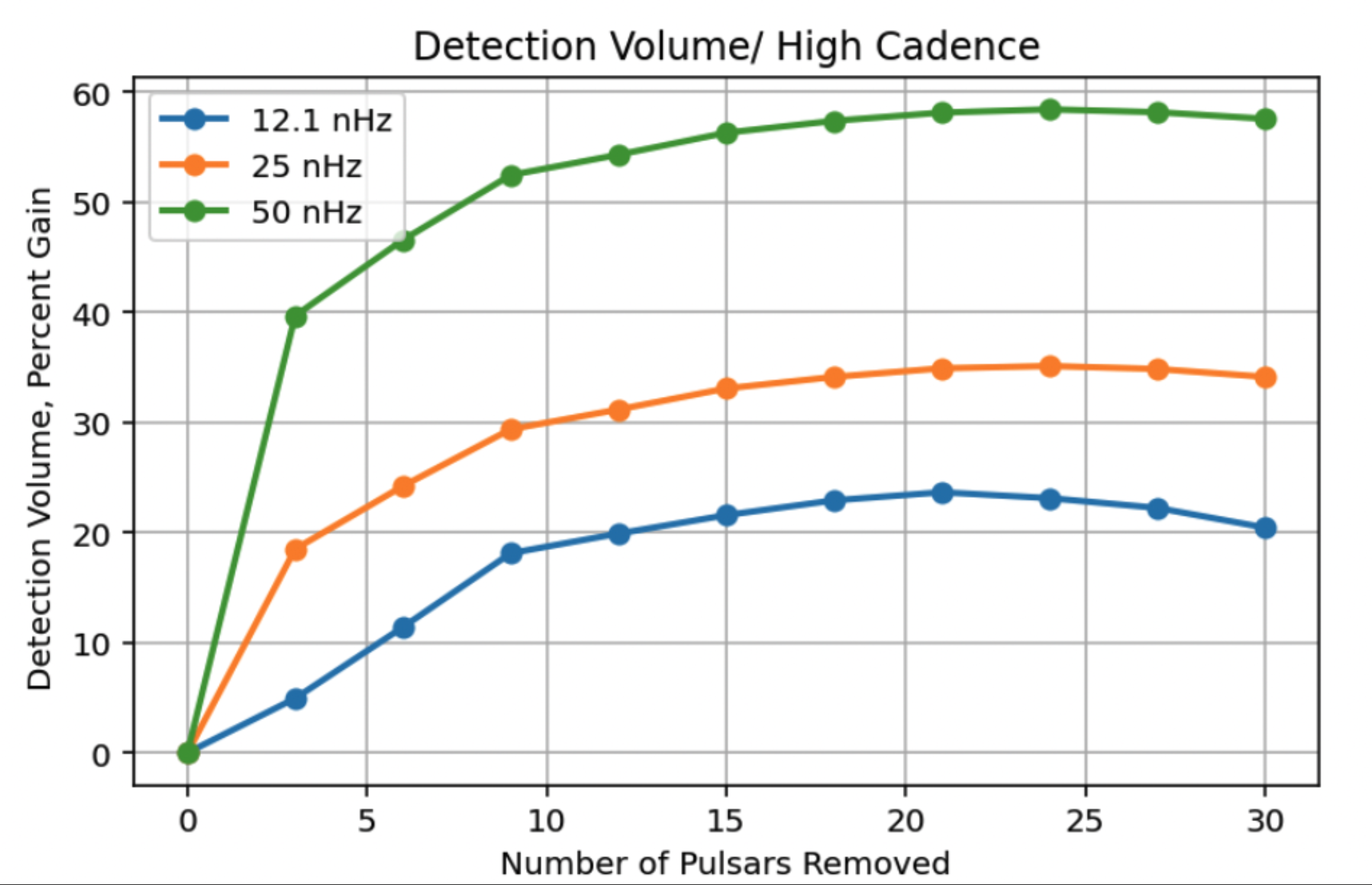
5.3 Multi-messenger Observations of Supermassive Black Hole Binaries
Tingting Liu (West Virginia University)
Through the precision timing of a large number of millisecond pulsars (MSPs), the next-generation pulsar timing array (PTA) experiment with the DSA-2000 will significantly boost the detection prospects of individual supermassive black hole binaries (SMBHBs) and enable multi-messenger science in the nanohertz gravitational-wave (GW) frequency regime, with significant synergies with EM observatories such as the Rubin LSST.
SMBHBs are expected to form as the result of hierarchical structure formation and are important for addressing questions such as the role of mergers in the growth of SMBHs. Yet, convincing evidence for their existence has been scarce. This can be largely attributed to the observational challenges of searching for, and confirming, sub-pc SMBHBs which cannot be spatially resolved with current (or perhaps even future) observatories. Therefore, the most direct evidence for their presence will be provided by GW detections. Through the precision timing of an array of MSPs, PTAs are increasingly sensitive to GWs in the 10–10 Hz range. In fact, the major PTA collaborations have recently announced the evidence for a stochastic background of GWs ((Agazie, Anumarlapudi, Archibald, Arzoumanian, et al. 2023; Reardon et al. 2023a; Antoniadis et al. 2023b; H. Xu et al. 2023)), and detections of individual sources are possible by 2030.
Additionally, SMBHBs are thought to be able to accrete from their gaseous environments and radiate at AGN luminosities; hence, they are also promising multi-messenger sources. Numerical simulations of accreting SMBHBs suggest that their unique structural features, together with the orbital motion of the binary, could imprint themselves on the EM emission of the AGN, making it possible to search for SMBHBs via indirect observations. In particular, the search for periodic or quasi-periodic variability in AGN has attracted significant interest in recent years as a possible approach to searching for sub-pc SMBHBs. More than 100 candidates have been proposed as the result of systematic searches in current time-domain surveys, and it has been predicted that there may be hundreds of periodically varying SMBHBs detectable in the Rubin LSST volume ((L. Z. Kelley et al. 2019; Luke Zoltan Kelley, D’Orazio, and Di Stefano 2021)).
What is more exciting for GW and multi-messenger astronomy is the prospect of performing targeted searches in PTA GW data following the identifications of EM candidates by observatories such as Rubin. Recent work has shown that by using the EM information of the source as priors, targeted searches can yield higher signal-to-noise ratios (SNRs) and more precise parameter measurements ((T. Liu and Vigeland 2021)). Thus, multi-messenger searches could uncover sources that are otherwise undetectable in unguided, all-sky GW searches. Furthermore, the resulting parameter measurement precision will allow us to extract detailed astrophysical information from the observations, test theoretical predictions, and study these sources as rare and fascinating laboratories for binary accretion in AGN.
The DSA-2000 will significantly boost the single-source detection capabilities of the PTA, by timing a large number of MSPs with high timing precision. A monthly pulsar timing campaign of MSPs with the lowest timing noise (all_sky_best) would achieve approximately the same results as a monthly all_sky campaign in terms of detection SNR and parameter estimation, but with less total observing time (first two filled circles in the lower panels in Figure 5.1). For an intermediate-SNR source (represented by S2 in the figures), the PTA can measure the GW amplitude () at the % level and the GW frequency () at the % level. Further, by timing the best pulsars at a higher (e.g., weekly) cadence, both SNR and parameter measurement uncertainties can be significantly improved (solid circles versus empty circles in the all_sky_best case in the lower panels).
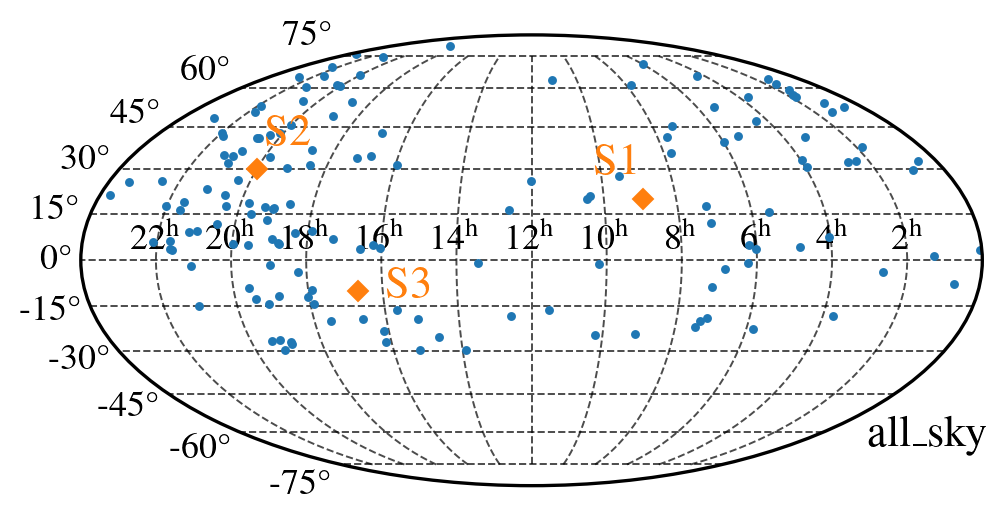
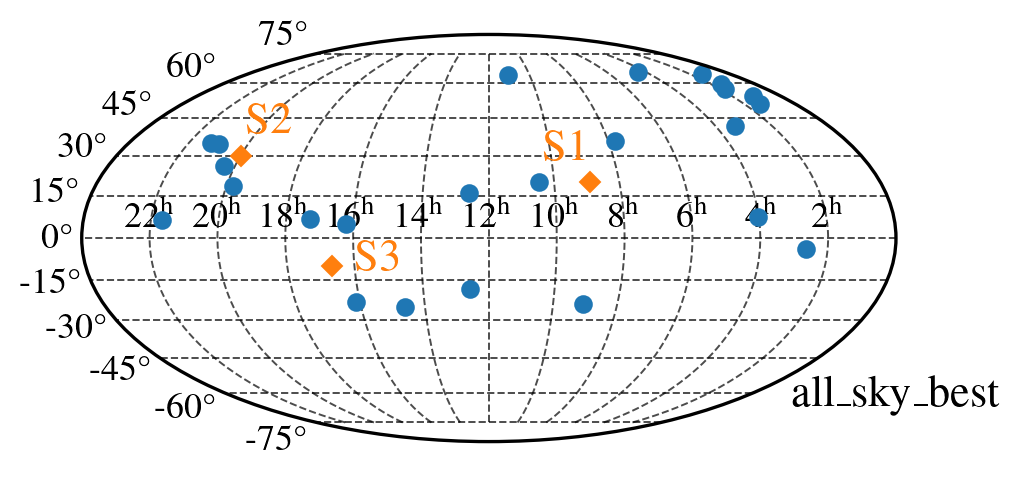
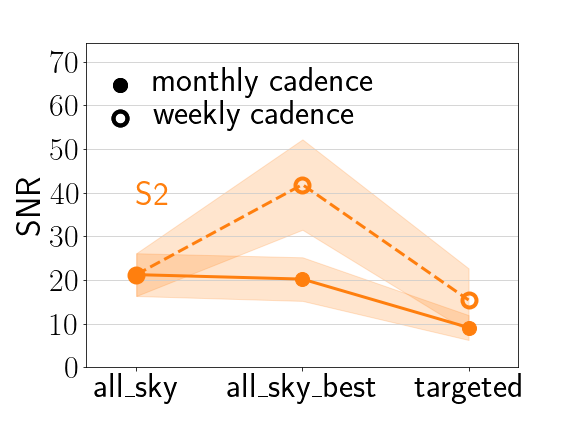
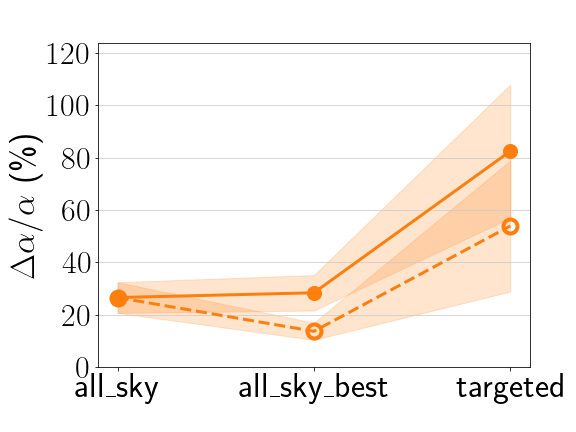
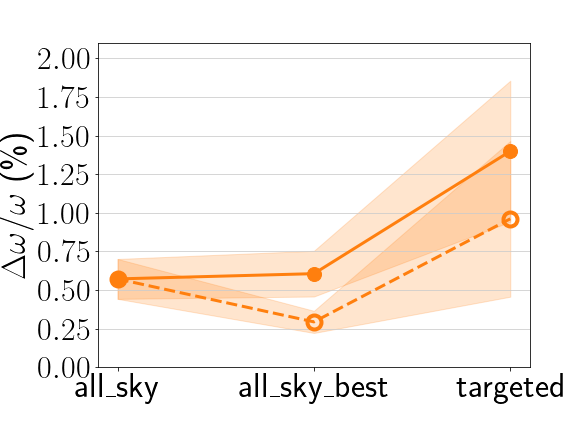
To optimize the PTA for single source observations, a high cadence campaign of pulsars with the lowest timing noise is preferred.
| DSA-2000 baseline reference design | match to project | |
|---|---|---|
| Pointing | all–sky | pulsar timing fields |
| Cadence | 1 every 4 months | monthly or weekly |
5.4 High-precision pulsar timing with DSA-2000
Sophia Sosa (RIT, NANOGrav)
DSA-2000 is expected to play a central role in pulsar searching and monitoring campaigns, both of which constitute the centerpieces of NANOGrav’s efforts to detect long-period gravitational waves (GWs). In particular, DSA-2000 will represent a substantial improvement over currently-existing observatories twofold: by implementing broadband radio-receivers, which will allow for high-timing precision observations, and by significantly improving the cadence of current monitoring campaigns, which in turn will enable the detection of GW single sources.
In the current era of multi-messenger astrophysics, the next natural step is to expand our search to long-period gravitational waves (GWs). Such GWs are beyond the scope of Earth-based detectors, and observing them involves using pulsars through the technique of pulsar timing. Since 2004, NANOGrav has been consistently searching, observing, and analysing pulsar data in order to achieve the timing precision (Alam, M.F., et al. 2021a, 2021b) and time baselines (Siemens et al., 2013) necessary for detecting these long-period signals. These efforts are strongly dependent on the available observing infrastructure. As of 2023, NANOGrav has been awarded roughly 5% of the total observing time of the Green Bank Telescope (GBT) and monthly observations at the Very Large Array, while working towards integrating data from the CHIME telescope. The decommissioning of the Arecibo Telescope, which was the primary instruments in pulsar searching, severely hindered NANOGrav’s observational capabilities. In this scenario, DSA-2000 emerges as a natural successor of Arecibo’s trajectory.
DSA-2000 has the potential to significantly expedite NANOGrav’s first detection of long-period gravitational waves due to its following characteristics:
-
Broadband receivers: Using narrowband observations to model frequency-dependent effects, such as interstellar dispersion, can introduce parameter mis-estimations in the timing model, which in turn introduce offsets in the timing residuals, limiting the GW sensitivity (See Fig. [fig:mis-estimations]). By introducing broadband receivers, DSA-2000 will be able to mitigate such mis-estimations, thereby providing better timing solutions. As a byproduct, we will also gain better models of frequency-dependent effects and an invaluable understanding of the interstellar medium.
-
Improved timing precision: It has been reportedly proven (Alam, M.F., et al. 2020) that broadband receivers wide bandwidth () with multiple polarization channels (), such as those proposed for DSA-2000, can significantly decrease the systematic error of timing residuals, as theorized by the radiometer equation (Lorimer and Kramer, 2012):
Sosa Fiscella et al (2021) quantified the effects of both variables on the RMS of timing residuals, and found that using and increasing the by a factor of 2 can decrease the RMS by a factor of (see Fig. 5.2). We expect similar improvements using DSA-2000’s receivers.
-
High observation cadence: the observing time allocated at DSA-2000 for NANOGrav’s observing campaigns will improve upon the weekly to monthly cadence of other observatories in the International Pulsar Timing Array (Perera et al. 2019; Lam & Hazboun 2020). This is of particular importance for resolving GW single-sources, such as SMBHBs (Arzoumanian et al. 2020).
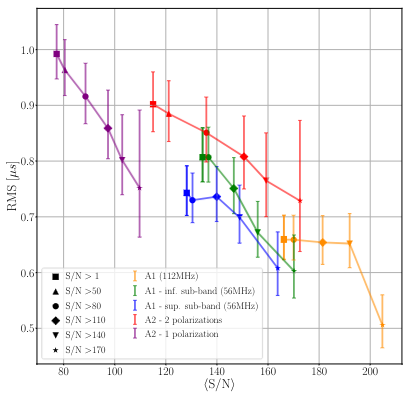
Extending the frequency band up to 4 GHz would allow us to match GBT’s backends. A higher observation cadence is of utmost importance for resolving GW single sources.
| DSA-2000 baseline reference design | match to project | |
|---|---|---|
| Frequency band | 0.7–2.0 GHz | Desirable: 0.7–4.0 GHz |
| Declinations | -31 | Some pulsars at lower DEC, but OK |
| Cadence | 1 every 4 months | Higher cadence for single source detection |
5.5 Pulsar Timing with the DSA-2000 (and Some Lessons from CHIME/Pulsar)
Deborah C. Good
DSA-2000 will be a valuable instrument for pulsar timing, especially high precision millisecond pulsar (MSP) timing, which is used for tests of general relativity and gravitational wave searching. Commissioning a new pulsar timing instrument like DSA-2000 and integrating it into pulsar timing array (PTA) data sets is non-trivial, but rewarding. Recent work commissioning CHIME/Pulsar and integrating CHIME/Pulsar data into the NANOGrav dataset provides a road map for the DSA-2000 pulsar timing backend.
Pulsars are rapidly rotating, highly magnetized neutron stars, observed primarily at radio frequencies and increasingly at high frequencies (X-ray and -ray). Though the neutron star emits light continuously, its spin creates the appearance of pulsation, with the pulse period equal to the spin period of the pulsar. Radio pulsars were first discovered in 1967 ((Hewish et al. 1968)), and their value as tests of gravity was quickly realized (for a review see (Stairs 2003)). Later, the discovery of millisecond pulsars (MSPs; (Backer et al. 1982)), which have very high timing precision, opened the possibility of detecting a stochastic background of low-frequency gravitational waves with a pulsar timing array (PTA). PTAs are discussed in more detail in “Gravitational Wave Astrophysics with Pulsar Timing Arrays” elsewhere in this volume.
We observe pulsars by recording their pulses, particularly the pulse profile and the time of arrival (TOA). Before recording pulse information, we mitigate dispersion effects from the ionized interstellar medium. In modern pulsar instruments like DSA-2000, we use coherent de-dispersion to remove these effects; see (Hankins and Rickett 1975). It is possible to record individual pulses, but most pulsars (especially MSPs) are too dim to observe in this manner. Instead, we “fold” data at the pulsar’s spin period, stacking many sections of raw data, each one period long, to increase our signal-to-noise ratio.
From each folded observation, we extract the time of the pulse’s arrival using a template for the pulse ((J. H. Taylor 1992)). These TOAs become the primary data product used in pulsar timing analyses. We fit a timing model to these TOAs including spin parameters, astrometric parameters, binary parameters, time-dependent dispersion measure variations, and additional white & red noise parameters. Precision timing models must be refit each time more data is added to the data set. For more thorough discussions of pulsar timing techniques, see (Lommen and Demorest 2013) and (Lorimer and Kramer 2005); for a NANOGrav specific discussion, see (Alam et al. 2021). PTAs like NANOGrav are then able to leverage these timing solutions for gravitational wave searches.
To observe pulsars, DSA-2000 will employ a digital beamforming, enabling the simultaneous observation of several pulsars by forming linear combinations of the voltages from each antenna, “phasing up” the array to several points simultaneously. After beamforming, DSA-2000 will include a digital backend to conduct de-dispersion and folding, generating psrfits format files ((Hotan, van Straten, and Manchester 2004)). NANOGrav and other pulsar timing users will then extract TOAs and update timing models.
DSA-2000’s pulsar observation system is a unique and exciting project, but one following a well-trod path. In particularly, DSA-2000 bears certain similarities to CHIME (the Canadian Hydrogen Intensity Mapping Experiment), especially CHIME/Pulsar. The CHIME/Pulsar project is described in (CHIME/Pulsar Collaboration et al. 2021) and early integrations with the NANOGrav dataset are presented in (Good 2021).
In preparation for the 2023 DSA-2000 Science Meeting, the CHIME/Pulsar team prepared a list of lessons learned to share with the DSA-2000 team. Our primary message is “Timing is the easy part.” We also had five specific recommendations. First, everything takes more time and more people than you expect. Second, it is very valuable to involve science personnel in system work. Third, distribute your knowledge base, avoiding single points of failure amongst personnel. Fourth, diversify the science you generate with each data product, being open to new projects. Fifth and finally, don’t reinvent the wheel: use existing tools wherever possible.
The DSA-2000 will time MSPs on a monthly basis, which will significantly improve NANOGrav’s ability to detect and characterize low-frequency gravitational waves. (See “Gravitational Wave Astrophysics with Pulsar Timing Arrays.”) It will also improve our ability to determine the physical parameters of neutron stars and determine the neutron star equation of state. (See “The Equation of State of Dense Nuclear Matter with the DSA-2000.”)
DSA-2000 is well-suited to pulsar timing, but there are certain important system requirements. Pulsar timing requires a beamforming system, able to digitally point the array at individual pulsars and a digital backend capable of coherently de-dispersing and folding beamformed data. The proposed 0.7-2.0 GHz frequency range is suitable for pulsar timing, but lowering the minimum observing frequency to 0.5 GHz would be advantageous, allowing improved understanding of dispersion measure variations and other interstellar medium effects.
| DSA-2000 baseline reference design | Match to project/NANOGrav requirements | |
|---|---|---|
| Pointing | all-sky | beams targeting NANOGrav pulsars |
| polarization | IQUV for 2 MHz channels, | IQUV for all channels |
| I only for all other channels | ||
| continuum channels | 605 channels, 0.7–2.0 GHz, | 605 coherently-dedispersed channels, |
| 2.15 MHz resolution | 0.7–2.0 GHz, 2.15 MHz resolution | |
| Cadence | 1 every 4 months | at least one 20- to 30-minute |
| pointing per pulsar month |
5.6 Massive Neutron Stars with the DSA–2000
Scott M. Ransom (NRAO Charlottesville / University of Virginia)
Measurements of the masses of the highest mass neutron stars provide extremely strong constraints on the dense matter equation of state, and therefore crucial (and high impact) input into high density nuclear physics. The DSA–2000 should make many such measurements, if it can find new millisecond pulsars and make occasional multi-hour timing tracks of the most promising systems.
The cores of neutron stars contain some of the most exotic and unknown physics in the Universe. The densities are so high, and the nuclear physics so uncertain, that we know neither the particle makeup of the cores, nor all the ways that those particles interact. That uncertainty means that measurements of the physical properties of neutron stars, such as their mass and radius, especially those with extreme values, will strongly impact multiple areas of physics. High-precision pulsar timing observations can provide precise measurements of interesting neutron star masses for a small subset of pulsar binaries.
The most constraining pulsar masses are the highest ones, which we expect from millisecond pulsars (MSPs) that have been “recycled” via mass accretion during an x-ray binary phase. Mass measurements require two “post-Keplerian” timing parameters, and the most robust of those come from two sub-classes of systems:
-
Highly-inclined (i.e. nearly edge-on) systems with 1 s timing precision (i.e. the same precision needed for NANOGrav timing for gravitational waves) where the Shapiro Delay can be measured.
-
Rare eccentric systems, as found in globular clusters or occasionally in the Galactic disk, where precession of periastron and one other parameter can be measured over short (i.e. 12 yr) timescales.
The DSA–2000 will provide world-leading (or near world-leading, given FAST and SKA-Mid) pulsar timing observations of MSPs over a large fraction of the sky. That timing precision is a crucial requirement for well-determined pulsar masses via Shapiro Delay, and it greatly improves masses for pulsars in eccentric systems, as well. Since NANOGrav will effectively time all high-precision MSPs visible by the DSA–2000, basic Shapiro Delay measurements will happen as a matter of course since monitoring will randomly sample the orbital phases of the binaries.
However, those Shapiro delay measurements will improve substantially if promising systems are targeted at key orbital phases (e.g. superior conjunction) for 12 long tracks of 48 hrs each. Such requests would be rare but likely high-payoff.
In addition, the currently planned pulsar search capability of the DSA–2000 means that it should uncover thousands of new pulsars, dozens of which will be in binaries suitable for NS mass measurements. Many additional exotic binaries, especially eccentric systems, could be found by the DSA–2000 if deep searches of globular clusters (i.e. 18 hr tracks) can be made before SKA-Mid comes fully online.
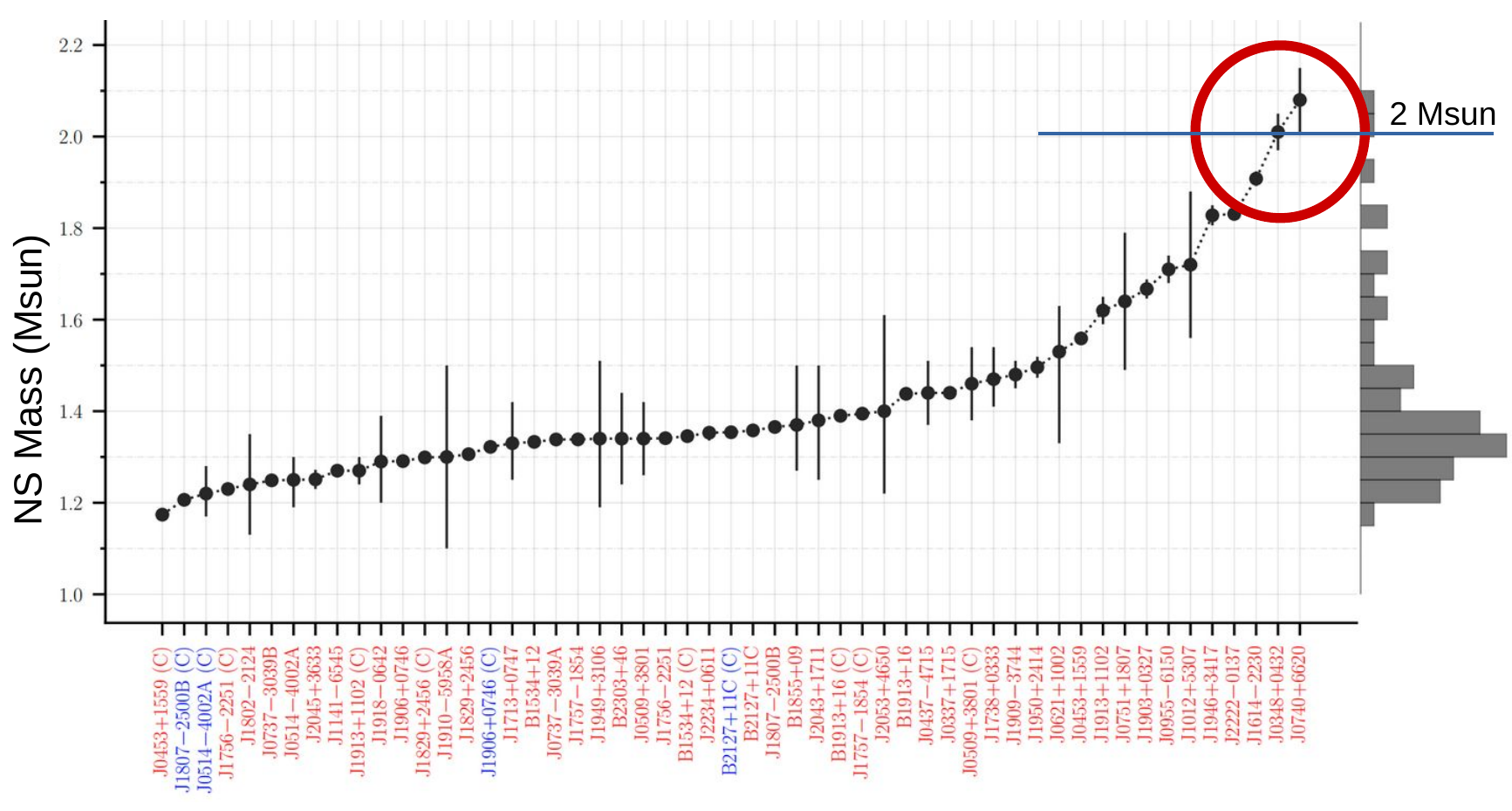
Besides the baseline requirements for high-precision timing of MSPs, in general, to best measure high-mass neutron stars, we will need to search for and find MSPs over the whole sky. The searches will require finer frequency resolution and a substantially different and more complex backend than the timing observations. We will then need to carefully time the small subset (i.e.1%) of pulsar binaries in the two subsets listed above. This will include both new pulsars and older systems where the DSA–2000’s timing precision is “world-best”. For Shapiro delay observations, 12 long tracks (i.e. 48 hrs) for each system would greatly improve parameter estimates. Deep search capabilities (i.e. 18 hrs in duration) of globular clusters not searched by FAST or SKA-Mid, where eccentric MSP binaries are much more common, would be highly desired.
| DSA-2000 baseline reference design | match to project | |
|---|---|---|
| need for additional modes | N/A | Occasional 48 hr timing tracks |
| need for additional modes | N/A | MSP search capabilities, in general |
| need for additional modes | N/A | Pulsar search 18 hr observations(?) |
5.7 Identifying highly scattered young pulsar candidates through circular polarization continuum observations
Frank Schinzel
With more than 300 -ray pulsars detected by the Fermi -ray satellite and an unabated pace of pulsar discoveries, it has long been assumed that there are few new radio-loud pulsars to be found in the Galactic plane (GP). The 4FGL-DR3 catalog however presents a doubling in the number of pulsar-like -ray sources with no plausible multi-wavelength counterpart, so called unassociated -ray sources (UAS), to about one quarter of all detected GP sources. It is the hypothesis that the growing population of UAS in the GP are in fact missing radio-loud young, energetic pulsars that are hidden from standard pulse searches by interstellar scattering. To overcome this limitation, an all-sky search of circularly polarized GP sources has the potential to uncover highly scattered pulsar candidates, missed by traditional pulsar searches. This would allow a concentrated follow-up of identified pulsar candidates with limited resources at higher frequencies to overcome interstellar scattering. This has the potential to extent the young pulsar population to objects beyond the Galactic center and provide a better census of birth-rates and kick-velocities for this class of pulsars.
In the past, radio imaging techniques were successfully applied to identify large numbers of AGN among the Fermi UAS (e.g. Schinzel et al. 2017). More recently imaging methods were used for pulsar identifications of UAS, exploiting their steep radio spectral indices to help discover at least seven MSPs ((Bhakta et al. 2017; Frail et al. 2018)), a pulsar wind nebula ((Bhakta et al. 2017)), and a score of candidate pulsars ((S. D. Hyman et al. 2019; Bruzewski et al. 2021)).
All non-thermal radio sources are polarized at a low level. Pulsars are unusual in having time-resolved (circular and linear) polarized emission as much as 100%, or time-averaged values of 10-15%. Most interestingly is that (Weltevrede and Johnston 2008) note that the young, energetic pulsars have much higher polarization than normal. Low-mass flare stars and RS CVns are known to produce bursty, highly-polarized emission (Villadsen and Hallinan 2019b). Nonetheless, pulsars dominate polarized sources in large-scale surveys (e.g. Lenc et al. 2018b), while the false positive rate of flare stars is small ((1/250 deg; Callingham et al. 2021)) and they are easily identified via their X-ray and optical/NIR emission. Linear polarization can suffer from bandwidth depolarization if radio waves pass through a strong magneto-ionized medium along the line of sight, also commonly referred to as Faraday rotation. The same electrons that scatter-broaden pulsar pulses can reduce or even cancel out any linear polarization. However, circular polarization (V Stokes) is immune from Faraday rotation and is thus preserved.
The perhaps first, independent discovery of a pulsar using circular polarization was that of PSR J1431-6328 ((Kaplan et al. 2019)), followed by identification of two pulsar candidates near the Galactic center where confirmation is still pending ((S. D. Hyman et al. 2021)). In those instances, fractional circular polarization (Stokes V/I) is found at levels of 13–20%. To summarize, circular polarization serves as a strong tracer for pulsars, is immune to scattering from the interstellar medium, and does not suffer from depolarization due to bandwidth depolarization.
DSA-2000 will be able to contribute to this search in three ways. 1) It’s sensitivity will be at least one order of magnitude greater than what can easily be achieved with today’s point and shoot telescopes. 2) Its widefield, all-sky survey capabilities will essentially provide a large list of potential pulsar-like circularly polarized candidates for follow-up in search of radio pulsations at 2.0 GHz. This will beat interstellar scattering, while employing limited follow-up telescope resources. 3) Its survey cadence will allow for variability as factor to distinguish circularly polarized source classes.
N/A
5.8 The Dynamic Ionized Interstellar Medium in the DSA-2000 Era
Michael T. Lam
The DSA-2000 will provide an unprecedented view of the dynamic ionized interstellar medium through radio pulsar and transient observations. Utilizing the information encoded in a number of propagation effects on the radio emission, and with high-cadence, wideband observations of up to 200 pulsars, DSA-2000 will provide an unprecedented view of the physics of turbulence in the interstellar medium across many spatial scales.
Radio pulsar emission travels through free electrons in the ionized interstellar medium (ISM), causing the emission to undergo numerous propagation effects. The dominant effect for radio waves is dispersion, in which the light is dispersed so that longer wavelengths are delayed and arrive later at the observatory than shorter wavelengths. The time delay is inversely proportional to the electromagnetic frequency squared () and directly proportional to the dispersion measure (DM), which is the integrated electron density along the line of sight from the pulsar to the Earth, .
Time variations of DM are well known in the literature and there have been many methods of modeling them, including piecewise constants (“DMX”), trend analyses, and Gaussian-process regression. Physical mechanisms for the time-variability include the line of sight passing through the turbulent ISM, solar wind, filaments, compact plasma lenses, and more. Therefore, long-term, high-cadence monitoring of DM is important for uncovering the physics of the ionized ISM.
In addition to dispersion, radio emission undergoes refraction, scattering, and scintillation. These propagation effects cause observable changes in pulse shapes and delays, as well as dynamic spectra, allowing us to infer what impacts the geometry and physics of the intervening media have on the radio emission. The turbulence in the ISM is described by the electron-density wavenumber spectrum, which has a power-law form across many orders of magnitude. The exact physics of turbulence in the interstellar medium is encoded in this spectrum. Different observables probe different spatial scales of this spectrum, and so tracking these observables along many lines of sight allows us to build a complete picture of turbulent structures in the ISM.
The DSA-2000 will provide high-sensitivity access to the electron-density wavenumber spectrum covering many orders of magnitude, from Earth-radius to kiloparsec scales. It will observe DM variations in up to 200 pulsars and scintillation/scattering variations in many of them. Galactic and extragalactic transients will provide additional spatial and temporal constraints.
The current baseline design would allow for probes of the electron-density wavenumber spectrum between and kpc scales. Sub-arraying capabilities will allow for a greater tracking of pulsars while optimizing cadences and integration lengths for these types of studies. A pipeline for Galactic and extragalactic transients will assist in coverage across the sky.
| DSA-2000 baseline reference design | match to project | |
|---|---|---|
| Cadence | 1 every 4 months | 200 pulsars observed monthly |
| need for additional modes | N/A | Sub-arrays optimize for pulsar |
| sensitivity/cadence/integration | ||
| considerations |
5.9 Probing Turbulent Magnetized Plasma in the Galactic Interstellar Medium with Pulsars and other Tracers
James M. Cordes, Stella Ocker, and Shami Chatterjee
Understanding the cycling of energy in the interstellar medium (ISM) requires a much better characterization of ionized gas including densities, magnetic fields, and temperatures on a wide range of scales (e.g. Stinebring et al. 2019, Twelve Decades: Probing the Interstellar Medium from kiloparsec to sub-AU scales, https://ui.adsabs.harvard.edu/abs/2019BAAS...51c.492S). Density and magnetic fluctuations occur from km to pc (or larger scales), suggestive of a turbulence process. The ISM also strongly influences the outcomes of surveys for pulsars and fast radio bursts (FRBs), which themselves yield the objects and signals that uniquely diagnose the medium. Survey design and interpretation therefore requires detailed modeling of the Milky Way’s ISM.
Next-generation Galactic models for the ionized ISM (i.e. electron density and magnetic fields and their multiscale fluctuations) will have utility across many subfields. They require large samples of the standard four measures [dispersion (DM), Faraday rotation (RM), scattering (SM), and emission measure (EM)], which can be provided by DSA-2000 in concert with multifrequency continuum maps (for EM). Current models suffer from poor sampling of clumps and voids (e.g. HII regions and hot-phase bubbles) in the ISM.
DSA-2000 can provide a transformational increase in the number of lines of sight for Galactic tomography: another 5000 pulsar lines of sight, or more FRB lines of sight, and millions of AGNs, many of which will pass through intervening galaxies and clusters. The HII regions in the MW require a comparable number of pulsars to have at least one pulsar sample each HII region. Multiwavelength follow up of AGNs (e.g. optical absorption and VLBI angular broadening measurements) can yield characterization of the ISM in other galaxies for comparison with that of the Milky Way.
In broad brush, the Galaxy is well characterized in terms of large scale features, gas phases, and overall energetics but a holistic, multiscale model that accounts for the dynamics of structure and turbulent flows remains to be developed. Also from a purely astronomical viewpoint, Galactic models are only coarsely predictive. For example, the inventory of DMs on FRB (fast radio burst) lines of sight relies on suitable modeling of the foreground Galactic electron density (ditto for RM). It is already known that the foreground DM is overpredicted for some FRBs, yielding large uncertainties in redshifts based on DM and even in whether some FRBs are extragalactic.
Multiple subfields can benefit from vastly improved interstellar diagnostics and modeling that will result from large samples. In addition to FRBs, these include the distance scale for pulsars and magnetars; predictions of interstellar signal distortions on spectra from stellar flares (e.g. features in dynamic spectra) and on any signals detected in SETI; and multiscale modeling of the Galactic magnetic field, relevant to cosmic ray propagation. Also, characterization of lines of sight is beneficial to pulsar timing arrays for disentangling ISM-induced fluctuations from long-wavelength gravitational waves.
Work over the last decade has refined methods for exploiting the high information content contained in dynamic spectra of pulsars (especially ‘scintillation arcs’). These reveal the presence of poorly understood thin screens that likely are associated with shocks or interfaces between larger scale features. Parallel developments have led to estimates for the ‘inner scale’ of (most likely) turbulent density fluctuations - km based on analysis of scattering broadening of pulsar pulses. A uniform set of wideband measurements of dynamic spectra and pulse shapes will allow mapping of thin screens over the solar neighborhood of the MW and a picture for variations in inner scale over a good fraction of the MW.
DSA-2000 has the potential for sampling many thousands of lines of sight (and more AGNs) and providing data products (dynamic spectra and chromatic pulse shapes in all Stokes parameters) that are needed for the program outlined above. The sensitivity of DSA-2000 is key to providing these data products in the context of pulsar and FRB detections in observations conducted commensally with the sky survey. Multiple passes in the sky survey are important for this as well. The outcome will be a sea change in our ability to model structure in the ISM on small as well as large scales.
Pulsar dynamic spectra require sub-MHz frequency resolutions in the lower part of the RF band and time resolution for dedispersed pulse shapes with pulsar periods from to 20 s needs to be as short as 10 for millisecond pulsars. The dwell time needed for dynamic spectra depends on the DM of the pulsar. More distant pulsars have finer scale scintillations so the 15m dwells of the sky survey over multiple epochs are adequate for those. More nearby pulsars need longer dwells in the upper part of the DSA-2000 band but may be sampled adequately in the lower part of the band if RFI is not prohibitive.
Faraday rotation measures require channelization that satisfies with in GHz and where is the allowed polarization position angle rotaton across a channel.
| DSA-2000 baseline reference design | match to project | |
|---|---|---|
| Frequency band | 0.7–2.0 GHz | |
| Pointing | all–sky | |
| Declinations | -31 | |
| Spatial resolution | 3.5 | |
| polarization | IQUV for 2 MHz channels, | |
| I only for all other channels | ||
| continuum channels | 605 channels, 0.7-2.0 GHz, 2.15 MHz resolution | higher resolution needed |
| low–resolution HI channels | 5600 channels from 0.7–1.45 GHz, | |
| 134 kHz (28 km s at z=0, 56 km s at z=1) | ||
| tuneable zoom band A | 4096 channels, 8 kHz (1.8 km s) | |
| tuneable zoom band B | 2048 channels, 1.05 kHz (0.22 km s) | |
| need for short–baseline array | N/A | |
| Cadence | 1 every 4 months | |
| need for additional modes | N/A |
5.10 Probing the Interstellar Medium using CLEAN Deconvolution on Radio Pulsar Profiles
Olivia Young and Michael T. Lam
Pulsar radio waves are distorted and delayed as they propagate toward the Earth due to interactions with the free electrons that comprise the interstellar medium. Multipath propagation results in later times of arrival for the lower frequencies and causes the observed pulse to arrive with a broadened tail described by the pulse broadening function. We employ CLEAN deconvolution to recover the intrinsic pulse shape and pulse broadening function. Our work expands upon previous efforts and parameterizes the efficacy of the method on simulated data, leading to an automatic and consistent determination of the scattering timescale and its uncertainty.
Radio emission from pulsars is distorted as it moves through the ISM. Irregularities in the ISM cause multipath propagation, resulting in the pulse of light arriving at the Earth with a broadened tail. A common model of the ISM assumes turbulent Kolmogorov fluctuations, leading to an exponential tail, which we know is not accurate along many lines of sight.
CLEAN deconvolution is an iterative method used to determine the pulse broadening timescale of radio pulsar profiles and rebuild the intrinsic profile. CLEAN iteratively subtracts small copies of a simplified, broadened pulse from the observed pulse. We are then able to rebuild the intrinsic pulse and choose the “correct” broadening timescale using a set of figures of merit.
CLEAN’s performance is predominantly dependent on two factors: the pulse broadening timescale and the S/N of the observation, with recall accuracy increasing as both factors increase. The current success of CLEAN is limited by the need for high signal-to-noise ratio (S/N) profiles, which often require summing observations over long timespans or large bandwidths to achieve these high S/N values. With the DSA-2000’s sensitivity, high cadence, and wide bandwidth, CLEAN will be usable on a larger array of pulsars, and enable short-timescale measurements of ISM variations.
As current applications are impeded by a lack of access to high S/N data, the DSA-2000 will greatly increase both the numbers of pulsars with high enough S/N for CLEAN to be able to accurately recover the pulse broadening, and will therefore also allow for better sampling in time of the changing ISM.
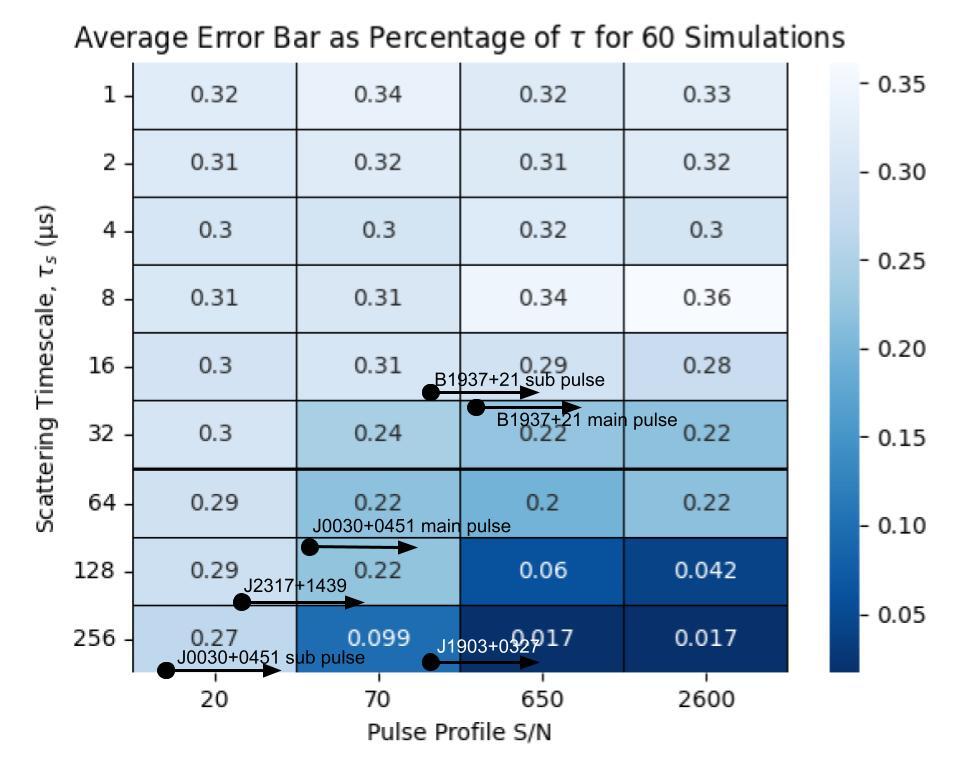
The current baseline design would allow for wideband observations of up to 200 pulsars at high cadences, allowing us to deploy CLEAN on many pulsars with high time resolution to measure rapid (monthly) changes in the ISM. A pipeline for Galactic and extragalactic transients will assist in coverage across the sky.
| DSA-2000 baseline reference design | match to project | |
|---|---|---|
| Cadence | 1 every 4 months | 200 pulsars observed monthly |
| need for additional modes | N/A | Sub-arrays optimize for pulsar |
| sensitivity/cadence/integration | ||
| considerations |
5.11 Constraining black-hole formation in the early universe: the case for 100 yr of pulsar timing
Joseph Simon (University of Colorado) and James Cordes (Cornell University)
Pulsar timing arrays (PTAs) have revealed a stochastic gravitational wave background (GWB), most likely produced by a population of supermassive black hole binaries (SMBHBs). Detection of individual binaries, particularly at , is needed to probe formation and evolution of SMBHBs. Remarkably, for fixed observed GW frequency the GW strain increases for because of its strong dependence on orbital period, which is shorter in the rest frame than in the observer’s frame by a factor . Current data sets yr in length need to be extended substantially in order to probe redshifts because coalescence times are much shorter for fixed period in the observer’s frame. Other benefits of long data sets include (1) better characterization of the GWB and SMBHB evolution astrophysics; (2) increased chances of detecting gravitational memory bursts; (3) greater likelihood of detecting gravitational lensing from Galactic objects, including dark matter clumps; detecting flyby events from substellar objects; and detecting plasma lensing events, whose astrophysics is also not well understood.
The co-evolution of galaxies and their SMBHs remains one of the great puzzles in astrophysics. Recently, there is increasing evidence that SMBHs were more massive in the early Universe than previously thought, which is leading to a shift in our understanding of SMBH formation and evolution. JWST observations revealed a SMBH at ((Bogdán et al. 2023)), and a re-examination of HST galaxies highlighted the potential for SMBHs at ((Matt, Gültekin, and Simon 2023)). Even the stochastic GWB measured by PTAs hints at a more massive and more numerous population of SMBHBs ((Agazie, Anumarlapudi, Archibald, Baker, et al. 2023)), with the potential for individually detectable binaires at much higher redshifts than previously thought ((Simon 2023)).
Now that a stochastic GWB has been measured at nanohertz frequencies, the next milestone is to identify some of the individual SMBHBs that comprise it. Each will appear as a continuous wave [CW] signal in timing residuals at twice the redshifted orbital frequency, . Requiring several GW cycles for detection, a time series of length is needed.
Data sets substantially longer than those currently available ( yr) are required because the greatest sensitivity is for observation frame periods , corresponding to rest-frame periods , which can have much shorter coalescence times than binaries at low redshifts (see Figure 1). This reduces the likelihood for a signal existing in the PTA band. The greater cosmological volume sampled at high redshifts can compensate, but only up to redshifts where the formation rate of SMBHBs is substantial. A reduced formation rate at high therefore requires longer data sets to maximize the odds of detection and also increase the detection sensitivity. Also helpful is the scaling of the dimensionless strain (where is the luminosity distance), which first decreases with and then increases for for fixed observed GW frequency ((Rosado et al. 2016)). This implies that the primary factor for constraining the high- population of SMBHBs is the availability of sustained pulsar timing data. As outlined in the summary, long spans of PTA data also have other, unique astrophysical benefits.
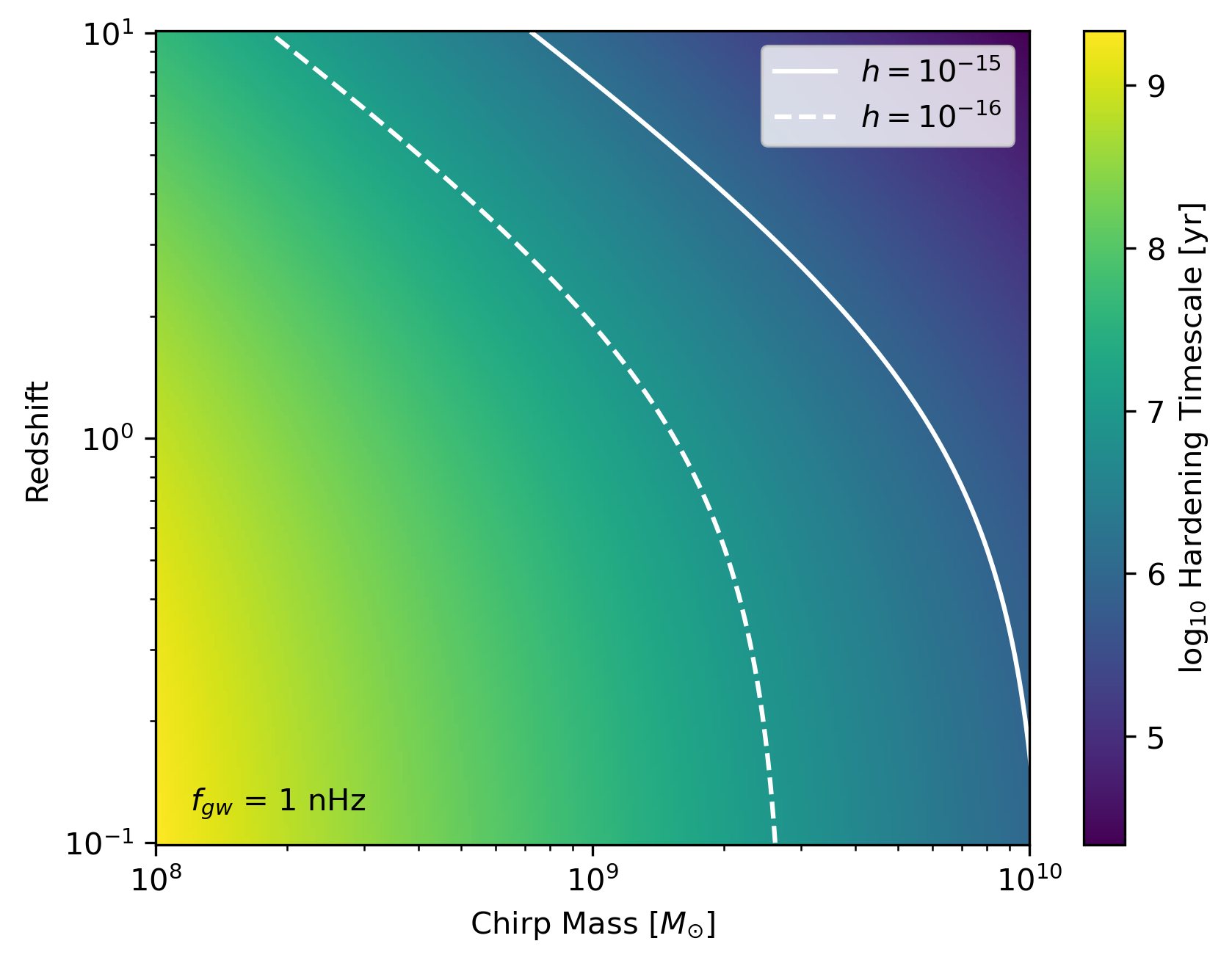
PTA observations are continuing globally but without coordination and long-term planning, so a lapse in observations is possible. DSA-2000 is therefore highly important because it provides dedicated time for PTA observations with the best sensitivity to pulsar observations that yield highly precise arrival times.
System requirements already include those needed for precision pulsar timing. The explicit requirement for probing high redshift GW sources is sustained timing with monthly cadence into the indefinite future.
6 Multi–Messenger Astronomy: Compact Binary Coalescence
Summary: Compact Binary Coalescence
Poonam Chandra (on behalf of the SAC)
The coalescences of compact binaries announce themselves via multiple messengers. In September 2016, the merger of two stellar mass black holes led to the first direct detection of gravitational waves. Since then several such events have been found, and gravitational waves have been the only signatures of these mergers. However, if at least one of the compact object of the binary system is a neutron star, the coalescence of such a system is expected to produce a plethora of signatures, including but not limited to gravitational waves, a collimated short gamma-ray burst, and a quasi-isotropic kilonova. The merger of two neutron stars on 17 August 2017 revealed all these phenomena in gravitational waves as well as across the electromagnetic spectrum. This event thus marked the unambiguous initation of multi-messenger gravitational wave astronomy.
It is speculated that in some cases, the mergers involving neutron stars may temporarily lead to a massive, rapidly spinning magnetar or a supra-massive neutron star before the final collapse. This temporarily stable magnetar may power synchrotron emission via energizing the kilonova ejecta by depositing part of its rotational energy. However, there is also a possibility to create interesting precursor transients before the mergers, serving as early gravitational wave warning systems and unraveling new surprises. Simulations have shown that a reasonable amount of dipole misalignment in the magnetic fields of the two neutron stars may lead to coherent pre-cursor radio emission or X-ray flares. There are also a few favorable scenarios where compact binary coalescence may provide favorable conditions for fast radio bursts (FRB) production before, during or after the merger.
Sometimes the intrinsic signals produced in the coalescence may undergo propagation effects, especially if the magnetic field of the medium is high. Hence it is clear that coalescence of compact binaries leads to a landscape of varied astrophysical phenomena. Radio observations will play a critical role in unraveling this diversity. With its unique combination of wide FOV and high sensitivity, DSA-2000 will play an especially important role. The large FOV of DSA -000 will be very useful for covering the large localization regions of gravitational wave events when searching for electromagnetic emission. In fact, if a coalescence involves a neutron-star and black hole, radio signals may be the only electromagnetic signals. If a magnetar has formed, then reenergized kilonova ejecta is expected to produce a delayed synchrotron signal at radio wavelenghts; however the timescales at which one expects these signals is not known. As DSA-2000 will carry out a multi-epoch survey of the northern sky, the chances of detecting these signatures are quite high. The search for FRB-like events before, during, and after the merger is also highly likely due to the large instantaneous field of view of DSA-2000. In addition, radio measurements are the ideal way to constrain the inter-galactic medium magnetic field and thus quantify the damping of gravitational waves. The next few chapters elaborate on these astrophysical phenomena resulting from the coalescence of compact binaries and how DSA-2000 will prove instrumental in improving our understanding of them.
6.1 Compact binary coalescences in the era of multi-messenger astronomy
Alessandra Corsi
The discovery of GW170817, the merger of two neutron stars (NSs) observed via both its gravitational wave (GW) siren and its glow at all wavelengths of light, has marked spectacularly the start of multi-messenger GW astronomy. The discovery of a radio afterglow from GW170817 played a unique role in (i) uncovering the first ever off-axis afterglow of a gamma-ray burst (GRB); (ii) probing the existence and structure (energy and speed profile) of the relativistic jet launched in the merger; (iii) reducing the degeneracy between observing angle and distance that affects the GW measurements and the impact that these can have on cosmological studies. Here we describe the role that DSA-2000 can play in the context of multi-messenger studies of compact binary coalescences over both the near- (next 5 years) and longer-term (next 10-15 years) future.
Over the next 5 years, the LIGO, Virgo, and KAGRA GW detectors should allow us to go from 1 to GW170817-like events ((LIGO Scientific Collaboration and Virgo Collaboration 2017; B. P. Abbott, Abbott, Abbott, Acernese, Ackley, and others 2017)), by enabling the localization of a growing number of NS-NS and black hole (BH)-NS mergers to sky areas deg. Finding the radio counterparts of these events is key to probing their diversity in terms of ejecta energy and velocity profile, density of the material surrounding the merger site, and viewing angles (e.g., (Nakar and Piran 2011; G. Hallinan, Corsi, et al. 2017b; Mooley, Deller, et al. 2018b; Lazzati et al. 2018; Petrov et al. 2022; Balasubramanian et al. 2022) and references therein). In particular, unveiling NS-NS/BH-NS mergers that may not be optically bright, at distances matching the improved reach of GW detectors, requires radio arrays with an optimal combination of survey speed, sensitivity, and resolution. The DSA-2000 is one such array.
The community is also developing concepts for improved sensitivity and next generation ground-based GW observatories (such as, LIGO A#, Voyager, the Einstein Telescope, and Cosmic Explorer; e.g., (Branchesi et al. 2023; Evans et al. 2023)) that would become operational in the next decade (starting from the 2030-2035s). These improved GW detector networks could probe, for the very first time, compact binary mergers associated with short gamma-ray bursts (GRBs) up to the peak of star formation ((Ronchini et al. 2022; I. Gupta et al. 2023)). At these higher redshifts, radio arrays like DSA-2000 may be our only way to uncover (on-axis) radio afterglows in relatively large localization areas, unless the US retains capabilities such as those of the Swift satellite (arcmin localization of short GRBs). In this respect, the DSA-2000 would be complementary to other next generation radio facilities such as the ngVLA ((E. J. Murphy 2018)), that could probe to very deep limits (and at higher frequencies) the more nearby events that would be localized by next generation GW detectors to regions deg ((I. Gupta et al. 2023)).
Over the next 5 years, the ability of DSA-2000 to reach sensitivities of Jy () over areas of deg in 1 hr will enable follow up of GW triggers localized to within 100 deg. Over the next 10-15 years, the key advantage of the DSA-2000 will be the ability to probe the nearly on-axis radio afterglows from NS-NS and BH-NS mergers that will be unveiled by next generation GW detectors at the higher redhifts where localizations would still deg (hence requiring the DSA-2000 survey speed).
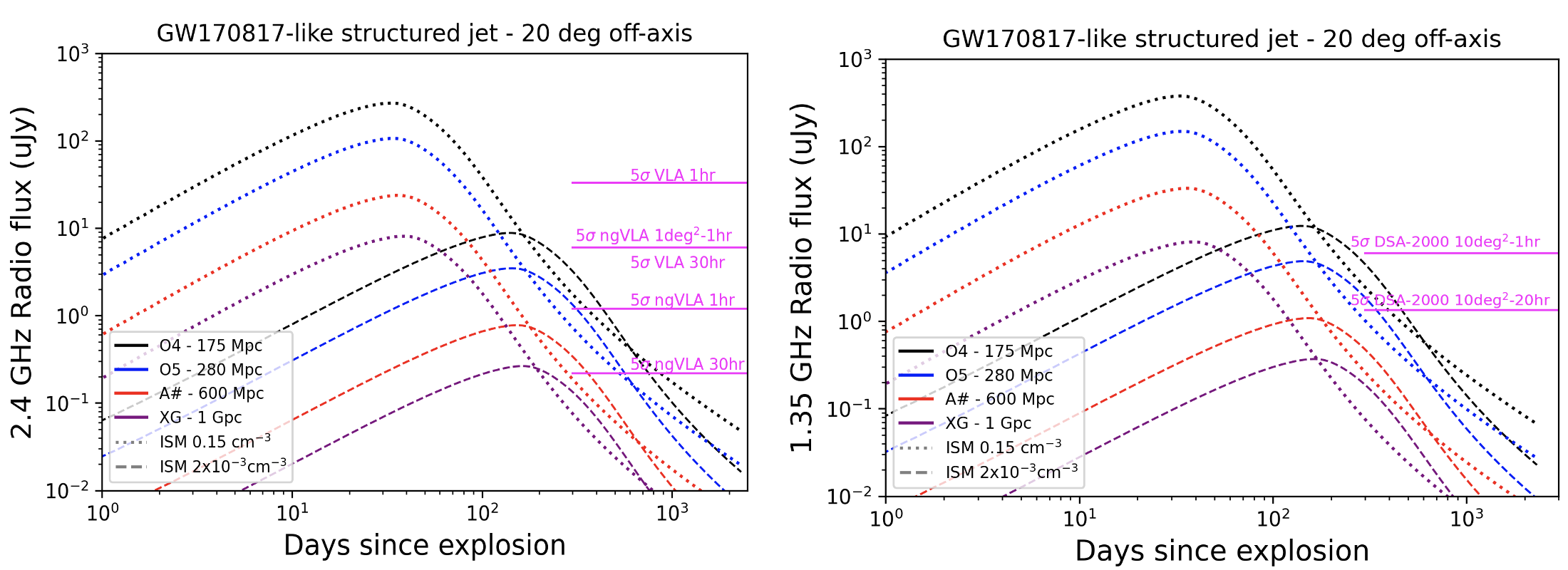
The current design of the DSA-2000 works well for this science case. A key requirement is the ability to respond to ToOs within 1-3 days.
| DSA-2000 baseline reference design | match to project | |
|---|---|---|
| need for additional modes | N/A |
6.2 Searching for the Elusive Magnetar Remnant Radio Signal from Binary Neutron Star Mergers
Genevieve Schroeder (Northwestern University)
The DSA-2000 all sky survey will very likely detect the radio afterglows of some short gamma-ray bursts (SGRBs). These detections can help inform radio follow-up, as well as help provide constraints on the circumburst densities of these events. Additionally, the survey will observe the fields of many previously detected SGRBs, which may have formed magnetar remnants that can energize surrounding ejecta and produce radio emission years after the burst. Therefore, the DSA-2000 survey will also help probe the existence of these magnetar remnants.
The merger of two neutron stars (NSs) is known to produce gravitational wave (GW) emission, a short gamma-ray burst (SGRB), and kilonova, and may also be responsible for the production of a massive, rapidly spinning, highly magnetized NS, known as a magnetar. If this magnetar remnant is at least temporarily stable against collapse, it will deposit a fraction of its rotational energy (ejecta energy up to erg) into the surrounding kilonova ejecta (mass ), powering a synchrotron radio signal from the interaction of the ejecta with the circumburst medium, which may be detected years after the burst ((Nakar and Piran 2011)). We can use radio observations to search for these magnetar signatures, and place constraints on the fraction of SGRBs that produce stable magnetar remnants as well as the maximum mass of a non-rotating NS.
Several attempts to detect this type of emission have been performed in the past by observing the fields of SGRBs in the radio at late times (i.e. (Metzger and Bower 2014; Horesh et al. 2016; Fong et al. 2016; Klose et al. 2019; L.-D. Liu, Gao, and Zhang 2020)), with no definitive detections to date. Recently, a new survey combined all of the previous observations, along with 9 new observations of SGRBs, to place limits on the of these mergers. With these limits, the fraction of SGRBs that produce stable magnetars was constrained to , and the maximum mass of a non-rotating NS was constrained to ((Schroeder et al. 2020)). These constraints are limited by the small sample size ( SGRBs followed-up at late times), but deep all sky surveys will allow for more robust constraints.
The expected brightness of the magnetar emission is estimated using SGRB afterglow parameters, such as the circumburst density (). Radio detections of the SGRB afterglow are some of the best tools to accurately constrain these parameters (see (Fong et al. 2015)). However, few radio afterglows of SGRBs have been discovered to date (see (Schroeder et al. 2023)). Utilizing all sky radio surveys, such as the DSA-2000 survey, will allow for more informed radio followup by providing template images to compare new radio observations against, as well as likely serendiptiously detecting SGRB radio afterglows (see Fig. 6.1).
The DSA-2000’s all sky survey will be a valuable resource for both the discovery and follow up of SGRB radio afterglows, as well as potentially the radio signal from a magnetar remnant. With it’s month cadence and deep Jy RMS, it is well matched to the detectability timescale and flux of a short GRB radio afterglow (see Fig. 6.1). Additionally, the survey will cover the locations of many previously detected SGRBs. Therefore, we can utilize the DSA-2000 all sky survey to perform systematic searches for late time radio emission from NS mergers to probe the existence of a magnetar remnant (see Fig. 6.2).
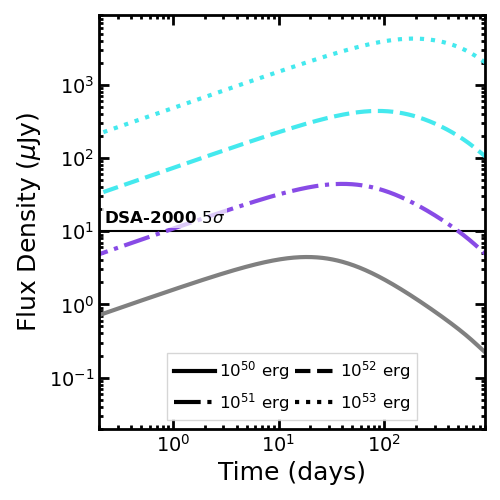
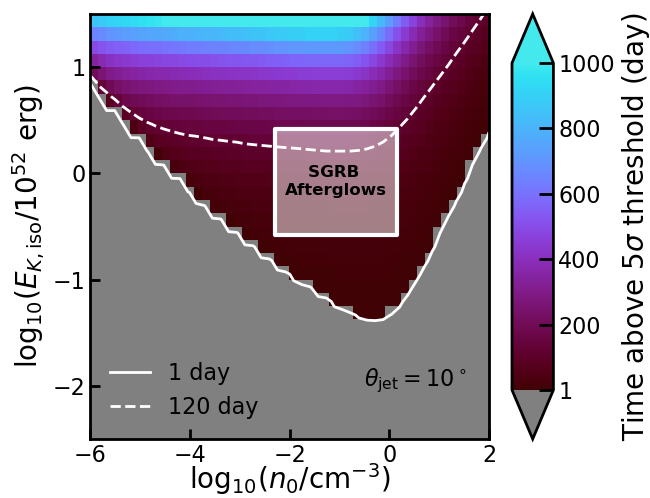
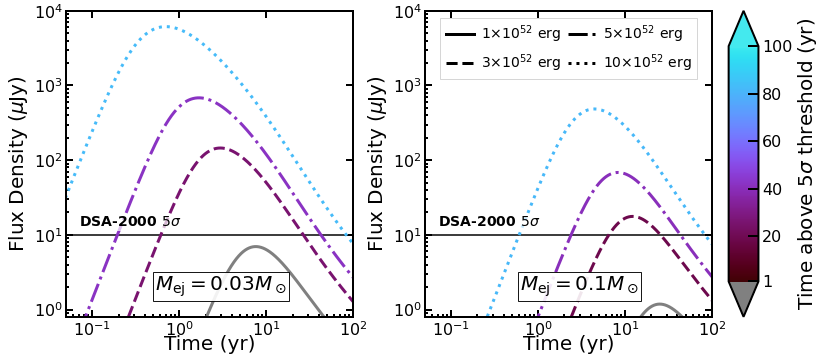
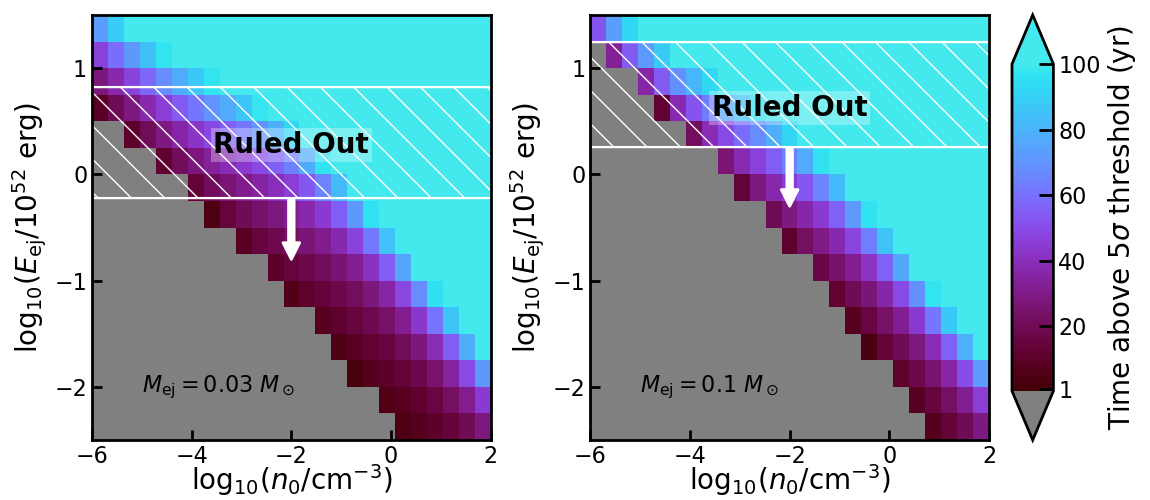
The current design of the DSA-2000 works well for this science case. Importantly, having quick access to data products and even prior knowledge to when a field would be observed would be very beneficial. If one could query the DSA-2000 to see when a certain field would be observed next, it could help inform radio follow up. E.g. if an SGRB is detected and the DSA-2000 will observe that field in the next week, we may choose to hold back triggering ToO programs until the DSA-2000 observations have been taken and analyzed, to see if a radio afterglow was detected.
6.3 Fast radio precursors transients to merging neutron stars
Elias Most
Gravitational wave events of merging neutron stars might be accompanied by Fast-Radio-Burst-like transients. These could be the result of processes in the common magnetosphere, present in the late stages of the inspiral phase. Recent numerical simulations have been able to show that this could happen for field strengths well below the magnetar level. Driven by the interaction of strong electromagnetic flares, emitted from the premerger system, millisecond-long bursts of radiation with frequencies 2-20GHz for magnetic fields of G at the stellar surface could be detectable. Overall luminosities would fall in the range of erg/s, with potential millisecond periodicity of 2-5 episodes.
Over the past few years, the LIGO-VIRGO-KAGRA collaboration has detected gravitational wave (GW) from merging binary neutron star (B. P. Abbott et al. 2017b, 2020), and black hole – neutron star (R. Abbott et al. 2021) systems. Due to the presence of neutron-rich matter, these events can power electromagnetic counterparts optical & infrared (Cowperthwaite et al. 2017; Chornock et al. 2017; Villar et al. 2017; Nicholl et al. 2017; Troja et al. 2018; Tanvir et al. 2017; Drout et al. 2017), gamma- (B. P. Abbott et al. 2017a; Savchenko et al. 2017) and X-ray (Troja et al. 2017; Raffaella Margutti et al. 2017; R. Margutti et al. 2018; Hajela et al. 2019), as well as radio (G. Hallinan et al. 2017; Alexander et al. 2017; Ghirlanda et al. 2019; Mooley et al. 2018; Mooley, Deller, et al. 2018a) bands, making these systems exciting targets for multi-messenger astronomy. However, not all of these systems are expected to feature such counterparts, especially in the case of black hole –neutron star system (Anand et al. 2021; Coughlin, Dietrich, et al. 2020; Coughlin et al. 2020), see also (Raaijmakers et al. 2021). However, for the currently inferred coalescing neutron star – black hole population, it seems unlikely that enough remnant matter is left after the merger to power afterglow transients (Biscoveanu, Landry, and Vitale 2022).
However, these electromagnetic counterparts, such as the kilonova afterglow (Metzger 2017), may not be the only ones that can be sourced by the merger. Different from transients sourced after the merger, there may also be the possibility to create counterparts before the merger. Since neutron stars feature strong magnetic fields in the inspiral, their interaction prior to merger might release substantial amounts of energy, potential capable of powering precursor transients (Hansen and Lyutikov 2001; Lai 2012; Piro 2012; Lyutikov 2019). These transients may be relevant for proposed early gravitational wave warning systems aiding their pursuit (James et al. 2019; Sachdev et al. 2020; Yu et al. 2021; Z. Wang et al. 2020). All-sky capability may help associate detected radio bursts to rapid localizations of neutron star gravitational wave events (Gourdji et al. 2020).
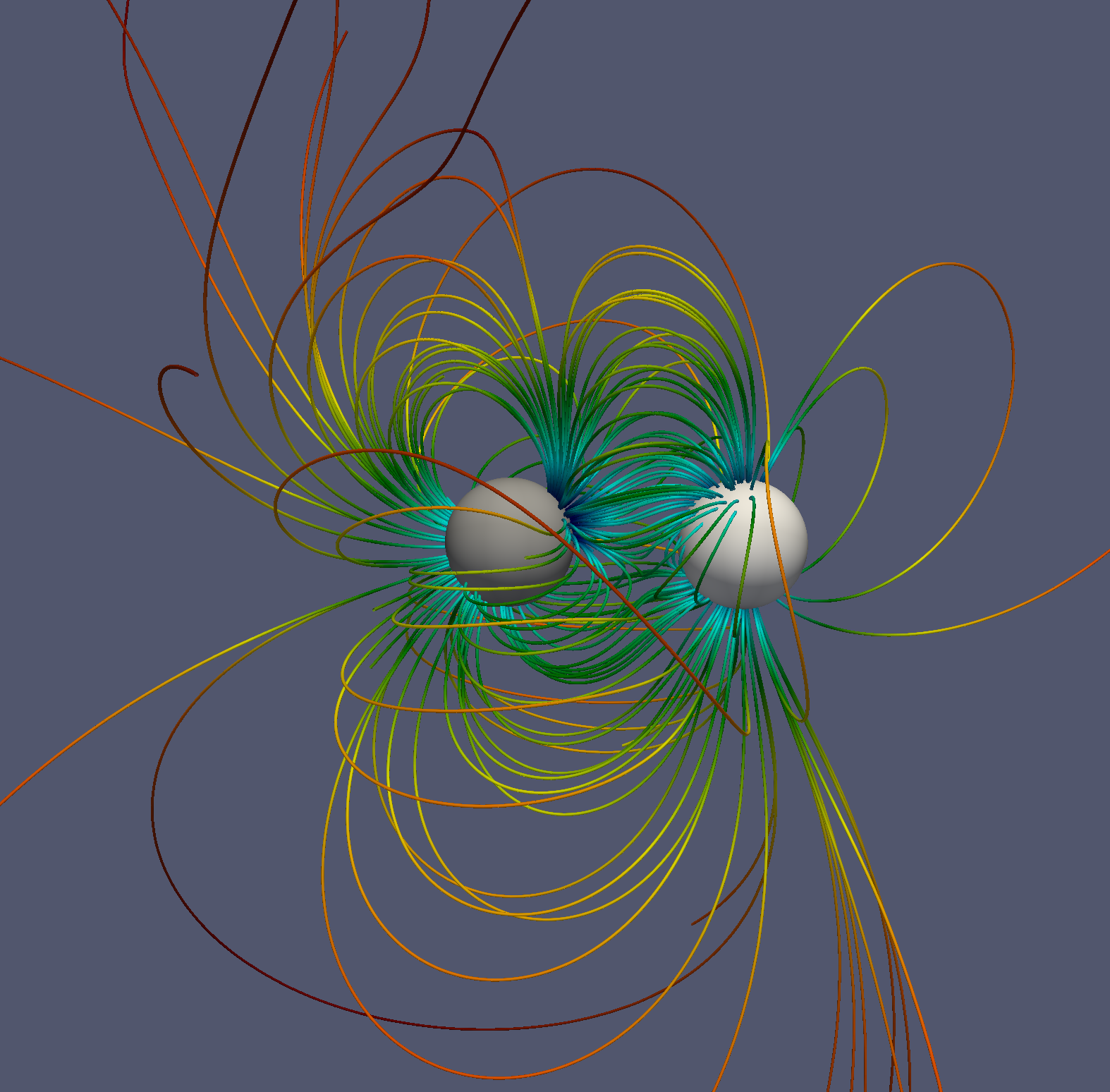
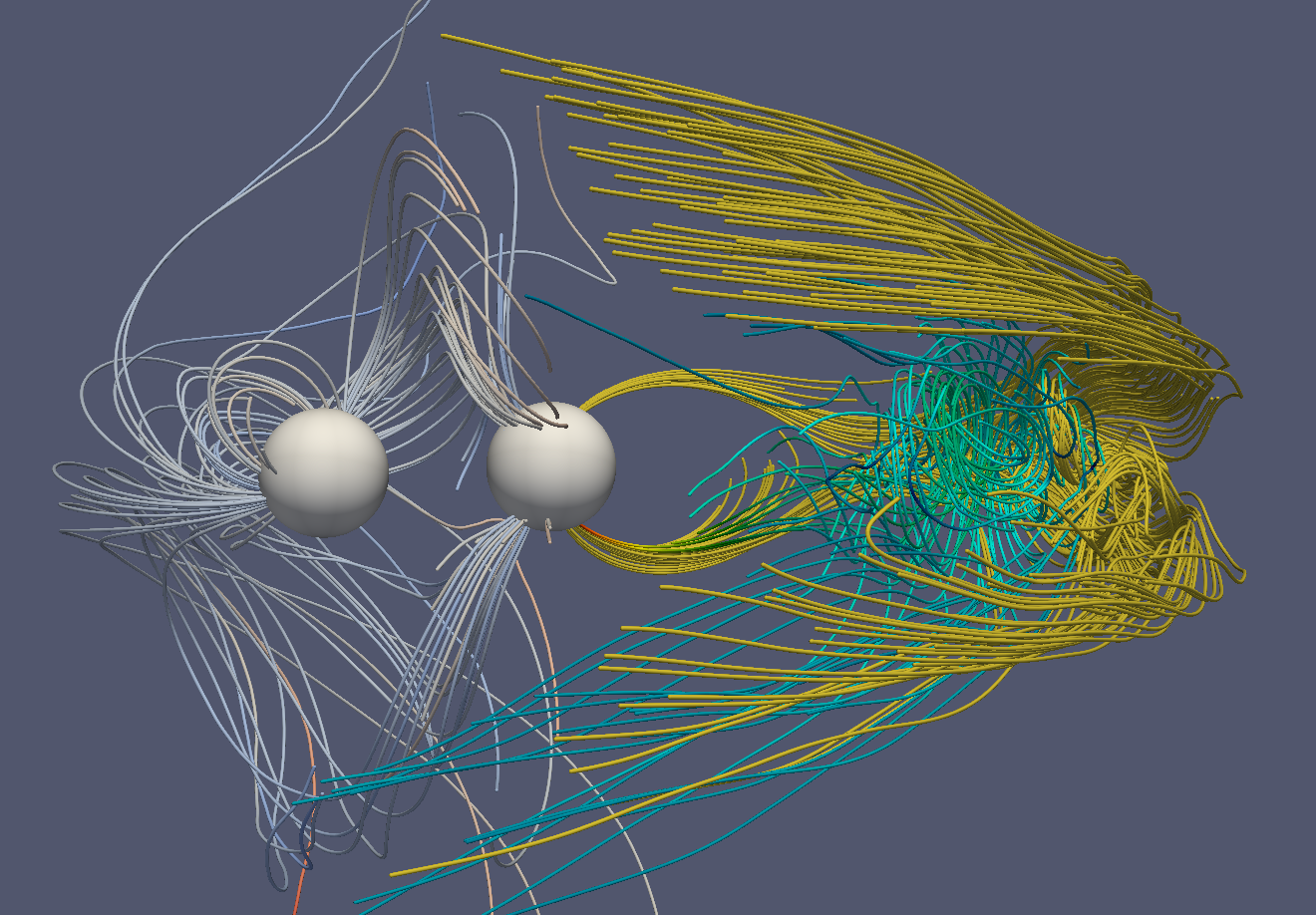
Although most progress in this field has been limited to analytical work (Hansen and Lyutikov 2001; J.-S. Wang et al. 2016; Lyutikov 2019; Sridhar et al. 2021; McWilliams and Levin 2011; D’Orazio and Levin 2013; Mingarelli, Levin, and Lazio 2015; D’Orazio et al. 2016), over the past decade numerical simulations of the common magnetosphere have been carried out (e.g., (Paschalidis, Etienne, and Shapiro 2013; Palenzuela, Lehner, Ponce, et al. 2013; Palenzuela, Lehner, Liebling, et al. 2013; Ponce et al. 2015; Carrasco and Shibata 2020; Carrasco, Shibata, and Reula 2021; East et al. 2021)). These have focused on continuous emission signatures, largely associated with the motion of the orbiting stars. Recently, three-dimensional relativistic force-free electrodynamics have uncovered a novel flaring mechanism in magnetospheres of binary neutron star systems (Most and Philippov 2020), see Fig. 6.3 . These flares are emitted quasi-periodically, and do not strongly depend on the magnetic field configuration (Most and Philippov 2022a), as long as sufficient misalignment of the two dipoles is possible. In the case of black hole – neutron stars, similar behavior has been observed (Most and Philippov 2023) . Part of the magnetic energy is also released in reconnection processes, leading to potential X-ray flares (Beloborodov 2017) and coherent radio emission (see (Most and Philippov 2020) for details). However, the main emission mechanism has been found to lie in the radio band (Most and Philippov 2022b) More precisely, the interaction of the flare with the orbital current sheet can trigger forced reconnection leading to plasmoid formation and merger. The resulting fast waves can travel below the plasma frequency (and only decouple later), which otherwise would be high in these systems (Carrasco, Shibata, and Reula 2021). This emission mechanism is similar to the one proposed by Lyubarsky for linearly polarized Fast-Radio-Bursts (Lyubarsky 2020).
Based of these simulations, we expect these flares to lead to Fast-Radio-Burst-like transients with frequencies of 2-20GHz for magnetic fields of G at the stellar surface. Overall luminosities would fall in the range of erg/s, with potential millisecond periodicity of 2-5 episodes. (Most and Philippov 2022b).
6.4 On radio detection of gravitational waves and gravitational wave sources
Bing Zhang (UNLV)
This contribution includes two parts: 1. possible frequency-dependent damping of long-wavelength gravitational waves (GWs) potentially detectable with pulsar timing arrays (PTAs); and 2. several possible, yet-detected, FRB-like signals associated with various types of GW sources from compact binary coalescences (CBCs), including signals before, during, and after the events.
1. PTA and low-frequency GWs
The PTA community is on the verge of detecting low-frequency GW background.
Possible damping of GWs has been discussed over the years but no known effect can significantly damp GW fields. In (Lieu, Lackeos, and Zhang 2022), we showed that there is likely a damping effect of very long wavelength GWs if the magnetic field strength in the intergalactic medium (IGM) is strong enough. The basic arguments include the following ingredients: (1) GWs accelerate charged electrons and protons in the ionized IGM, allowing them radiate electromagnetic waves; (2) Different thermal velocities of electrons and protons allow that the radiations of electrons and protons do not exactly cancel out; (3) Some modes (X-mode for or R-mode for ) of the very low electromagnetic waves can propagate if the wave frequency is below the Larmor frequency. As a result, the GWs will undergo partial damping at low frequencies if the IGM magnetic field is strong enough. As a result, one expects a turnover in the low-frequency end of the GW background spectrum with the turnover-frequency depending on the strength of the IGM magnetic field. In the future, if the nHz GW background as detected by various PTAs shows a turnover in the low-frequency regime as compared with the model prediction, it would give a measurement of the average IGM magnetic field strength.
Even though the origin of cosmological fast radio bursts (FRBs) is still not fully identified, it is now well accepted that the dominant population of FRBs likely originates from repeating sources such as magnetars. Nonetheless, compact binary coalescences (CBCs, including NS-NS, NS-BH, and BH-BH mergers) provide the physical environments to produce FRBs or FRB-like events, which may have or have not been detected. In the following, I list several possible mechanisms I have proposed in recent years. Due to the limited space, this section is not meant to be a comprehensive review of all possible FRB-like signals proposed in the literature. The topics will be discussed in three subsections: charged CBC (cCBC) effect during the merger, magnetospheric interactions long before the merger, and the blitzar mechanism after the merger.
2.1. During the merger: cCBC signals
If at least one of the members of a CBC system is charged, then besides the rapid increase of GW power towards the coalescence (the GW chirp), the electromagnetic (EM) power of the system also quickly increases towards the coalescence ((B. Zhang 2016, 2019)), which we may define it as an “EM chirp”. The absolute power of EM radiation is proportional to , where is the charge of the member normalized to the characteristic charge defined by its mass. The power increases rapidly as the separation decreases, i.e. for electric dipole radiation and for magnetic dipole radiation. For comparison, the GW luminosity increases following . One can see that a cCBC naturally gives rise to a brief EM radiation pulse. If a fraction of the released EM energy goes to the radio band in the form of coherent radiation, it may generate FRB-like events. Such events are expected to occur simultaneously with respect to the GW chirp after the plasma dispersion correction.
The question is how much charge a compact object can carry. Neutron stars are spinning magnets so by definition they carry charges. For reference, Crab-like pulsars carry . NSs with stronger fields or faster spins carry larger values. The case of black holes is less clear. The collapse of a spinning NS makes a Kerr-Newman (spinning charged) BH, but the charges may be lost through balding later, even though the timescale of losing the charges is not well studied.
Since is typically small, the cCBC signals are quite faint. NS-NS mergers and NS-BH mergers with NS tidal disruption are expected to produce bright EM counterparts (short GRBs and kilonovae) and dirty environments, so the associated cCBC signals are difficult to observe. BH-BH mergers likely produce very faint cCBC signals. The best chance of detecting cCBC signals is from plunging NS-BH systems ((B. Zhang 2019)), because the cCBC signal should exist (the NS is charged) and be clean (without the contamination of the tidally disrupted material surrounding the merger remnant). For a Crab-like NS in the system, the maximum total luminosity is . Since only a fraction of emission may go to the radio band, the luminosity of these events may fall into the range of low-luminosity FRBs. The detection or non-detection of such signals in association with plunging NS-BH merger events will place constraints on the charge of the NS member in the merging binary.
2.2. Before the merger: magnetospheric interactions for NS-NS mergers
Most EM precursor models for NS-NS mergers invoke processes right before the merger. It is worth noting ((B. Zhang 2020)) that repeated, FRB-like events might happen long before the merger, because for typical parameters, the magnetospheres of the two NSs have started to interact decades or even centuries before the merger. Since the two NSs have different rotation periods and likely different inclination angles with respect to the orbital plane, magnetic reconnections may happen occasionally. If these reconnections produce narrowly beamed jets and coherent radio emission, these systems can produce repeated FRB-like events with the expense of the magnetic energy (and eventually the spin energy) of the two NSs. According to this picture, some nearby FRB repeaters could be GW sources detectable by future space-borne GW detectors such as DECIGO, LISA, Taiji and TianQin.
2.3 After the merger: blitzar events due to the collapse of supramassive NSs
If the neutron star equation of state is stiff enough, NS-NS mergers may leave behind supramasssive neutron stars that can survive for an extended period of time. Later the supramassive neutron star will collapse to a black hole to power an FRB ((B. Zhang 2014)). The FRB mechanism is the so-called blitzar mechanism ((Falcke and Rezzolla 2014)), which invokes the ejection of the magnetosphere of a supramassive neutron star by a newly formed black hole. A potential association between the NS-NS merger event GW 190425 and the one-off FRB 20190425A that occurred 2.5 hours after the GW event has been proposed ((Moroianu et al. 2023; Panther et al. 2023). If such an association is physical, one would expect more GW-FRB association pairs in the future.
If the merger leaves behind a long-lived magnetar, which requires even stiffer neutron star equation of state, the source may emit repeated bursts similar to known magnetars. In such a case, a NS-NS merger remnant may become a repeating FRB source.
DSA-2000’s large field of view and high sensitivity make it an ideal equipment to carry out studies in the above-mentioned areas.
In the case of PTA and GW detection, DSA-2000 will detect more millisecond pulsars that will be suitable for GW detection. The detection of the GW background and the measurement of the GW spectrum reply on the already-accumulated data from the PTAs. The benefit of using DSA-2000-detected new pulsars would be therefore in long term. Because the expected spectral turn-over would appear in the very long-wavelength regime (again the break frequency depends on the IGM magnetic field, (Lieu, Lackeos, and Zhang 2022)) and because long observing time will probe the regime of long wavelength, the precise measurement of the GW spectrum in the long-wavelength regime requires very long observing time. The impact of the DSA-2000 observations on this subject is expected to show up decades later.
The search for GW-associated FRB-like events before, during, and after the CBCs is more straightforward. This requires the instantaneous field of view of DSA-2000 to be as large as possible, so that the chance of catching FRB-like events during or shortly after CBC events is as high as possible. High sensitivity also helps because some predicted events (e.g. cCBCs from plunging NS-BH mergers) are expected to be very faint. For GW190425/GRB 20190425A-like associations ((Moroianu et al. 2023; Panther et al. 2023; B. Zhang 2014)), target-of-opportunity (ToO) observations are encouraged for BNS mergers hours after the mergers. For repeating FRB-like emissions, e.g. magnetospheric interactions decades/centuries before a BNS merger ((B. Zhang 2020)) or magnetar emission years after a BNS merger, no special requirement is needed. One just needs to search for possible associations between established FRB repeaters and known GW sources, including the GW sources detected by space-borne GW detectors for the pre-merger models and the BNS merger remnants identified from the ground-based GW/EM observations for the post-merger models.
ToO observations are desirable
| DSA-2000 baseline reference design | match to project | |
|---|---|---|
| Cadence | 1 every 4 months | ToO observations are desirable |
7 Our Cosmic History: Continuum
Summary: Cosmic History: Continuum
Kristina Nyland (Naval Research Laboratory), on behalf of the SAC)
The formation and evolution of supermassive black holes (SMBHs) and galaxies are believed to proceed in a symbiotic manner, commonly referred to as SMBH-galaxy co-evolution. Although we have made great strides in understanding the co-evolution of SMBHs and galaxies over the past century, many important unsolved puzzles remain. In particular, a detailed understanding of the physical drivers of galaxy evolution, such as feedback from active galactic nuclei (AGN), is lacking. Major advancements in our understanding of SMBH-galaxy co-evolution ultimately require new and innovative approaches to tracing supermassive black hole and stellar growth over billions of years of cosmic history.
Historical challenges to surveying the faint populations of AGN and star-forming galaxies in an unbiased and statistical manner include insufficient sensitivity, obscuration effects, sky area coverage, and host galaxy cross-identification accuracy. The radio continuum surveys planned for the DSA-2000 will overcome each of these challenges and ultimately provide a complete and obscuration-free census of the formation and growth of SMBHs and the galaxies in which they reside. With its unprecedented combination of sensitivity and wide sky area coverage, the DSA-2000 will identify billions of radio continuum sources associated with AGN and star-forming galaxies in an obscuration-free manner. The DSA-2000’s angular resolution of 3.5 will enable accurate host galaxy cross-identifications with new optical/NIR telescopes and surveys, including the Vera C. Rubin Observatory’s Legacy Survey of Space and Time (LSST), Euclid, and the Nancy Grace Roman Space Telescope. Furthermore, the multi-epoch + broadband spectral coverage of the DSA-2000 will distinguish between low-level AGN and star formation emission on the basis of slow radio variability and spectral shape.
Supermassive Black Hole Seeds: The DSA-2000 will identify 100 million AGN, providing a large statistical database for exploring SMBH formation and growth. With a sensitivity of 500 nJy/beam over 30,000 deg for the shallowest/widest survey planned, the DSA-2000 will reveal previously “hidden" populations of AGN at high redshift, low-mass, and low-luminosity that have yet to be fully explored. In the low-mass SMBH regime, the DSA-2000 will constrain SMBH seed formation models. Improved observational constraints on SMBH formation are especially timely and important given NANOGrav’s recent detection of a low-frequency gravitational wave background that is consistent with SMBH inspirals.
AGN Jet Physics: Radio spectral modeling may be used to measure the evolutionary stage and physical conditions of compact AGN jets. The DSA-2000 will provide broadband radio light curves covering 16 epochs that will enable direct measurements of AGN jet duty cycles and lifetimes. Comparison with multiwavelength spectroscopic surveys will provide further insights into radio AGN jet triggering (e.g. whether a recent galaxy merger commonly precedes the formation of a jet). The DSA-2000’s radio continuum census of AGN from to the epoch of reionization will further constrain the importance of jet-driven feedback for shaping galaxy evolution. At lower redshifts (), the DSA-2000 continuum data may also be combined with spectral line measurements of HI to identify and study the physical properties (mass, velocity, etc.) of jet-driven outflows.
Star-forming Galaxies: The DSA-2000 will survey the Jy radio continuum source population dominated by star-forming galaxies in unprecedented detail. The DSA-2000 is expected to identify several hundred million star-forming galaxies. Contamination from faint, but variable, AGN will be mitigated using the multi-epoch radio light curve data. The DSA-2000 will therefore enable unbiased statistical analyses of the unobscured cosmic star formation rate density (SFRD) as a function of redshift. The SFRD encodes important information on the timing of stellar mass assembly in different types of galaxies and environments, and is therefore of fundamental importance for understanding the connection between SMBH and galaxy growth over cosmic time.
7.1 The Case for a Deep Wide-Area Continuum Survey
Tessa Vernstrom
There are a number of science drivers for a wide-area deep continuum survey. These range from Galactic, galaxies (both star-forming and AGN), large-scale structure and cosmology. Such a deep Northern survey would be an important compliment to the Southern surveys of the SKA, as well as Northern low-frequency surveys such as though with the LOFAR telescope.
While there are many sciences case that could be discussed I highlight two major ones here.
-
AGN: With good surface brightness sensitivity, extended emission from radio galaxies will be detected that will change our understanding of their overall structure (see Bruggen et al. 2021; Norris et al. 2021b, for examples from EMU pilot survey). This will influence models of the powering jets as well as the interactions with the surrounding medium. In addition, strange structures which challenge our models are important but rare, and can only be found by surveying sufficiently large areas of sky with superb surface brightness sensitivity. Giant radio galaxies are probes of both extreme jet physics and low density environments, and still present a quandary - are they an evolutionary state of AGN or a product of environment ? To answer this a large sample of GRGs are needed. Dying radio galaxies, or remnants, are important for understanding the duty cycle of AGN and, when relaxed, are a good probe of surrounding pressures. A key question is where the radio emission of high-redshift infrared-luminious sources arises, i.e., a weak jet, quasar winds, disk winds, nuclear starburst, or something else. Because of the relatively low radio luminosity of the majority of these high-z sources highly sensitive observations are needed.
-
Cosmology: Large radio surveys have the capability to provide important tests of the fundamental physics of the Universe, including questions such as the nature of the accelerating force (Dark Energy) and the mechanism that generates the initial conditions, both of which are currently mysteries. Radio galaxies can be used to trace the distribution and the evolution of the gravitational potential at higher redshifts through their clustering statistics. By cross-correlating radio surveys with the CMB the late-time Integrated Sachs-Wolfe (ISW) effect (Crittenden & Turok 1996; Stolzner et al. 2018) can be measured. This cross-correlation also enables the characterization of the redshift distributions and bias of the radio source population (Alonso et al. 2021), but requires a large contiguous area and high source density to be uniformly sampled. Cross-correlating with a galaxy survey (e.g., WISE, VHS, DES, KiDS, DESI Legacy) further allows cosmic magnification (Scranton et al. 2005) to be detected and utilized. This is in addition to studying the large-scale clustering of the faint radio source population, weak lensing, as well as searches for dipoles and tests of non-Gaussianity.
All of the cosmological tests require a large sample of galaxies over the whole sky, as their precision scales with the area covered and the number density of sources. Of these, area is more vital, and a maximal area is the best case (thus the area covered by DSA-2000 and or DSA-2000 combined with SKA). Reducing the area has an effect that is greater than just a linear scaling, as with other science cases. Poorer resolution and sensitivity lowers the effective source count, and makes splitting the sample into multiple redshift bins less effective (see Asorey & Parkinson 2021).
Regarding remnant galaxies, as well as diffuse cluster emisison, the low frequency array, LOFAR, and its LoTSS survey have found many interesting objects but a higher frequency survey, well-matched in sensitivity to LOFAR, is needed to increase detections as well as spectrally confirm the types of objects that have been found (or spectrally confirm the particle acceleration mechanisms at play).
The DSA-2000’s sensitivity will probe AGN in the highest numbers out to the highest redshifts. This will enable study of AGN evolution across cosmic times better than any previous survey.
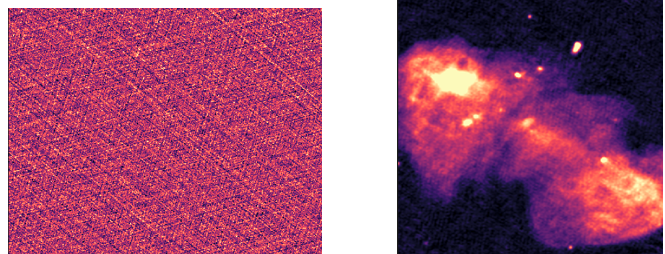
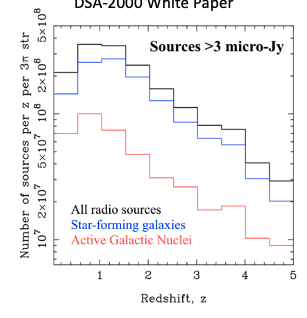
N/A
7.2 A clean history of star formation over cosmic time
Allison Matthews (Carnegie Observatories)
The DSA-2000 will detect a billion individual radio sources down to 3.5 Jy and constrain the radio population as a whole down to 15 nJy—flux density levels necessary for detecting radio emission from star formation in the first few Gyr of cosmic time. Since radio emission is a dust-unbiased tracer of star formation rate, the DSA-2000 all-sky and deep surveys will provide a truly clean and robust history of star formation throughout cosmic history.
Our understanding of SFRD evolution has been primarily driven by ultraviolet (UV), optical, and infrared (IR) observations, which are shrouded in uncertainties due to dust and the presence of older stellar populations. Getting around the dust is key to getting the science right. Radio observations have the distinct advantage of being entirely unaffected by dust and old stars. Cosmic ray electrons accelerated in the supernova remnants of massive stars produce the radio synchrotron emission associated with star-forming galaxies (SFGs). The legitimacy of radio emission as an SFR indicator rests on the tight, empirically determined FIR/radio correlation ((Helou, Soifer, and Rowan-Robinson 1985; Condon, Anderson, and Helou 1991)). However, radio observations are not without their own uncertainties. AGN can also contribute to radio emission, and ordinary SFGs are very faint at radio frequencies. Our Milky Way would have a flux density of only Jy at , the peak of star formation (cosmic noon).
Recent upgrades to the VLA and the coming online of “next generation” interferometers (e.g. MeerKAT) have enabled radio observations deep enough to detect star-forming galaxies at high redshift (see Figure 1). Initial studies of the faint radio population (Jy) indicate that the vast majority of radio sources in this flux density regime are powered by star-formation—not by AGN ((Vernstrom et al. 2016; Algera et al. 2020); see Figure 1). The most sensitive 1.4 GHz image to date was taken when commissioning the MeerKAT telescope ((Mauch et al. 2020)). By analyzing the statistics of the confusion (overlapping faint sources) in this image, (Matthews et al. 2021a) constrained the radio source count down to Jy, the necessary flux level to detect Milky-Way like galaxies beyond cosmic noon. Brightness-weighted source counts at a given redshift are proportional to the the local luminosity function modified by luminosity and density evolution. When modeling the evolution of radio sources with redshift, (Matthews et al. 2021b) found that the counts demand that there is 50% more star formation at nearly all epochs than implied by the prevailing UV/IR picture.
The DSA-2000 will reliably detect a billion individual radio sources down to Jy, even considering the effects of confusion. Unlike surveys done with higher angular resolution (), the DSA-2000 will not have to correct for resolved sources missing because they have peak flux densities below the survey limit, but integrated flux densities above that limit. These corrections have led to excessive scatter among various faint source counts that cannot be attributed to Poisson counting error or galaxy clustering alone. The DSA-2000’s large statistical sample covering a generous swath of the sky with medium angular resolution will enable direct source counts down to faint flux densities with unprecedented precision and accuracy. The implications of such a large, reliable, and complete radio sample for the study of galaxy evolution and cosmology cannot be limited to one paragraph. But for the purpose of this science case alone, the DSA-2000 will yield the first truly clean and robust measurement of the star formation history of the universe—free from uncertainties due to dust and cosmic variance.
The DSA-2000 is (almost) perfectly suited for point-source continuum science. Assuming a reliable detection requires 25 beam solid angles per source, the angular resolution of 3.5 translates to a limiting source flux density of 3.5 Jy for a blind radio survey. However, a DSA-2000 nearly-perfect Gaussian beam with minimal sidelobes () is particularly well-suited for analyzing the confusion statistics of deep images. A analysis could constrain the evolution of radio sources down to 15 nJy.
7.3 New Insights on Quasar Jet Life Cycles with the DSA-2000
Kristina Nyland (Naval Research Laboratory)
The DSA-2000 will identify 100 million active galactic nuclei (AGN). With its multi-epoch, broadband monitoring approach, the DSA-2000 will provide new insights into the physics of AGN feedback in the context of galaxy evolution. It’s sensitivity will also reveal previously “hidden" populations of AGN at high redshift, low-mass, and low-luminosity that have yet to be fully explored.
The large-scale (10’s to 1000’s of kpc) lobes of radio galaxies and quasars regulate star formation (SF) via the inhibition of cooling flows in the intracluster medium (Fabian 2012). This mode of feedback is prevalent among massive galaxies in dense environments at low redshifts. However, classical radio galaxies and quasars represent a small minority (%) of all active galactic nuclei (AGN). Recent studies suggest that compact ( kpc) jets may be common, perhaps outnumbering classical large-scale sources at cosmic noon (; e.g. Czerny et al. 2009). Compact jets may be associated with youth, lower intrinsic jet powers, interaction with a dense ISM, or shorter jet lifetimes (Jarvis et al. 2019, Patil et al. 2020, Nyland et al. 2020). Despite their prevalence, the potential impact and importance of feedback by compact jets with sub-galactic sizes, such as jets that are young or confined by a dense ISM, remains unknown.
Progress in this area requires deep, multi-epoch, broadband radio continuum data to track the evolution of growing quasar jets. A game-changing advancement in the search for young jets has recently been made possible by the Very Large Array (VLA) Sky Survey (VLASS; Lacy et al. 2020). VLASS is a multi-epoch (3 epochs over 7 years) survey at 2–4 GHz of the entire northern sky visible to the VLA (). Candidate newborn quasar jets have been identified by comparing recent data from VLASS and historical radio surveys, such as the Faint Images of the Radio Sky at Twenty Centimeters (FIRST; Becker et al. 1995) taken from 1993–2011. Nyland et al. (2020) identified a sample of 26 quasars with jets that have brightened dramatically in the radio in the past 1–2 decades by comparing FIRST and VLASS. The radio properties are consistent with young, pc-scale jets (e.g., GPS sources; O’dea & Saikia 2021) launched in the past few decades, possibly associated with a state transition of the SMBH, making them among the youngest jets known (Gugliucci et al. 2005). As VLASS and other on-going multi-epoch radio continuum surveys, such as VAST (Murphy et al. 2021), continue, additional candidate newborn quasar jets are expected to be identified.
The sensitivity, resolution, and time domain coverage of the DSA-2000 will enable fundamental new advancements in our understanding of jetted AGN and quasars. In particular, the multi-epoch + broadband spectral coverage of the DSA-2000 will identify young and growing jets on the basis of their slow radio variability (over timescales of years) and radio spectral modeling (Figure 1). This will enable direct measurements of quasar jet duty cycles and lifetimes for statistical samples of newborn quasar jets. Together with multiwavelength data from other instruments/surveys that are expected to be operating in the 2020’s (e.g. Roman, Euclid, LSST), the DSA-2000 will allow us to explore how quasar jets influence (and are influenced by) their environments over cosmic time.
N/A
| DSA-2000 baseline reference design | match to project | |
|---|---|---|
| Spatial resolution | 3.5 | sufficient for quasar-host matching |
| polarization | IQUV for 2 MHz channels, | “bonus" quasar science |
| I only for all other channels | ||
| low–resolution HI channels | 5600 channels from 0.7–1.45 GHz, | sufficient for quasar outflows |
| 134 kHz (28 km s at z=0, 56 km s at z=1) | ||
| Cadence | 1 every 4 months | quick data release turnaround preferred |
| need for additional modes | N/A | long-baseline outriggers ( imaging)? |
7.4 Where do stars explode? – A comprehensive volume-limited census of atomic gas around supernovae and their progenitors with DSA-2000
: Sumit K. Sarbadhicary (OSU), Adam Leroy (OSU), Eric Koch (CfA), Ness Mayker Chen (OSU), Erik Rosolowsky (U.Alberta), Jordan Wagner (OSU), LGLBS + PHANGS teams
With DSA-2000, we will obtain the largest sample of “supernova ISM densities” – average density of the ambient gas environments where stars inject their explosion energy. The ambient density plays a major role in the proportion of thermal vs momentum feedback from supernovae, which in turn sets the global star-formation properties of a galaxy at any given point in time. DSA-2000 will provide a much-needed observational census of such densities through simultaneous maps of 21 cm-traced atomic hydrogen and sites of stellar feedback (HII regions and supernova remnants) traced by 0.7-2 GHz radio-continuum for more than 10 galaxies in the 50 Mpc volume. The resulting measurement will serve as an indispensable benchmark for design and calibration of feedback models, which are currently the largest sources of uncertainties in galaxy simulations.
Stellar feedback, particularly in the form of supernovae (SNe), is an important regulator of the star-formation history of galaxies. Supernovae inject heat and momentum into the ISM, which drives powerful outflows that disperse gas and cycle metals through the ISM and CGM, produce ISM turbulence, amplify magnetic fields and accelerate cosmic rays that provide pressure support in the ISM, and maintain a multi-phase ISM distribution. The non-linear interplay of these phenomena set the global star-forming properties of the galaxy at any given point of its evolution.
The outcome of SN feedback however depends sensitively on the ISM density, and it is unclear apriori the range of densities where stars typically explode as a result of the complex interplay of progenitor lifetimes, molecular cloud lifetimes, and stellar kinematics. In dense molecular-cloud environments, SN energy gets quickly radiated away, while in low-density environments, energy is more efficiently retained. The locations in the ISM where SNe explode can therefore dramatically affect the distribution and filling factor of hot and cold gas, and eventually star-formation and outflow rates. An understanding of the distribution of ambient gas densities of SNe is therefore critical for the design and calibration of subgrid models of feedback, which remain the largest source of uncertainty in modern cosmological simulations of galaxy formation.
Recently, ALMA and JVLA has opened the window to sensitive imaging of the 21-cm atomic and CO-traced molecular gas down to individual cloud scales in nearby galaxies, making it possible for the first time to also probe the ‘local’ ISM environments of actual SN explosions. With the PHANGS survey of molecular ISM in nearby star-forming galaxies within 20 Mpc, Mayker Chen+ (2023) found that core-collapse SNe (Type II and Ib/c) are more likely to explode near giant molecular clouds than SN Ia, but nearly 60% of core-collapse still explode in regions of no detectable H. In Sarbadhicary+ (2023, in prep), where we had access to both atomic and molecular gas maps of M33 (thus fully accounting for the mass-filling ISM phase), we showed that younger massive stars are more likely to explode in dense molecular-dominated environment, but a significant (44%) of even these youngest ( M) stars (whose lifetimes are comparable to typical clouds) explode in the atomic-gas-dominated inter-cloud medium, likely due to pre-SN feedback clearing the parent molecular cloud of their OB associations, and some contribution from kicks from stellar interaction that deserves continued investigation (Figure 1).
While these results show the value of targeted surveys of nearby SN galaxies for such studies, an all-sky high-resolution survey like DSA-2000 will be a major leap by providing an orthogonal ‘large survey’ counterpart to this line of work as we explain below.
With DSA-2000, we will have 21-cm spatially-resolved atomic gas observations of over 15000 LMC-like-and-larger galaxies out to 50 Mpc, at an unprecedented resolution of 3.5”, enabling both cloud-scale studies (at spatial resolution of <100 pc) of SN gas environments for galaxies within 5 Mpc, and the kpc-scale environments for an even larger sample of SNe out to 50 Mpc. Within this 50 Mpc volume, current discovery statistics indicate a sample of over 300 known historical SNe (Cronin+ 2021), and an expected 50-100 future core-collapse SNe per year with Rubin-era surveys. This statistical information of SN gas environments at different spatial resolutions will be a unique and novel guide for theoretical simulations that are also carried out with different grid-resolution elements (depending on the simulated density/volume), allowing them to more closely align their input feedback physics with observations and accurately predict properties from first principles.
The simultaneous radio-continuum observations will also provide an unprecedented sample of the HII region and supernova remnant (SNR) population in these galaxies, free from extinction-related uncertainties, in the universe. HII regions will provide a census of the massive young stellar objects/OB-associations where significant pre-SN feedback (i.e. winds, radiation-pressure, photoionization) is taking place, while SNRs, particularly within 10 Mpc, will provide an additional 10-100 ‘past’ SN explosions per galaxy.
Specifications are well-optimized for the proposed science. Higher angular resolution and wider bandwidths (e.g. up to S-band), if possible, would be useful for localizing targets and obtaining higher S/N spectral index measurements (for classifying continuum sources) respectively.
7.5 Constraining models of cosmic-ray transport in L–star galaxies with DSA-2000
The physics of highly relativistic charged particles, cosmic rays (CRs), have recently been included in simulations of galaxy formation. With a variety of physical and numerical treatments, these simulations have shown that CRs may play an important role in galaxy formation and evolution, contributing a significant source of non-thermal pressure support in the circum-galactic medium (CGM) with corresponding effects on the CGM gas phase structure and transport of cool gas from the inter-galacic medium (IGM) to the disk. However, these notable effects in the CGM are dependent on the macroscopic transport rate of CRs, which are highly dependent on micro-physical, plasma-scale physics of CRs, for which there is large model variation. Current observational constraints are very limited at delineating between models of CR transport, and so novel constraints are needed. By increasing our sample of spatially resolved non-thermal emission from galaxies by orders of magnitude, DSA-2000 will provide crucial new constraints on CR transport in galaxies in both the ISM and CGM.
Highly relativistic charged particles (cosmic rays) and magnetic fields (B) have recently been included in simulations of galaxy formation (Booth et al. 2013; Marinacci, Pakmor, and Springel 2014; Butsky and Quinn 2018; Hopkins et al. 2020; Buck et al. 2020)). Injected by dying stars into the interstellar medium (ISM), CRs have long known to be an important source of non-thermal pressure in the ISM ((Boulares and Cox 1990)) and have notable dynamical and chemical effects as they traverse along magnetic field lines throughout the ISM and into the circum-galactic medium (CGM). The recent simulations of galaxy formation have predicted considerable dynamical effects of the 1-10 GeV CRs (which dominate the bolometric CR energy density) in the CGM of L galaxies - CRs have been shown to be capable of establishing significant non-thermal pressure in the halo, acting as a source of significant preventative feedback by preventing cool gas inflow to the ISM and changing the phase structure of the CGM.
While these physical effects of CRs have been noted in galaxy formation simulations with highly variant physical and numerical treatments, the macroscopic effects of CRs ultimately depends on the physics of their transport on "microscopic" plasma scales, where the dominant scattering mechanisms of CRs remain deeply uncertain (Hopkins, Chan, et al. 2021; Hopkins et al. 2022). Two popular model classes proposed in the literature are those of "extrinsic turbulence" and "self-confinement", where CRs scatter off of gyro-resonant fluctuations in B following some turbulent cascade in the fluid, and where CRs excite these gyro-resonant fluctuations as Alfven waves themselves via streaming instabilities and subsequently scatter ((Jokipii 1966; Skilling 1975)). While these model classes predict qualitatively quite different scalings of the CR scattering rate as a function of plasma properties like gas density, strength of B, ionization fraction, temperature, etc., there are model variants within these model classes remain in agreement with the existing constraints we have on CRs from Voyager and Fermi-LAT ((Hopkins, Squire, et al. 2021)).
To make further progress in this field, new observational constraints are required to determine the dominant mode of CR transport in galaxies and subsequently their effects on galaxy formation and evolution. Towards this end, we have produced synthetic synchrotron images from high-resolution, cosmological, magneto-hydrodynamic simulations of galaxy formation from the Feedback in Realistic Environments project (FIRE-2; (Hopkins et al. 2020; Hopkins, Squire, et al. 2021; Ponnada et al. 2022)) which evolve CRs using different models of CR transport described above. Preliminary results indicate that deep radio surveys sensitive to the low-surface brightness emission from galaxies will be able to provide very crucial constraints on the dominant mode of CR transport in galaxies.
The DSA-2000 will measure low-surface brightness, non-thermal emission from 10 face-on and edge-on L galaxies, which will provide crucial constraints on CR transport physics both in the ISM and in the inner CGM, where there are few extra-galactic constraints.
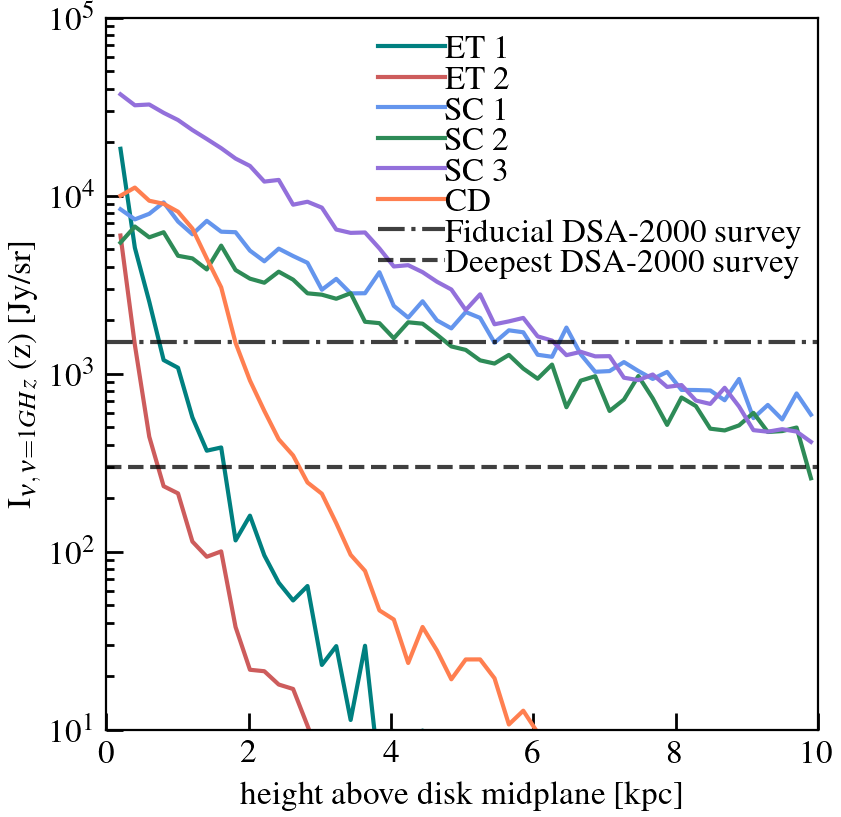
Note: could use a check on the fiducial/deep DSA-2000 lines quoted here, assumed beam of 3.5", 500 and 100 nJy/beam respectively
N/A
7.6 Compact Symmetric Objects: The Possible Connection with Tidal Disruption Events
A. C. S. Readhead, V. Ravi, I. Liodakis, M. Lister, S. Kiehlmann, and P. N. Wilkinson
Compact Symmetric Objects (CSOs) are compact ( kpc), jetted-active galactic nuclei (AGN), in which the observed emission is NOT strongly beamed towards the observer, as is the case with blazars and most other high-luminosity compact jetted-AGN. The class was introduced in order to identify a class of jetted-AGN in which the absence of strongly beamed emission towards the observer makes it possible to make accurate determinations of the physical properties of the emission regions, such as the magnetic field strength, the particle energy density, the speed of components moving along the jets, and the speed of advance of the jets through the interstellar medium. These physical quantities are difficult to determine in blazars due to the uncertainties introduced by relativistic beaming. Unfortunately, the main purpose of the classification, which was to discriminate between objects whose observed emission is strongly beamed towards the observer, and those in which it is not, was not understood by many in the astrophysics community, who interpreted the CSO classification merely as a purely morphological classification, and as a result the class has been contaminated by blazars mis-classified as CSOs. This has now been rectified by the introduction of a set of stricter criteria for inclusion in the CSO class. Two major classes of CSOs have been identified: a low-luminosity, edge-dimmed class (CSO 1), and a high-luminosity, edge-brightened class (CSO 2). A recent study of 79 bona fide CSOs has revealed that CSO 2s provide a unique time domain window on central engines of AGN and the supermassive black holes (SMBHs) that drive them, since they are (i) a distinct class of jetted-AGN with a sharp size cutoff at pc; (ii) the vast majority must be created in a manner different to other jetted-AGN; and (iii) that they might be caused by single star capture and hence provide an important link with Tidal Disruption Events (TDEs). Whatever their origin, it is clear that the systematic study of CSO 2s will be both crucial and pivotal for investigations of the launching of high-luminosity relativistic jets. The DSA-2000 is the ideal search engine for CSO 2s in view of its sensitivity, frequency coverage, polarization capability, and cadence.
To provide context, we begin with the emerging picture of the Compact Symmetric Object (CSO) Family, which is shown in Fig. 7.1. As we see, the CSO family is complex. This field has proven to be far richer than any of us at first imagined it would be, and it raises a number of crucial astrophysical questions that are listed at the end of this document.
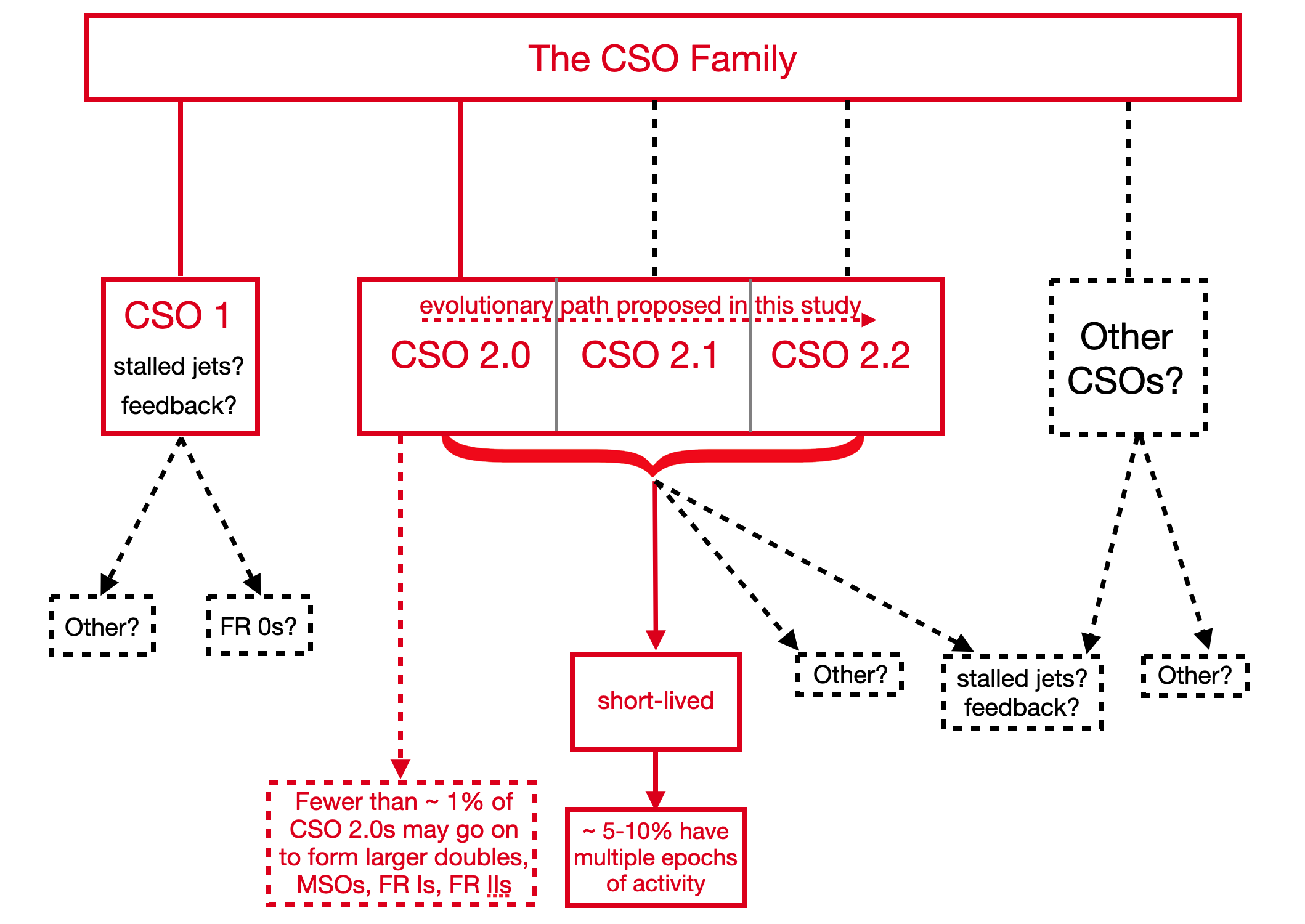
The class of CSOs was defined by (Wilkinson et al. 1994) in order to differentiate between the vast majority of compact radio sources observed in cm wavelength radio surveys, which are blazars with an asymmetric “core-jet” morphology, and the small number ( in complete samples) of symmetric objects in which the observed emission is not strongly beamed toward the observer. Since the observed emission in CSOs is predominantly unbeamed, the magnetic field strengths, particle energy densities, and total energies may easily be determined, and hence compared with these properties in larger radio sources, FR Is and FR IIs ((Fanaroff and Riley 1974)). Another crucial property of CSOs is that they are compact enough to measure the separation speeds of their outer hot spots on timescales of years to decades, making them accessible to direct prediction and verification. In other words, CSOs open the window on time domain studies of 1000 smaller analogs of FR I and/or FR II objects. Contamination of the CSO class by blazars has obfuscated their importance to studies of the central engines of AGN, and the mechanism(s) for launching relativistic jets. This has greatly hindered progress in the field. However, the criteria for inclusion in the CSO class have recently been strengthened and, following a comprehensive literature survey, a sample of 79 bona fide CSOs has now been defined by (Kiehlmann, Lister, et al. 2023).
While this study was undertaken for the sole purpose of initiating the compilation of a comprehensive list of bona fide CSOs, it was confirmed during the course of the work that CSO 2s show an upper cutoff in size at around pc, as can be seen in Fig. 7.2, i.e. well before the nominal cutoff at 1 kpc imposed by the compact selection criterion ((Kiehlmann, Readhead, et al. 2023)). Statistical tests of the size cutoff were carried out using the three complete samples of Pearson-Readhead, Caltech-Jodrell 1, and the Peacock and Wall ((Pearson and Readhead 1988; Polatidis et al. 1995; Peacock and Wall 1981, 1982; Wall and Peacock 1985)). Although these numbers are small, the Kolmogorov-Smirnov test shows that the cutoff is significant at the (p-value ) level, and the binomial test returns almost identical results. This in itself is a robust statistic that makes for a compelling case for an upper cutoff in size at pc, and age at yr. In addition, the fractions of CSO 2s relative to FR Is and FR IIs in complete samples, and the redshift distribution of CSO 2s in complete samples both provide completely independent strong corroborative evidence that CSO 2s constitute a population of jetted-AGN that is distinct from the other classes of jetted-AGN, including compact steep spectrum(CSS) objects, medium symmetric objects (MSOs), FR Is and FR IIs, and must therefore have a significantly different physical origin than these other classes. Simple intermittent fueling, for example, cannot cause a sharp cutoff in the distribution in physical sizes such as that seen in Fig. 7.2. There must be an upper limit to the fuel available, which is why we favor the single star capture hypothesis, where the initial mass function provides the kind of upper limit that is needed.
A study carried out by (Readhead et al. 2023), of the 54 bona fide CSOs identified in (Kiehlmann, Lister, et al. 2023), which have spectroscopic redshifts, shows that CSOs are differentiated by morphology in the luminosity-size plane, in a way that is likely due to evolution. The distribution of CSO 2s in the plane provides a powerful approach to questions of the variation of luminosity and the speed of advance of the jets with size and age in jetted-AGN. Studies of the energies required show that these are consistent with what might be supplied in the capture of a single star by a supermassive black hole in a galactic nucleus. The most luminous CSO 2s would require to be fueled by the capture of a massive star, and these have been found to spend enough time with their envelopes in the size range that can be disrupted by an SMBH, as can be seen in Fig. 7.3. Furthermore, the observed CSO 2 birthrates are consistent with those of jetted tidal disruption events (TDEs) (see Fig. 7.4).
Thus the known facts about CSO 2s are consistent with the hypothesis that most CSO 2s are formed by the capture of a single star by a quiescent SMBH in the nucleus of an elliptical galaxy. A very important scenario to be tested is that of a single star, tidally disrupted by an SMBH, providing magnetic field to the ergomagnetosphere, and the trapped magnetic flux providing the power to launch a Blandford-Znajek powered relativistic jet ((Blandford and Znajek 1977)). Were this scenario for extracting spin energy from the SMBH to work for CSO 2s, it might also work for other, larger, jets. This could bring about a fundamental shift in our understanding of the launching of relativistic jets in AGN.
Key Astrophysical Questions Arising from Recent CSO 2 Studies: . Is the cutoff in CSO 2 sizes shown in Fig. 7.2 real or are we being misled by small numbers? . If the cutoff is real, then what causes this? . Are the vast majority of CSO 2s caused by the capture of a single star by an SMBH in a galactic nucleus, as hypothesized by (Readhead et al. 2023)? . If not, then does their energy derive from the spin of the SMBH, as hypothesized by (Readhead et al. 2023), or from the accretion disk, in manner similar to that operating in dwarf novae, and if not one of these mechansisms where does their energy derive from? . Is the distribution of CSO 2s in the plane telling us that the jet power is constant or increasing with size in CSO 2s? . Will the smallest CSO 2s resolvable at higher frequencies, or with a Near Earth Orbiting satellite, provide a useful test-bed for the early life of FR IIs, when we know that the jet power must be increasing?
These are all interesting questions that have the potential of opening a completely new window on jetted-AGN, and very likely causing paradigm shifts in our understanding of AGN, by uniting time domain studies (and possibly jetted tidal disruption events) with structural VLBI studies. Our hypotheses and questions are far from proven or answered, but they are intriguing enough to make arguments for further study compelling.
These hypotheses and questions can be addressed comprehensively only by increasing the number of CSOs in complete samples by several orders of magnitude. We must increase the numbers of CSOs to the 1000s and push down in the luminosity function by three orders of magnitude so that low luminosity CSOs can be observed at high redshifts. We anticipate very rapid growth in studies of CSOs with the DSA-2000 playing a critical role in what will have become a major new area of study of AGN, relativistic jets, tidal disruption events, and stellar populations in the environs of SMBHs in the nuclei of elliptical galaxies.
Existing facilities can, at most, increase the sample of CSOs under study to about 100 bona fide CSOs in complete samples. This will be sufficient to confirm indisputably, the sharp cutoff observed in CSO 2s by (Kiehlmann, Readhead, et al. 2023) in just the 17 objects shown in Fig. 7.2. However, it is essential to extend the numbers of CSO 2s to the 1000s and to push down in the luminosity function by three orders of magnitude to where low luminosity CSO 2s can be observed at high redshifts. The DSA-2000 is the ideal CSO 2 search engine in view of its frequency coverage and sensitivity and cadence. CSO 2s show fractional variability of less that 20%/yr, and the cadence of once every 4 months is ideal for discriminating between CSOs and blazars. The DSA-2000 will identify many thousands of compact, slowly varying radio sources which will be CSO candidates that can then be followed up with ground-based VLBI that includes at least one large antenna, such as the GBT, which is needed to reach the required sensitivity levels. We are, in parallel, developing the case for a Near Earth Orbiting (NEO) satellite to extend the resolution by a factor 2.5 and provide exceptional dynamic range, that would enable CSO 2s of size 1 pc to be imaged and the structural variations to be monitored. The DSA-2000 is therefore essential for opening this important new window on SMBHs and the launching of relativistic jets.
N/A
7.7 Census of relativistic jets at the highest redshifts
Eduardo Bañados (MPIA), Fabian Walter (MPIA)
Relativistic radio jets are thought to be important for black hole growth and co-evolution with host galaxies. The DSA-2000 will provide a complete census of radio jets to the epoch of reionization at , reaching more than one order of magnitude deeper than even the deepest existing L-band observation of a source at this cosmic epoch. The DSA-2000 will also reveal young jets turning on/off and play a key role in unveiling the obscured accreting supermassive black holes in the early Universe.
Quasars—powered by accreting supermassive black holes (SMBHs)—are among the most luminous objects known in the Universe. They can be found and studied in detail to the highest redshifts. The last decade has seen a surge in the population of SMBHs within the first Gyr of the Universe, the so-called epoch of reionization. Now more than 500 quasars are known at ((Fan, Bañados, and Simcoe 2023)). The current redshift records are at ((Bañados et al. 2018; F. Wang et al. 2021)), but the most distant of such quasars with known powerful relativistic radio jets is at ((Bañados et al. 2021)).
Most current efforts focus on identifying type-I or unobscured quasars. However, radio emission prevails even in cases of extreme obscuration ( cm). It can therefore be used to aid the selection of obscured quasars, which might be one of the prevalent modes of SMBH growth. Recently, (Endsley et al. 2022) identified the first obscured quasar at , thanks to strong radio emission (Fig. 7.5). Notably, this obscured quasar was found in the 1.5 deg COSMOS field, while similar but unobscured quasars are much rarer (deg; (Endsley et al. 2023))
Powerful radio jets are thought to play a key role in SMBH growth and SMBH/galaxy co-evolution ((Volonteri, Silk, and Dubus 2015; Hardcastle and Croston 2020)). Moreover, the identification of radio sources at the highest redshifts will enable unprecedented studies of the epoch of reionization by detecting 21 cm absorption due to the intervening neutral intergalactic medium ((Thyagarajan 2020)). The identification of a larger number of jetted sources has been mainly limited by the sensitivity of all-sky radio surveys (Fig. 7.5).
DSA-2000 will provide a complete census of relativistic jets within the first Gyr of the Universe. Indeed, DSA-2000’s unprecedented all-sky sensitivity will detect sources with W Hz at . At those luminosities, we will detect not only relativistic jets but also sources like the local high-excitation radio galaxies, whose radio emission is from a combination of AGN and star formation, a regime thus far unexplored at high redshift ((Ceraj et al. 2018)).
Time domain quasar studies at high redshift are in their infancy. Recent multi-epoch radio surveys like VLASS have revealed significant radio variability on a couple of radio-bright quasars, measurable in just a few years ((Bañados et al. 2023)). The proposed cadence for DSA-2000 will not only enable an additional method to select the highest redshift AGN but it can also identify young jets turning on/off and constrain SMBH growth models ((Nyland et al. 2020)).
DSA-2000, in combination with the new generation of optical/NIR all-sky surveys (e.g., Rubin/LSST, Euclid, Roman), will enable the discovery of obscured AGN, which are thought to be an important phase for SMBH growth. These obscured AGN are expected to outnumber the type-I quasar population, but thus far, only one is known in the epoch of reionization ((Endsley et al. 2022), see Fig. 7.5).
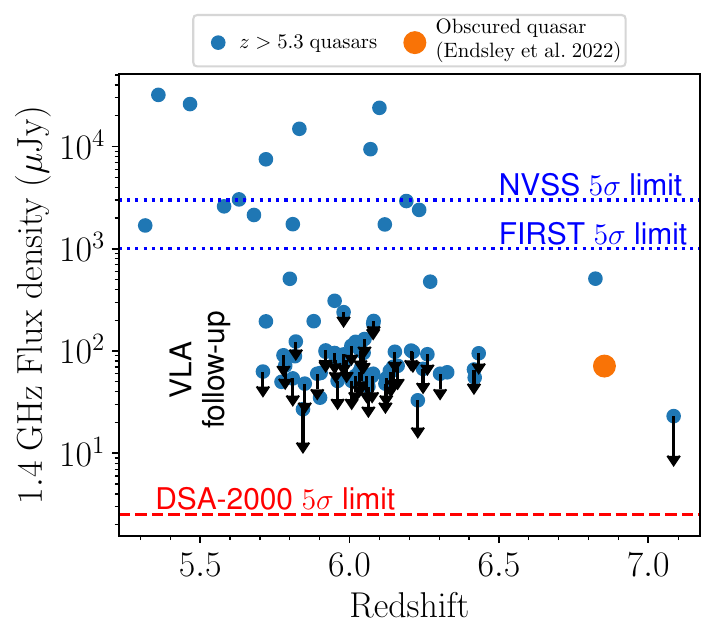
The baseline design is already an excellent match to the high- quasars science case. If possible, pushing to lower declinations would have a critical positive impact on the census of the earliest jets, even if the sensitivity is slightly worse than the rest of the survey.
| DSA-2000 baseline reference design | match to project | |
|---|---|---|
| Declinations | -31 | OK, but the lower, the better |
| Spatial resolution | 3.5 | 18 kpc at . Unresolved. |
7.8 Weak Lensing Cosmology with the DSA-2000
Liam Connor
Weak gravitational lensing is a powerful probe of the Universe’s composition and expansion history, and is an essential tool for constraining the physical nature of dark energy. Weak lensing imparts a distortion on distant galaxy shapes known as “shear”, causing a separation-dependent correlation between galaxy shapes that is determined by the Universe’s large scale structure and its evolution with time. Measuring the power spectrum of this cosmic shear allows us to constrain the cosmological parameters. The large number of radio galaxies detected by DSA-2000 could enable the first significant radio weak lensing experiment. This would require a serious effort in shear calibration and super-resolution, but may end up being a powerful independent probe of cosmology. See our paper for more details7.
Nearly all significant advances in weak lensing cosmology have come from Optical/IR and CMB data. In the radio, few surveys thus far have had sufficient angular resolution, sensitivity, and sky coverage to detect the large numbers of SFGs required to do weak lensing cosmology. However, there may be an opportunity with the DSA-2000 to carry out a valuable weak lensing survey thanks to its enormous number of galaxies and their deep redshift distribution. Based solely on the areal density of sources and their redshift distribution, DSA-2000 has significantly more constraining power than DES or SKA1-mid, and is comparable with Euclid. If it worked, having a radio weak lensing measurement would be a valuable complement to upcoming OIR experiments, because the lensing signal is chromatic while systematics are not. It must be said, however, that weak lensing is very difficult and is typically systematics limited. Many person-years have been spent preparing for weak lensing analysis on Euclid, LSST/Rubin, and Roman, not to mention the work that has already been done on the Dark Energy Survey (DES) or in the CMB. For this reason, a weak lensing experiment on DSA-2000 would require a concerted effort and imported expertise from the OIR; a single radio astronomy postdoc almost certainly could not do this alone.
Here I offer the strengths and weaknesses of the DSA-2000’s WL prospects.
Pros:
-
Large number of sources, good areal density, and deep redshift distribution
-
PSF can be forward modeled, known a priori (unlike OIR)
-
Polarization information for intrinsic alignment
-
Provides a complementary measurement to OIR WL experiments, where systematics are different
The last bullet may be the most significant. WL is a primary science driver for space-based NIR experiments such as Euclid and Roman, not to mention surveys such as LSST. For this reason, a measurement of the same signal but at radio wavelengths could be valuable. We could cross-correlate the two surveys, allowing for the mitigation of systematics.
Cons:
-
Relatively poor resolution (3.5’’) compared with small median SFRG size (0.5’’)
-
Calibration / analysis infrastructure does not exist for WL at long wavelengths
-
Requires super-resolution—implications of such algorithms on shear calibration is not clear
-
Need redshifts. SPHEREx galaxies catalog could be used, but needs to be folded into an analysis pipeline
POLISH requires image plane data and a well-understood PSF. As long as both are available, a model can be trained for deconvolution and super-resolution.
7.9 Strong gravitational lensing on DSA-2000
Liam Connor
Strong gravitational lensing of distant galaxies enables a variety of applications in cosmology and astrophysics. The dark matter distribution in lensing halos can be constrained, time-delay cosmography of special systems provides a measurement of H, high redshift sources can be discovered that would not have been detectable in the absence of lensing magnification, etc. Strong lensing is a rare phenomenon, meaning a large sample of extragalactic sources is required to amass a sizeable collection of lensed systems. Lensing is also highly redshift dependent, with an optical depth increasing as for sources within 1.5. DSA-2000 is therefore an excellent survey instrument for a strong lensing sample: It will find 1 billion radio sources with a significantly deeper redshift distribution than strong lensing surveys in the OIR such as LSST/Rubin and Euclid. One limitation is the DSA-2000’s moderate spatial resolution, which will limit the number of systems whose Einstein radius is below our PSF scale. We argue that this can be mitigated with super-resolution, allowing for the discovery of strong lenses in the CASS.
To date, there are only known strong lensing systems. Fewer than 10% are detected in the radio. However, upcoming OIR surveys will find tens of thousands of lenses led by the Rubin Observatory and Euclid. One significant hurdle will be identifying strongly lensed galaxies in the enormous datasets that coming wide-field experiments will produce. Indeed, a sub-discipline of strong lensing has emerged whose goal is to develop the best lens-finding algorithms. Metcalf et al. (2018)8 compared 24 lens finding algorithms on a mock survey. The models that performed the best were typically learning based. On DSA-2000 we will have to build a custom lens finding model that knows about our PSF and the morphologies of radio continuum sources. This will likely be a convolutional neural network. We will have to fold in multiwavelength information to confirm lens candidates, for example identifying a lens galaxy in NIR with SPHEREx.
The DSA-2000 could increase the sample of radio strong lenses by a factor of . My impression, as an outsider, is that the name of the game is to find as many systems as possible such that one can identify special systems for each application. For example, time-delay cosmography requires multiply imaged time-variable quasars behind lensing galaxies whose mass distribution can be easily modelled. In Wong et al. (2019)9 the authors use just six lensing systems as a gold sample. “Jackpot systems” have two Einstein rings–rare events that require a much larger sample to identify. Many of these lensing systems will be co-detected by Roman, Rubin, or Euclid. This multiwavelength information will be valuable for studying special systems and for confirming each survey’s candidates. In addition, radio polarimetry allows one to measure the magnetic field strengths of lensing halos thanks to differential Faraday Rotation.
As long as the antenna configuration remains roughly the same, most choices that will impact strong lensing can be made in software. POLISH requires image plane data and a well-understood PSF. As long as both are available, a model can be trained for deconvolution and super-resolution.
7.10 Deep radio surveys as a powerful complement to next generation (sub)mm wave surveys.
Scott Chapman, Ryley Hill, South Pole Telescope collaboration
The SPT-SZ survey unexpectedly identified 85 bright, dusty point sources (SmJy), 90% of which ALMA showed were strongly lensed submm galaxies (SMGs). However, 10% have been characterized as unlensed, dense cores of =3-7 protoclusters of galaxies with integrated SFRs10,000 M/yr. Radio-AGN in massive clusters are important for feedback in the intra-cluster medium (ICM) and central brightest cluster galaxy. The radio loud AGN detected by ATCA in the SPT2349 protocluster is of pivotal importance for understanding and interpreting the early forming structure. Deep MeerKAT followup has characterized the radio spectral index and detected star forming cluster members. Radio observations have the unique possibility to efficiently followup and identify these mm-wave sources in large surveys. In addition to providing positions, the strength of the radio emission itself can separate AGN from star forming sources. DSA-2000 can play an important synergistic role with upcoming (sub)mm-wave suverys like CCAT-prime and CMB-S4.
The South Pole Telescope (SPT) survey ((Carlstrom et al. 2011)) covering 2500 deg was initially aimed at a Sunyaev-Zeldovich (SZ) cluster survey along with primary CMB science. The second generation receiver, SPT-Pol, brought polarization sensitivity over 1000 deg and the first maps of the B-mode CMB polarization allowing characterization of the lensing B-mode spectrum. Currently SPT is in it’s third generation survey, “3G”, covering 1000 deg to unprecedented depths at 1.4mm, 2mm, and 3mm.
The SPT-SZ survey unexpectedly identified 85 bright, dusty point sources ((Vieira et al. 2010)), 90% of which are strongly lensed submm galaxies (SMGs), unveiled by ALMA ((Vieira et al. 2013)). However, 10% appeared to be unlensed, incredibly luminous sources in the far-IR. ALMA followup has revealed that they break up into numerous submm sources, and has shown them to be candidate cores of =3-7 protoclusters of galaxies ((Miller et al. 2018); (Chapman et al. 2023)). The SPT-3G survey is increasing these numbers by 100, paving the way to find many hundreds of such forming clusters of galaxies, but making followup challenging. Future surveys such as CMB-stage4 will do the same over the majority of the accessible sky from Chile.
Radio observations have the unique possibility to efficiently followup and identify these mm-wave sources. In addition to providing positions, the strength of the radio emission itself can separate AGN from star forming sources. A recent example is in the SPT2349-56 protocluster at =4.3 ((Miller et al. 2018); (Hill et al. 2020); (Rotermund et al. 2021), (Chapman et al. 2023)). This system is the brightest ‘unlensed’ SPT source found in SPT-SZ. The 1 ‘point source’ found by SPT has now been resolved by ALMA into 35 far-infrared luminous galaxies at 4.3. Their total L-IR is more than 10 L, corresponding to a SFR of almost 20,000 M/yr. Perhaps its most defining characteristic is that it is the most concentrated protocluster system known, and may represent the progenitor of the most massive present day cluster in the Universe, even more massive than the Coma cluster.
Curiously, no AGN were originally identified in SPT2349 in any (sub)mm or optical indicators, at odfds with protoclusters typically having overdensities of AGN/QSOs, or even being identified by them in the first place. ATCA observations at 2 GHz (25Jy RMS) were recently able to identify a luminous radio-loud AGN in the core of SPT2349. Deep MeerKAT followup at 816 MHz (7Jy RMS) were then able to robustly characterize the radio spectral index, and even detect several other cluster members through their star forming radio-FIR correlation. For context, with radio surveys at W/Hz (e.g., NVSS – Condon 1998), with source densities about 1/100 arcmin, sources are identified out to redshifts of 5, and all are radio-loud AGN. Between and W/Hz (e.g., JVLA deep surveys with Jy sources and 4/arcmin), radio sources are mostly star forming galaxy hosts. However, we caution that only 10% of AGN are radio-loud, and radio on its own is not a complete survey of AGN.
Radio-AGN in massive clusters are important for feedback in the intra-cluster medium (ICM), regulation and growth (evolution) of the cluster core and central brightest cluster galaxy. Thus detecting the radio loud AGN in SPT2349 is of pivotal importance for understanding and interpreting the early forming structure. As in Chapman et al. (2023), we can use the radio power to estimate (lower limit) jet power, and therefore energy injection into the ICM. They concluded that for SPT2349, this is sizeable amount of energy given the potential well of the M halo constrained from the velocity dispersion of the cluster. The radio power can even be reasonably used to infer a range of likely Xray luminosities (to within a factor of order 10), and from that derive the accretion rates onto the super massive black hole, setting the stage for targeted X-ray followup.
For the SPT-3G survey, these studies suggest that we should get the best/deepest radio data we can on protocluster sources and study the radio-loud AGN, as well as the other cluster members. Indeed we should study all SPT sources in the radio. To this end, a large MeerKAT program is underway (PIs: Roger Deane, Joaquin Vieira), aiming to match this 7Jy RMS depth at 816 MHz over 100 deg.
The capability of DSA-2000 ((Gregg Hallinan et al. 2019)) in surveying large areas (1000’s of deg) at even greater sensitivities is an obvious synergy with upcoming surveys at (sub)mm wavelengths with CCAT-prime, Simons Observatory, and CMB-S4, and in the longer term with 30-50m submm wave single dish telescope concepts such as ATLAST. Radio observations have the unique possibility to efficiently followup and identify these mm-wave sources. In addition to providing positions, the strength of the radio emission itself can separate AGN from star forming sources. The DSA-2000 sensitivity will identify and classify many 100,000’s of mm-wave sources out to redshifts of even 10.
N/A
7.11 AGN polarimetry
Mark Lacy (NRAO)
The DSA-2000 will measure the polarization properties of 3 million active galactic nuclei (AGN). This will enable vastly improved studies of foreground Faraday screens due to the Milky Way and nearby galaxy clusters, as well as statistical studies of depolarization of AGN by their surrounding haloes.
Faraday rotation – the rotation of the plane of polarization by a magnetized plasma proportional to the integral of the line-of-sight magnetic field times the electron density – is an important diagnostic of cosmic magnetic fields. AGN can provide valuable insights into the properties of magnetized plasma in two ways. First, the plane of polarization of background AGN can be Faraday rotated by foreground screens such as the Milky Way, or the intracluster medium of an intervening cluster of galaxies. Second, magnetized plasma in the immediate environment of the radio source (perhaps mixed with synchrotron-emitting plasma) can lead to large amounts of Faraday rotation and consequent depolarization.
7.11.1 AGN as background sources
By using the Faraday rotation of polarized light from background AGN we can map the magnetic field of the Milky Way. The resolution of this map is constrained by the density of AGN on the sky whose Faraday rotation can be accurately measured. Using the NVSS survey, with a polarized source density deg (Taylor et al. 2009) naturally limits the resolution to degree scales, though some areas of the sky now have better coverage e.g. from LoFAR (Hutschenreuter et al. 2022). Future surveys such as POSSUM (Anderson et al. 2021) will deliver even denser backgrounds, deg, and also allow the Faraday screens due to foreground galaxy clusters to be mapped (Figure 1).
7.11.2 Polarization as a diagnostic of AGN environments
Synchrotron radiation is emitted with an intrinsic polarization of %, but a typical radio AGN has a measured polarization of only % (Beck & Gaensler 2004; Hales et al. 2014). Some of this depolarization is due to line-of-sight and beam averaging, but much also arises in the immediate environment of the source itself. Detailed studies of polarized radio sources (e.g. Baidoo et al. 2023) show that the depolarizing medium has structure on kpc scales. While it is often unclear whether the depolarization occurs in the immediate vicinity of radio lobes, or further out in the halo of the host galaxy and any surrounding cluster, statistical studies, e.g. of the Laing-Garrington effect (an anti-correlation of jet-sidedness with depolarization; Laing 1988; Garrington et al. 1988) and studies of the depolarization of sources as a function of redshift (e.g. Goodlet & Kaiser 2005) suggest that at least some of the depolarization is from the halo. However, only a few tens of sources have been studied to date, making definitive conclusions difficult to draw.
The dense background of polarized sources expected from DSA-2000 ( deg) will greatly increase the possible range of Faraday screen studies. In particular, detailed studies of the magnetized ICM of nearby galaxy clusters could be carried out. The higher angular resolution than prior studies at GHz will result in less depolarization within a beam, increasing the signal-to-noise for polarized light. Combining DSA-2000 polarimetry with VLASS (Lacy et al. 2020) will result in thousands of sources with well-measured depolarization from 0.7-4 GHz at arcsec resolution, allowing large-scale statistical studies of the evolution of magnetic fields and turbulence in the galaxy/cluster haloes surrounding AGN.
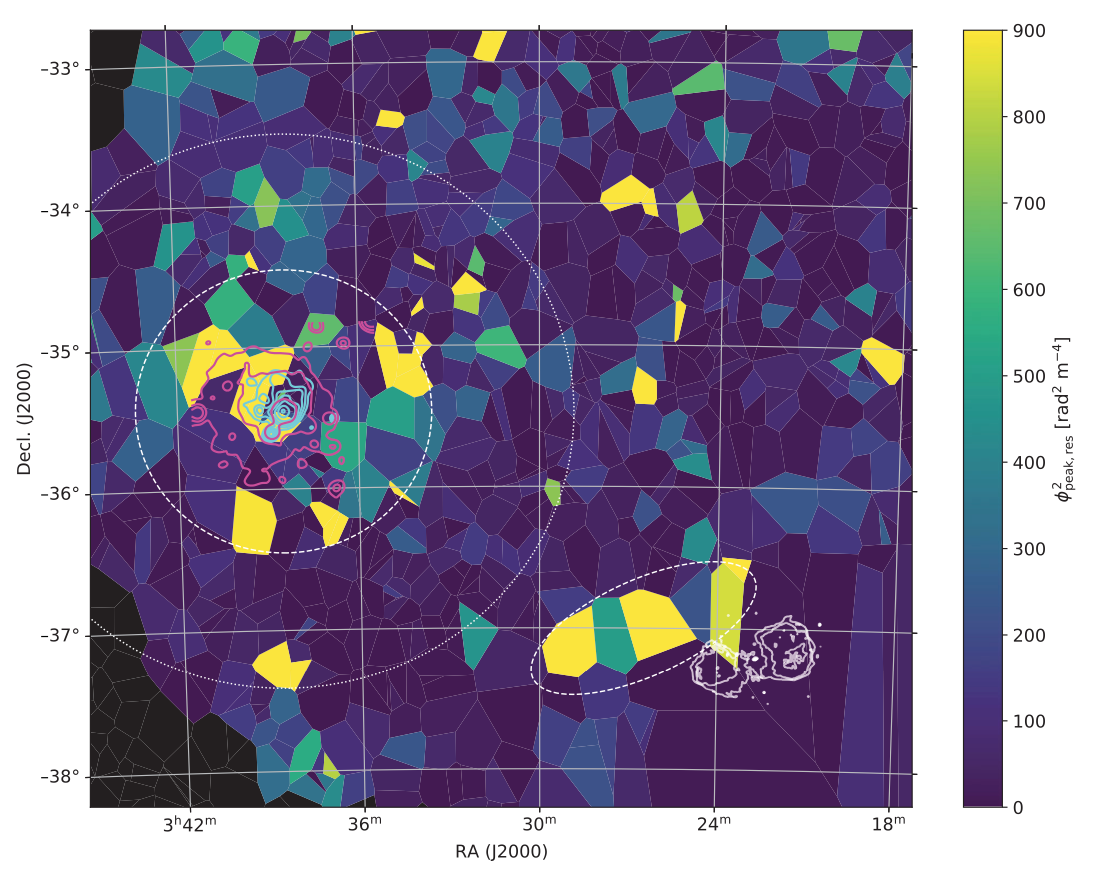
8 Our Cosmic History: Atomic Hydrogen (and other Spectral Lines)
Summary: Cosmic History: Atomic Hydrogen
S. E. Clark (on behalf of the SAC) DSA-2000 will use the 21-cm emission line of atomic hydrogen (HI) to study the detailed distribution of gas in the Milky Way, the reservoirs of gas in nearby galaxies, and the early epochs of structure formation in the universe. There are additional opportunities for DSA-2000 to map other spectral lines, in particular OH and radio recombination lines (RRLs). Storing full-Stokes information for spectral line observations would enable measurements of the line-of-sight magnetic field strength via the Zeeman effect in HI and potentially in OH.
The current baseline design of DSA-2000 is well-suited for studying the evolution of HI in galaxies over cosmic time. DSA-2000 will detect HI in millions of galaxies out to , and will resolve many of these systems out to . These observations will result in a measurement of the HI mass function as a function of redshift (Section 7.1), and will aid the search for electromagnetic counterparts to gravitational waves (Section 7.12). Additionally, the large population of resolved galaxies will enable statistical studies of the kinematics and morphology of gas-rich galaxies (Section 7.2). In the nearby (D 100 Mpc) universe, measurements of rotation curves for resolved galaxies would provide an unbiased census of dark matter density profiles, and thus an important constraint on galaxy evolution theory (Section 7.7). Science with the resolved galaxy population depends on the column density sensitivity of DSA-2000, so augmenting the column density sensitivity via a short baseline array would enhance this science. Additional channels in Zoom Band A could push the completeness of the resolved galaxy population out to 200 or 300 Mpc.
Closer to home, DSA-2000 is capable of making ultra-deep observations of nearby, low-surface-brightness galaxies. Such measurements are important for studying gas cold accretion and galaxy assembly over the full galaxy mass range (Section 7.6). There are two strategies that DSA-2000 could pursue in order to become competitive with MeerKAT for this science: one is to add a compact core, and another is to make deep (50 hour) observations of selected fields. DSA-2000 can also contribute to a large survey of hydrogen radio recombination lines (RRLs), toward times more sources than are accessible with other upcoming HI surveys (Section 7.9). This science case would strongly benefit from increased spectral resolution in the low-resolution HI channels, as well as increased frequency coverage.
DSA-2000 will make several major contributions to the study of our own Galaxy. High surface brightness sensitivity is critical for the study of diffuse Galactic HI emission, and so the planned DSA-2000 all-sky HI emission survey would be dramatically improved by the addition of a compact array. The high spectral resolution of Tuneable Zoom Band B is capable of resolving cold HI structures in the Galaxy, but increasing the bandwidth could be important for detecting high-velocity gas toward regions such as the Galactic center (Section 7.8). DSA-2000 will produce a sensitive survey of HI absorption over a large region of sky, providing important constraints on the thermodynamic state of the ISM (Section 7.4). However, the current baseline design misses the opportunity to store full-Stokes polarization data in the zoom bands, which would enable critical, direct measurements of interstellar magnetic field strengths via Zeeman splitting of the HI line (Section 7.4) and potentially also of OH, with the addition of further zoom bands (Section 7.8). These measurements would provide crucial information on the magnetic field in the diffuse and molecular ISM, respectively.
Finally, DSA-2000 can also be used as a line-intensity mapping experiment, probing late-time cosmology via measurements of the statistical distribution of 21-cm line emission at (Sections 7.10, 7.11). The current baseline design offers several advantages over competing experiments, including calibration, systematics, and sidelobe properties that will reduce the foreground leakage that plagues most 21-cm power spectrum measurements. However, this science case would be greatly enhanced by the addition of a compact core array, which would be enabling for measurements of baryon acoustic oscillations.
8.1 Resolved multiwavelength and kinematic studies of atomic gas in all the local galaxies
Adam K. Leroy
The proposed DSA 2000 would produce high quality measurements of the structure, quantitative morphology, and kinematics of K local galaxies out to Mpc. Existing or planned all-sky multiwavelength coverage that will capture the structure of stars, recent star formation, star clusters, and more for the same samples of galaxies. Combined, this would usher in new era of “big data” for resolved, panchromatic studies of galaxy evolution. The resulting measurements would have the promise to revolutionize our view of (1) how accretion, gas flows, and feedback shape galaxies, (2) how environmental regulates the efficiency of the matter cycle in galaxies, and (3) the link between dark matter and baryons in galaxies. Further, the massive multiplexing power of the DSA 2000 opens the window to truly revolutionary statistical measurements of the extended atomic gas reservoirs and both Galactic and extragalactic 21-cm absorption.
Most of the gas in the disks of galaxies at is atomic hydrogen (Hi) ((e.g., Saintonge and Catinella 2022a)), and this is likely true across almost all redshifts ((e.g., Tacconi, Genzel, and Sternberg 2020)). Though stars form directly from molecular gas, observations of the atomic gas capture the ultimate reservoir of material for star formation. Comparing the atomic gas to the distribution of recent star formation over a part of a galaxy represents an important probe of the overall efficiency of the gas-stars-feedback “matter cycle” that governs the buildup of galaxies. Meanwhile, the extended structure of the gas ((e.g., J. Wang et al. 2016a)) means that the Hi kinematics represent one of our most powerful ways to trace the dark matter in galaxies (e.g., (Bullock and Boylan-Kolchin 2017)). All of this makes resolves 21-cm mapping of galaxies, which traces the mass and kinematics of the Hi, critical to probe a tackle a series of big, open astronomical questions.
Although 21-cm observations represent one of our oldest methods of tracing the interstellar medium in galaxies ((Kerr, Hindman, and Robinson 1954)), the faintness and low frequency of the line have made it challenging to obtain large samples of high quality, high resolution 21-cm maps of galaxies. At present, a few hundred to 21-cm maps of good quality (resolution and sensitivity to cm) exist from the combined efforts of previous-generation radio telescopes, compared to integrated 21-cm measurements for 10,000s of galaxies.
Meanwhile, recent and upcoming facilities are mapping the whole sky at these resolution across the electromagnetic spectrum, providing a resolved view of the recent star formation, stellar content, and more for local universe galaxies. WISE, GALEX, SDSS, and soon Rubin/LSST, SphereX, and perhaps UVEX, and more will cover the sky from infrared to ultraviolet wavelengths at a resolution sufficient to resolve local universe galaxies (out to Mpc). The multiwavelength coverage means that we have (or will soon have) a resolved view of the stellar population, star formation rate, and structure of the stellar disk in essentially all local galaxies.
The DSA-2000 would yield high S/N, resolved 21-cm maps of local Mpc galaxies of all masses. This would represent an order of magnitude increase over current samples of 21-cm mapping, and would combine with this existing or planned panchromatic all-sky coverage to yield a complete, resolved view of baryons in across all types of galaxies. This would yield local measurements of the efficiency with which the “matter cycle” converts gas to stars, measure the morphology of the ISM across the star-forming main sequence, map out the halo mass-stellar mass relation for galaxies, and more. The complete sky coverage would also open the door to incredible stacking experiments, probing the atomic gas out into the CGM and potentially revealing the physical state of the atomic gas in the Milky Way and other galaxies via stacked absorption studies.
These all-sky multiwavelength surveys (and the lack of similar high resolution, high sensitivity 21-cm surveys for the northern sky) represent a huge opportunity for a telescope like the DSA-2000. Using the “zoom bands” and focusing on the 21-cm line, the proposed facility would yield: (1) 21-cm maps that could be compared to measurements of star formation, stellar mass, and more to measure the efficiency of the “matter cycle” and the structure of the neutral gas reservoirs in galaxies, (2) 21-cm kinematics that, together with measurements of the stellar structure probe the structure of dark matter in galaxies, and (3) absorption measurements against background continuum sources that probe the physical state of the atomic gas in our galaxy and others.
Concretely, based on likely sensitivity estimates in March 2023, a DSA-2000 h-per-point all-sky survey would detect the canonical edge of the Hi disk of galaxies, typically taken to be M pc, at S/N at resolution (the performance could be even better depending on the exact design of the array). Based the Hi mass-size relation of (J. Wang et al. 2016a), this would allow the DSA-2000 to resolve (placing resolution elements across) an galaxy like the Milky Way at Mpc, a dwarf spiral like the LMC at Mpc, a dwarf like the SMC at Mpc, and galaxies analogous to the smaller Local Group dwarfs out to Mpc. Based on the HyperLEDA database ((Makarov et al. 2014)), there are “Milky Ways” known out to Mpc, “LMCs” out to Mpc, “SMCs” out to Mpc, and analogs to Local Group dwarfs out to Mpc. Thus even leaving aside the exciting prospect of discovering many new dwarf galaxies, the DSA-2000 can be expected to provide resolved maps of the distribution and kinematics of atomic gas in galaxies. This on its will represent an order of magnitude improvement over the results of the previous several decades of 21-cm mapping using the VLA, WSRT, GMRT, and ATCA.
These data have immense scientific potential. We highlight three direct applications of the DSA-2000 survey here. First, the data would allow resolved, quantitative Hi morphology measurements for all of these galaxies, which can then be immediately related to to the stellar mass and star formation rate of each galaxy to chart out how the distribution of atomic gas within galaxies determines their current properties and future evolution (a topic that has been highly productive in understanding evolution of galaxies in cluster environments, e.g., (L. Cortese, Catinella, and Smith 2021)). Second resolve kinematic measurements paired with stellar structure, environmental metrics, and stellar mass mass estimates promise to populate the stellar mass halo mass relation with tens of thousands of diverse, well-understood galaxies, which should yield critical insight into both galaxy assembly (e.g., (Wechsler and Tinker 2018)) and the nature of dark matter (especially from well resolved, low mass, low baryon fraction galaxies, e.g., (Bullock and Boylan-Kolchin 2017)). Third, for each galaxy, the combination of the DSA-2000 and panchromatic data will measure the local balance of neutral gas to current star formation activity. This will chart how effective each part of each local galaxy is at concentrating the gas into cold, dense, star-forming objects. This efficiency is well-known to vary within galaxies, e.g., as a function of local stellar surface density, interstellar pressure, or metallicity (e.g., (Leroy et al. 2008)), but to date we lack the “big data” needed to complete a general, tested theory that covers the full matter cycle in galaxies.
The potential of the DSA-2000 is even higher when one considers the combination of multiwavelength all sky surveys with this new 21-cm mapping. From the multiwavelength data we will have an excellent prior idea of the mass, orientation, location, and other properties of each galaxy. The all-sky DSA-2000 coverage should, in principle, be well-suited to coherently average the emission from hundreds, or even thousands of similar galaxies. This allows the prospect of statistical “ultradeep” experiments probing low column density Hi via stacking or cross-correlation or more advanced techniques. In the simplest term, simply averaging 4 h DSA-2000 observations of 10,000 Milky Way mass galaxies would yield the equivalent (in some ways) of a 40,000 h stare towards the galaxies with a current generation interferometer. Though there are caveats this increase in surface brightness sensitivity may represent the critical leap to reach the column densities expected for the neutral CGM and so offer a powerful probe the most mysterious (but critical) portion of a galaxy’s gas reservoir (e.g., (Tumlinson, Peeples, and Werk 2017)).
The directions above describe possibilities for emission based studies, but 21-cm absorption also has large scientific potential. Atomic gas in galaxies spans K and cm, and while 21-cm emission is equally sensitive to all gas, the optical depth accessed by absorption is sensitive to temperature and is key to diagnose the physical state of the gas (e.g., (Claire E. Murray et al. 2018a)). To date, 21-cm absorption studies have been mainly restricted to the Milky Way and focused on dedicated observations of bright quasars. Using the high resolution zoom mode, the DSA-2000 would cover every continuum source in the northern sky with similar measurements. This is on its own a potentially powerful data set (discussed elsewhere in this book). The truly transformative (though admittedly uncertain) potential comes from full-sky, deep high resolution coverage of the full radio continuum point source population. Without requiring any additional pointings, the DSA-2000 can potentially capture absorption from both the Milky Way and external galaxies for every continuum source in the sky. If the likely velocity of absorption can be identified to sufficient precision, the radio point source population may potentially be averaged coherently to make powerful statistical statements about the optical depth and spin temperature of the atomic gas and the abundance of the cold neutral medium across a very wide range of environments. Though some technical development work would be needed, we argue that this prospect is exciting enough to merit special consideration in the survey design.
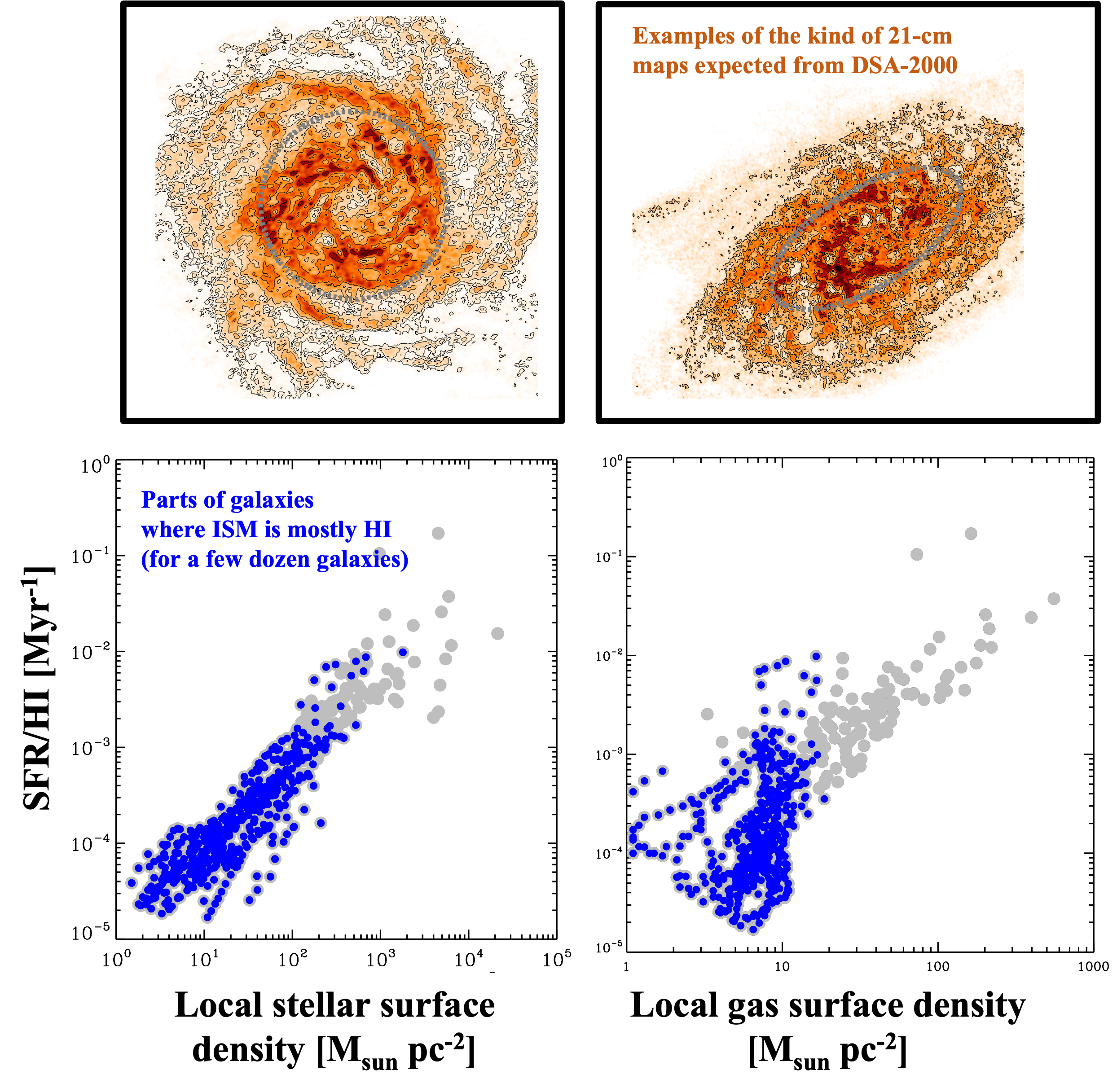
The critical capabilities for this science are the 21-cm zoom bands, an array configuration that yields good surface brightness sensitivity at scales, and as much collecting area and integration per point as possible. The absorption science and detailed ISM science in nearby well-resolved galaxies benefit from the high resolution zoom, 0.22 km s or at least km s to resolve cold Hi line profiles. The 21-cm emission-based science benefits from wide coverage at good velocity resolution, and the proposed tunable zoom band A or something close are critical for this. A plan to test the short and zero spacing recovery and integrate with a single dish facility to ensure complete flux recovery will also be an important technical consideration.
8.2 Galaxies in the Local Universe
David Cook, Joseph Mazzarella, George Helou
Galaxies in the local Universe play vital roles in many astrophysical research domains from galaxy evolution and star formation to finding the hosts to and understanding the environments of exotic transient events (sGRBs, FRBs, kilonovae, etc.). Consequently, understanding the completeness of known galaxies in the local Universe has become an important topic. The NASA/IPAC Extragalactic Database (NED) has recently developed a local volume sample (NED-LVS) which shows that the percentage of cataloged galaxies compared to expectations is 70% by NIR luminosity out to 300 Mpc but significantly decreases at further distances. The number of HI detected galaxies with accompanying redshifts from DSA-2000 will significantly increase the completeness of local galaxies and provide key HI gas mass measurements that are key ingredients for star formation.
One of the main science drivers for increasing the completeness of galaxies in the local Universe is the search for electromagnetic counterparts to gravitational wave (GW) events. The detection of GWs (B. P. Abbott et al. 2016) by the LIGO-Virgo collaboration (and later by the LIGO-Virgo-KAGRA collaboration; hereafter LVK) has opened a new window onto the Universe, but many of the most exciting discoveries from GWs are only possible when the electromagnetic (EM) counterpart is detected and studied concurrently. The EM counterpart to only one such event has been found to date (GW170817), yet has yielded remarkable results: constraints on the speed of GWs (B. P. Abbott et al. 2019), the origin of most metals heavier than iron (Kasliwal et al. 2017b), and an independent measure of the Hubble constant (B. P. Abbott, Abbott, Abbott, Acernese, Ackley, Adams, et al. 2017). Now the race is on to find a population of these events. However, due to the poor sky localizations of GW events, these searches will be difficult for the next several years where they will be limited by the availability and quality of galaxy catalogs.
the NASA/IPAC Extragalactic Database-Local Volume Sample (NED-LVS) is composed of nearly 1.9 million extragalactic objects with distances less than 1 Gpc (Cook et al. 2023; submitted). NED-LVS contains photometry from all-sky surveys (GALEX, 2MASS, and AllWISE) that are used to derive physical properties ( and SFR) via integrated-light scaling relationships from WISE luminosities, where 88% of objects have estimated values. The completeness of NED-LVS relative to the GALEX and 2MASS -bands are 100% out to 30 Mpc. Past this distance, the completeness relative to NIR luminosities (which trace a galaxy’s stellar mass) remains moderate (70%) out to 300 Mpc (Fig 8.1). In addition, when considering only galaxies with luminosities brighter than , NED-LVS is 100% complete out to 450 Mpc. A comparison to other local Universe samples shows that NED-LVS is more complete by number than both GLADE (Dálya et al. 2018) and HECATE (Kovlakas et al. 2021) by 10% and 30%, respectively, in the appropriate limiting distances. Measuring completeness by luminosity, NED-LVS is more complete than both GLADE and HECATE by 10-20% at distances beyond 80 Mpc.
Neutral hydrogen gas (HI) is a key component of the ISM of galaxies and makes up the majority of the total baryonic mass in star-forming galaxies (e.g., Catinella et al. 2018). However, given the relatively weak tracer of HI gas, the 21 cm line at 1420 MHz, studies of this key component are difficult even at intermediate redshifts (z0.2; Luca Cortese, Catinella, and Janowiecki 2017). Efforts of blind HI surveys in past decades have made significant progress in mapping the HI content of galaxies (HIPASS, ALFALFA, etc.; Barnes et al. 2001a; Giovanelli et al. 2005a), but are largely limited to more massive galaxies ( M at 100 Mpc; Haynes et al. 2011)). More recent HI surveys such as WALLABY (Koribalski et al. 2020a) will find an estimated 500,000 galaxies out to a redshift of 0.26, but will still be limited to more massive galaxies due to moderate sensitivites (1.6 mJy per beam; Duffy et al. 2012).
The DSA-2000 survey will provide the most complete census of HI galaxies in the local Universe given the 500 nJy per beam sensitivities across 3 sky. Based on the semi-analytical models of (D. Obreschkow et al. 2009), it is estimated that the full DSA-2000 survey data will detect approximately 2 million star-forming galaxies out to intermediate redshifts (). To put this into context, there are 2 million known galaxies in NED-LVS, where roughly half are star-forming in nature (using UV and MIR colors). Thus, DSA-2000 will provide or discover an additional 50% of known galaxies. These galaxies, their distances and HI masses, will significantly increase the search efficiency for exotic transients and provide needed data for studying the gas reservoirs out to cosmic noon.
N/A
8.3 DSA-2000 Extragalactic HI Surveys
Marcel Neeleman, Ryan Keenan, Fabian Walter, Leindert Boogaard
The DSA-2000 will provide an unprecedented improvement in our ability to detect HI-21 cm emission from galaxies out to . The all sky survey will detect millions of galaxies in HI emission, while deeper survey tiers will produce the first large samples of HI detections. This will provide a leap forward in our understanding of the role HI plays in the formation and evolution of galaxies.
Spectral line emission from HI plays a vital role in our understanding of galaxy evolution (Saintonge and Catinella 2022b). Over the past 25 years projects at a wide range of telescopes carried out surveys of HI emission in the nearby universe ((Barnes et al. 2001b; Giovanelli et al. 2005b; Fernández et al. 2016a; Xi et al. 2021)), resulting in detections of tens of thousands of galaxies. A new generation of radio telescopes, including the SKA pathfinders and large single dishes, are now pushing these surveys to greater depths and higher redshifts ((Koribalski et al. 2020b; E. A. K. Adams et al. 2022a; Glowacki et al. 2022; Rhee et al. 2023a; C.-P. Zhang et al. 2023)).
Figure 8.2 shows the landscape of these surveys in terms of sensitivity, sky coverage, and redshift range. Current blind HI surveys must make a tradeoff between survey area and survey depth. Future facilities, lead by the DSA-2000, will carry out much deeper large area surveys, measuring the gas properties of millions of galaxies.
We take two approaches to modeling the population of HI emmitting galaxies that will be observed by the DSA-2000. In the first, we assume the local HI mass function ((Jones et al. 2018)), HI mass-size relation ((Rajohnson et al. 2022; J. Wang et al. 2016b)), and baryonic Tully-Fischer relation ((Ponomareva et al. 2021)) are unchanging over and use these relations to predict the number counts of galaxies that will be seen by the DSA-2000 surveys. We refer to these predictions as the “local relations forecast”. In the second, we use output from the SHARK semi-analytic model (SAM; (Lagos et al. 2018)) which tracks the growth and evolution of atomic and molecular gas reservoirs in dark matter halos from the Millennium simulation. Galaxies from the SAM are used to create a mock catalog for the DSA-2000 all sky survey including information about the HI mass, line-width, and disk size for each galaxy. We refer to this set of predictions as the “SAM forecast”. Figure 8.3 shows a slice of the sky based on both of these forecasts. The two approaches are selected to be representative of a range of possible scenarios that the DSA-2000 might observe (and differentiate). In particular the SAM approach produces cool gas masses broadly consistent with current knowledge of the nearby and high redshift universe within a framework that also accounts for evolution of galaxy masses, sizes, and star formation rates. This results in predictions for the evolution of galaxy counts and HI mass functions which the DSA-2000 will be able to test. On the other hand, the local relations model produces forecasts that are maximally consistent with our knowledge of HI in the local universe, and represent a scenario in which the mass function has remained unchanged over time - consistent with current observations that cosmic HI density has been roughly constant since .
For both approaches, we calculate the fraction of galaxies the DSA-2000 can detect in HI as a function of HI mass and redshift, accounting for the angular size and line-width of each HI emitter. To consider a DSA-2000 survey capable of studying galaxies of a given and we require that at least 90% of such galaxies be detected at 10 or above. This may be overly conservative for the deep field surveys, in which galaxies near the sensitivity threshold will typically be unresolved and may have known optical counterparts to help in their identification.
In Figure 8.4 we show the redshift ranges and effective survey volumes over which the various DSA-2000 surveys can detect galaxies as a function of their HI mass. We consider the three planned DSA-2000 survey tiers – the all-sky survey (3 steradians), the pulsar timing fields (200 pointings observed for approximately 50 hours each), and deep-drilling fields (5 pointings observed for approximately 400 hours each) – as well as a hypothetical ultra-deep field consisting of a single 2,000 hour pointing. For comparison, we also show the results for a mock of the ALFALFA survey using our local relations forecast and a detection requirement of .
The DSA-2000 will provide a two order of magnitude increase in effective survey volume relative to previous wide-field HI surveys for sources at any HI mass. Among the most massive HI reservoirs, which can be detected over the full DSA-2000 all sky survey volume, the gain in volume is a factor of a few thousand. At the same time, deeper survey tiers will detect galaxies at the turnover mass of the HIMF () out to and an ultra-deep survey tier could potentially detect these galaxies over the full redshift range ().
Table 8.1 gives the expected number of galaxies the DSA-2000 will detect in HI for both of our models. Figure 8.5 shows the expected distribution of these galaxies in redshift and HI mass. The distributions for the all sky survey and pulsar timing surveys are similar, with peaks around and M. The deeper fields provide complimentary coverage of the parameter space, with improved sensitivity to and broader redshift distributions.
For the most massive HI reservoirs, extrapolation of the local HIMF assuming an exponential decline at the high-mass end results in the prediction that no objects with M exist. On the other hand, the such galaxies are predicted by some galaxy evolution models including the SHARK semi-analytic model. The DSA-2000 all sky survey is the only planned project with any facility that achieves both the sensitivity and survey volume necessary to detect such galaxies. The number of such galaxies detected will be a unique test of galaxy evolution models, and provide new insights into feedback and the baryonic processes affecting the most massive dark matter halos in the universe.
| Survey | Number (SHARK SAM) | Number (Local Scaling Relations) |
|---|---|---|
| DSA-2000 All Sky | 1.95 Million | 5.96 Million |
| DSA-2000 Pulsar Fields | 170,000 | 450,000 |
| DSA-2000 Deep Fields | 40,000 | 90,000 |
| DSA-2000 Ultradeep Field | — | 60,000 |
| ALFALFA | — | 25,437 ((Jones et al. 2018)) |
| HIPASS | — | 4,315 ((Zwaan et al. 2005)) |
The baseline design is sufficient for most of the science described here. To ensure detections of HI from galaxies, the addition of an ultra-deep survey tier, consisting of 5% of the total observing time (2,000 hours) spent on a single field is necessary.
to aid in planning for data storage requirements, we have estimated the space required to save cutout spectral cubes for each galaxy detected in HI and provide these values in Table 8.3. For this calculation we have assumed cutouts will be at least three times the HI diameter of the galaxy, and consist of 1,000 spectral channels for nearby ( Mpc) galaxies and 100 channels for distant ( Mpc) galaxies. We use the higher expected number counts from the local relations forecast, and assume, unlike elsewhere in this chapter, that galaxies can be detected in frequency ranges with significant RFI. We assume all cutouts are saved with 1" pixels and that each pixel requires 4 bytes of disk space.
| DSA-2000 baseline reference design | match to project | |
|---|---|---|
| Ultra Deep Field | Not included | 2,000 hour integration on a single field |
| Cutout Size | Number of Cutouts | Total Size |
|---|---|---|
| Mpc | ||
| 60" 60" | 7.37e4 | 1.06 TB |
| 120" 120" | 5.26e4 | 3.03 TB |
| 240" 240" | 3.30e4 | 7.61 TB |
| 600" 600" | 1.73e4 | 24.94 TB |
| 1200" 1200" | 1.93e3 | 11.13 TB |
| 3600" 3600" | 2.63e2 | 13.69 TB |
| Mpc | ||
| 60" 60" | 6.58e6 | 9.47 TB |
| 120" 120" | 3.02e6 | 17.42 TB |
| 240" 240" | 2.62e5 | 6.04 TB |
| 600" 600" | 1.76e4 | 2.54 TB |
| 1200" 1200" | 2.97e1 | 0.02 TB |
| Total | 96.94 TB | |
8.4 HI Mass Functions and the Mean Atomic Gas Density of the Universe
Ryan Keenan, Marcel Neeleman, Fabian Walter, Leindert Boogaard
The DSA-2000 will detect millions of galaxies in HI with no pre-selection enabling an unbiased determination of the HI mass function and integrated cosmic HI content over three-quarters of the sky and of cosmic history (up to ). The planned DSA-2000 all-sky survey can detect the most massive HI reservoirs over a volume times larger than previous the previous generation of wide-field surveys (ALFALFA and HIPASS), constraining the HI mass function to number densities a factor of bellow the knee mass () and providing unprecedented constraints on how feedback shapes the neutral gas content of the most massive dark matter halos. At the same time, the DSA-2000 will detect millions of sub- galaxies, constraining the low-mass behavior of the mass function over a volume essentially immune to cosmic variance and resolving the the discrepancies in this parameter seen by previous surveys. The pulsar timing and deep-drilling fields will add detections of sub- galaxies out to , providing a direct test for evolution in the shape of the HI mass function over the past 5 billion years.
The mass functions of atomic and molecular gas provide a global picture of the material available to fuel new star formation and galaxy growth. Together with the distributions of star formation and stellar mass, gas mass functions can be used to understand how galaxies process of baryonic matter into stars and collapsed objects over cosmic history ((Walter et al. 2020; Péroux and Howk 2020)). At the same time, comparison between the gas mass functions and the halo mass function provide insights into the feedback processes that shape the growth of galaxies.
Measurements of the star formation rate and stellar mass distribution functions are now available over a significant fraction of cosmic history ((Madau and Dickinson 2014)). Pioneering work in the millimeter regime has provided constraints on the molecular gas mass function out to ((Decarli et al. 2020; Pavesi et al. 2018; Lenkić et al. 2020; Boogaard et al. 2023)). However, owing to the faintness of HI direct measurements of the mass function of atomic gas have thus far been limited to the very nearby universe (; (Jones et al. 2018; Zwaan et al. 2005)). This results in a significant gap in our inventory of the baryon matter in galaxies over the first 12.5 billion years of their assembly. The lack of HI mass function (HIMF) measurements outside the local universe is particularly glaring, as this phase represents the interface between material accreting from the cosmic web and the fuel reservoir available for star formation in galaxies.
At much higher redshifts (), we can use the HI Lyman- absorption to study the mean HI density (; (Noterdaeme et al. 2012; Prochaska and Wolfe 2009)), providing an integral constraint the HIMF. These studies find that an evolution in the cosmic HI content from to , but the value of at is consistent with the value found by emission line studies in the local universe. This suggests that the HI content of the universe has been remarkably flat over the past 10 Gyr. Unfortunately directly constraining during this period is challenging because Lyman- emission cannot be observed from the ground at these wavelengths ((Neeleman et al. 2016)), and current HI-21cm observatories lack the sensitivity to probe HI in large samples outside the local universe.
In the nearby universe the HIMF has been measured to high precision by the ALFALFA and HIPASS projects ((Zwaan et al. 2005; Jones et al. 2018)). However, these surveys are fundamentally limited by cosmic variance due to the finite volume of the nearby universe. ALFALFA found the low mass slope of the HIMF differed by more than three times the statistical uncertainty when comparing their observations of the Fall and Spring skies. Advances in this regard will require surveys of larger volumes, which can be achieved only through an all sky survey, the inclusion of a larger redshift range, or both.
The DSA-2000’s all sky survey will expand the volume over which HI reservoirs at a given mass can be detected by at least two orders of magnitude compared to the previous generation of wide-field HI surveys (e.g. ALFALFA and HIPASS). This will result in measurements of the HIMF over volumes essentially immune to cosmic variance. The large volumes will also enable robust measurements of environmental variations in the shape of the HIMF.
Figure 8.6 shows the expected constraints on the HIMF, along with the measurement from ALFALFA ((Jones et al. 2018)). The DSA-2000 will constrain the mass function with high precision, and can easily differentiate different models in mass ranges where they differ. At the low mass end current surveys are limited by cosmic variance, as can be seen by the significant discrepancy between the ALFALFA measurements of the spring and fall skies. Compared to ALFALFA, the DSA-2000 all sky survey yields a two order of magnitude increase in the volume over which HI reservoirs of any given mass can be detected.
Figure 8.7 shows the HIMF measurements and uncertainties for select redshift bins. We consider the the DSA-2000 all sky survey alone or in combination with either the planned deep fields. In the deep-drilling fields, the DSA-2000 will detect galaxies at the knee of the HIMF out to , allowing for direct measurements of the HIMF over the past 5 billion years of cosmic history. This will constrain if, and how, HI reservoirs of “typical“ galaxies have changed over a period during which the cosmic star formation rate density and molecular gas density have fallen by %. We also consider the HIMF constraints possible with an ultra-deep field, consisting of 2,000 hours spent on a single pointing. The inclusion of an ultra-deep (2000 hour) field would extend the redshift range to or above, covering more than half of cosmic history and probing the HIMF at the end of cosmic noon.
Figure 8.8 shows the expected constraints on the cosmic HI density () in comparison to a compilation of literature measurements from (Walter et al. 2020). For lookback times of 0 to 4 Gyr the all sky survey can constrain in bins of 0.5 Gyr with essentially negligible error bars. At earlier times, the inclusion of deep or ultra-deep fields will provide competitive measurements out to . The DSA-2000 will map out the atomic gas history over more than half of cosmic history, providing accurate measurements of (HI) over a range in cosmic time currently not well-constrained.
The baseline design is sufficient for most of the science described here. However, to measure the HIMF at the highest redshifts accessible to the DSA-2000, the addition of an ultra-deep survey tier, consisting of 5% of the total observing time (2,000 hours) spent on a single field is necessary.
| DSA-2000 baseline reference design | match to project | |
|---|---|---|
| Ultra Deep Field | Not included | 2,000 hour integration on a single field |
8.5 Ultra-deep neutral hydrogen observations of nearby galaxies
F.M. Maccagni, W.J.G. de Blok
Ultra-deep studies of neutral hydrogen (HI) enable us to investigate several processes of galaxy formation and evolution in the nearby Universe. Low column density gas ( cm) is thought to replenish the interstellar medium (ISM) of star forming galaxies from the inter-galactic medium. Moreover, only by reaching low-mass detection limits ( ) we can characterize the gas content in low-surface brightness galaxies and therefore understand their evolution through cosmic time. Here, we show how these studies are currently done with MeerKAT on a limited field of view and show how DSA-2000 will expand these surveys to a much larger volume, and possibly all-sky.
Identifying the processes that fuel galaxies has been an active topic of research over the last few decades, both theoretically and observationally. Attempts to directly detect the cold infalling gas have so far not yet resulted in unambiguous detections, and led to many efforts to map the HI around galaxies to increasingly lower column densities. The deepest HI survey of nearby galaxies to date (MHONGOOSE, de Blok et al. 2016) is currently in progress on the 64-dish MeerKAT radio telescope in South Africa. It will characterize a sample of 30 gas-rich spiral and dwarf galaxies down to HI column densities of cm, one to two orders of magnitudes deeper than previous observations.
First results show that the outer parts of galaxies are complex environments, with signs of potentially accreting gas, but also with clear signs of minor interactions with low-mass companion galaxies (Fig. 8.9). Moreover, because both low-column density clouds and diffuse streams of HI are found in the inter-galactic medium, disentangling the effects of environment from direct cold gas accretion is an observational challenge. While being extremely sensitive at all angular scales (see Fig. 8.9, right), the MeerKAT field of view of deg does not sample, in many cases, the virial volume of the target galaxies. Observations of the low HI column-density environments taking advantage of the extended sky coverage of DSA-2000 will therefore be invaluable in helping solve the accretion problem.
The right panel of Figure 8.9 shows the comparison between the baseline distribution of MeerKAT and of DSA-2000. While having much fewer dishes than DSA-2000, MeerKAT’s antennas are distributed such that of all baselines lengths are less than 1 km. This guarantees a constant response with a synthesized beam (Point Spread Function) size from ” to ” (Fig. 8.10, left). DSA-2000 on the contrary has most baselines with lengths between 4 and 6 km. This provides high sensitivity at high spatial resolutions (between 3” and 6”), but introduces a linear dependence of sensitivity with increasing beam size (). Since HI column density is , DSA-2000’s sensitivity to column density becomes proportional to while MeerKAT’s scales quadratically (Fig. 8.10, right). For this reason MeerKAT detects low-column density gas over a wide range of angular scale, while the current planned DSA-2000 full sky survey (4 hours) will not reach the same limits.
DSA-2000 has the potential to perform deep HI studies over large volumes, thus providing an unprecedented complete view of cold gas accretion, galaxy assembly and gas content over the full range of dynamical masses of galaxies ( ). Nevertheless, to reach the sensitivities required for these studies DSA-2000 baseline configuration imposes a few limitations. If adding a compact core of antennas (for example a 10 10 dishes array distributed within 1 km) is not possible, we strongly suggest to select a few large fields ( deg) to observe with DSA-2000 for 50 hours, thus reaching MeerKAT sensitivities over an area that will not be matched until the completion of the Square Kilometer Array.
| DSA-2000 baseline reference design | match to project | |
|---|---|---|
| low–resolution HI channels | 5600 channels from 0.7–1.45 GHz, | NO |
| need for short–baseline array | N/A | compact core of 1010 antennas |
8.6 Spatially resolved census of HI in the nearby (100 Mpc distance) Universe
Fabian Walter (MPIA), W.J.G. de Blok (ASTRON), et al.
The DSA-2000 will obtain an unbiased (sub–)kpc view of the atomic hydrogen of all galaxies out to 100 Mpc (and ideally, 200 or even 300 Mpc). Together with the lower–velocity resolution (but mostly spatially unresolved) HI survey out to z=1 (CROSSREF), this survey represents the ’Sloan HI’ counterpart in the local universe, enabling a multitude of analysis, including precise measurements of the dark matter content through HI kinematics. This, together with the fact that the DSA-2000 will push down to HI masses that were previously inaccessible for large volumes will provide new and unique constraints for state-of-the art numerical simulations.
Obtaining a full account of neutral hydrogen in the Universe using large–area sky surveys has been a key goal in radio astronomy for decades. One of the most comprehensive surveys of this kind is the ‘HI Parkes All Sky Survey’ (HIPASS, Barnes et al. 2001) which mapped the entire sky south of declinations of +25 degrees over a velocity range from -1300 to +13.000 km s. Even though the spectral (18 km s) and spatial resolution (15 arcmin) of this single-dish survey were limited, it led to breakthrough science, and to first good constraints on the HI mass function in the local Universe (Zwaan et al. 2003), a key constraint for hydrodynamical galaxy simulations (e.g. Stevens et al. 2019). The extragalactic northern sky was since fully observed with the ‘The Effelsberg-Bonn HI Survey’ (EBHIS, Flöer et al. 2015, Winkel et al. 2016, Schröder et al. 2019) at comparable spectral and spatial resolution (10 km s, 9 arcmin). These single-dish surveys provide a full census of the bright end of the HI luminosity function with typical HI mass limits of about 10-10 M at distances of 0-10 Mpc (10-10 M at distances of 10-30 Mpc, and 10-10 M at 30-100 Mpc, Zwaan et al. 2003).
The next revolution in constraining the HI content of galaxies (and thus the HI mass function) to significantly lower masses is afforded by the latest generation of sensitive interferometric surveys. For example, the Australian WALLABY survey (Koribalski et al. 2020) is currently being executed at ASKAP, and will provide a HI survey covering the Southern Sky over the next few years at a spatial (spectral) resolution of 30 arcseconds (km s). Dedicated MeerKAT surveys, e.g. on the Fornax cluster, target special group and cluster environments at unprecedented depths (Serra et al. 2016, pilot data in Kleiner et al. 2021). Also, the 3400 hour LADUMA survey, a deep drilling in a single MeerKAT pointing, will detect HI emission out to redshift z=1.4.
The sensitivity and resolution of the all–sky DSA-2000 HI survey will take these studies to an entirely new level. It will provide a spatially resolved HI census of all galaxies out to D=100 Mpc (ideally: out to 200 Mpc, see below, 3.5 at 100 Mpc (200, 300) gives a spatial resolution of 1.5 kpc (3, 4.5), galaxies will be resolved over 10+ beams at least out to 200 Mpc). Among many other things, this will enable to derive accurate rotation curves for the galaxies, and thus dark matter density profiles / content.
For each HI–detected galaxy, the multi-wavelength properties will put them in context with the general galaxy population. In particular characterizing the properties of the smallest galaxies is crucial for understanding galaxy evolution, as in the hierarchical growth of galaxies it is these smallest galaxies that are the building blocks of more massive galaxies. Optical imaging for most fields will be available through Pan-STARRS, SDSS, EUCLID, with significant overlap by the Rubin LSST survey.
Given the high velocity resolution, the project will thus also push measurements of the HI luminosity function at z many orders of magnitudes below single-dish all-sky surveys, providing new constraints for state-of-the art hydrodynamical simulations.
The current baseline design would allow detailed spatial and spectral resolved HI imaging out to 100 Mpc (7000 km s). Doubling (or even tripling) that distance would be highly desirable. This would imply additional channels for zoom band A, as the current velocity resolution is needed for the nearby galaxies. An alternative would be to have an additional zoom band with courser velocity resolution (5 km/s) starting at D=100 Mpc.
| DSA-2000 baseline reference design | match to project | |
|---|---|---|
| Frequency band | 0.7–2.0 GHz | only needs 100 Mhz around HI |
| Declinations | -31 | restricted DEC range OK |
| Spatial resolution | 3.5 | gives 0.5 kpc res at 30 Mpc – OK |
| need for short–baseline array | N/A | benefits nearby targets D10 Mpc |
| need for additional modes | N/A | add’l zoom band 100MpcD300Mpc? |
ToDo: need to calculate number of galaxies targeted out to D=100 Mpc, 200 Mpc, 300 Mpc.
8.7 HI galaxy surveys out to z=1
Kristine Spekkens
The HI content and structure of gas-rich galaxies is an important evolutionary probe; population studies are the current state of the art. Several large HI surveys at new facilities around the world are now underway or set to begin soon. They will deliver the first statistical samples of local HI disks and a first look at HI in individual galaxies out to . An all-sky survey with the DSA-2000 will detect millions of galaxies out to , resolving many systems out to : these statistical samples of HI reservoirs and disks will be unparalleled by any survey through the mid-2030s.
The HI content, morphology and kinematics of gas-rich galaxies are important evolutionary probes. For example, the HI disks of Milky Way-like systems extend further into their parent dark matter halos than their stellar counterparts (e.g. (J. Wang et al. 2016c)); at lower star-forming galaxy masses, HI is the dominant baryonic component (e.g. (Bradford, Geha, and Blanton 2015)). The statistics of HI disks at therefore places important constraints on the interplay between baryons and dark matter during galaxy formation, while widefield HI surveys are the most efficient tracer of the faintest star-forming galactic building blocks. The state of the art for confronting galaxy formation models is transitioning from detailed studies of individual systems (e.g. (H. Katz et al. 2017), (Elizabeth A. K. Adams and Oosterloo 2018)) to population-wide constraints (e.g. (Dutton, Obreja, and Macciò 2019)). Because of historical limitations in detector bandwidth, sensitivity and field-of-view, the vast majority of HI samples available today are restricted to (e.g. ALFALFA, (Haynes et al. 2018)), with only a few direct detections beyond this redshift (e.g. (Fernández et al. 2016b), (Chakraborty and Roy 2023)).
A revolution in HI sky surveys is underway now, with several large ( thousands of hours) initiatives underway or set to begin soon at new or retrofitted observatories around the world. Figure 8.12 provides a visual summary of these major efforts, grouped by sky coverage and depth. Widefield HI surveys such as WALLABY on ASKAP ((Koribalski et al. 2020a)), CRAFTS on FAST ((K. Zhang et al. 2021)) and CHORD ((Vanderlinde et al. 2019)) will provide a new full-sky HI view of the Universe, with deeper efforts such as MALS, MIGHTEE-HI, Fornax and MHONGOOSE on MeerKAT ((N. Gupta et al. 2016), (Maddox et al. 2021), (Serra et al. 2023), (de Blok et al. 2020)) and Apertif ((E. A. K. Adams et al. 2022b)) also underway. Pencil beam surveys will push individual HI detections out in redshift for the first time, and include the completed CHILES on the VLA ((Dodson et al. 2022)), with DINGO on ASKAP ((Rhee et al. 2023b)) and LADUMA on MeerKAT ((Blyth et al. 2016)) starting observations now. The upshot of this massive, global investment of telescope time is that by 2030, the first statistical samples of HI disks (e.g. (Deg et al. 2022)) and the first HI detection statistics beyond will have been collected and made publicly available (e.g. (Westmeier et al. 2022)).
The DSA-2000 will detect millions of galaxies across sr out to , an order of magnitude more at than ongoing widefield surveys (Figure 8.13), and several orders of magnitude more at than ongoing pencil beam surveys. Galaxies with out to will be spatially resolved, which no other ongoing survey will achieve. The DSA-2000 will deliver unparalleled HI detection and HI disk statistics out to until a putative SKA Key Science Project in the mid-2030’s.
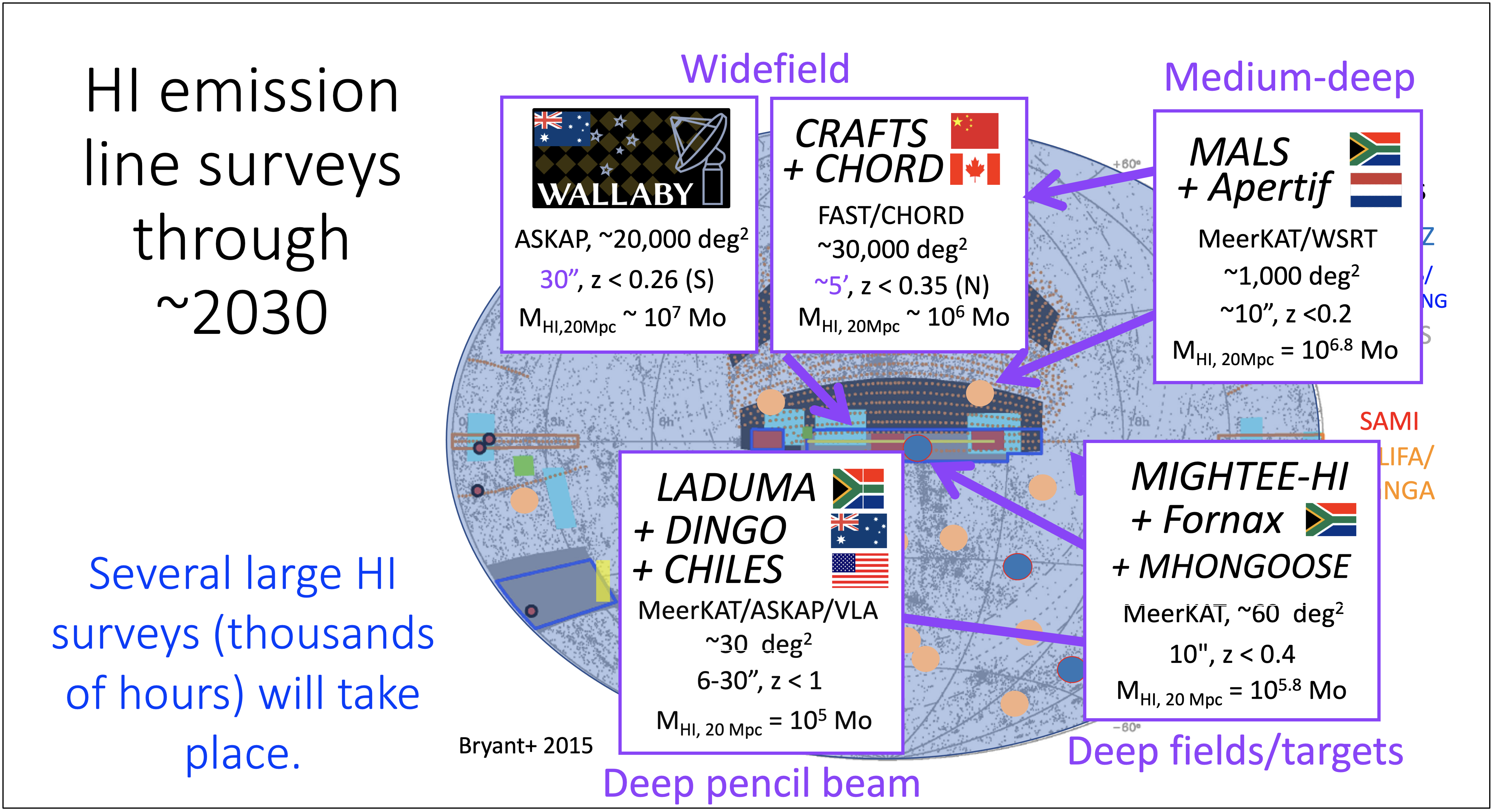
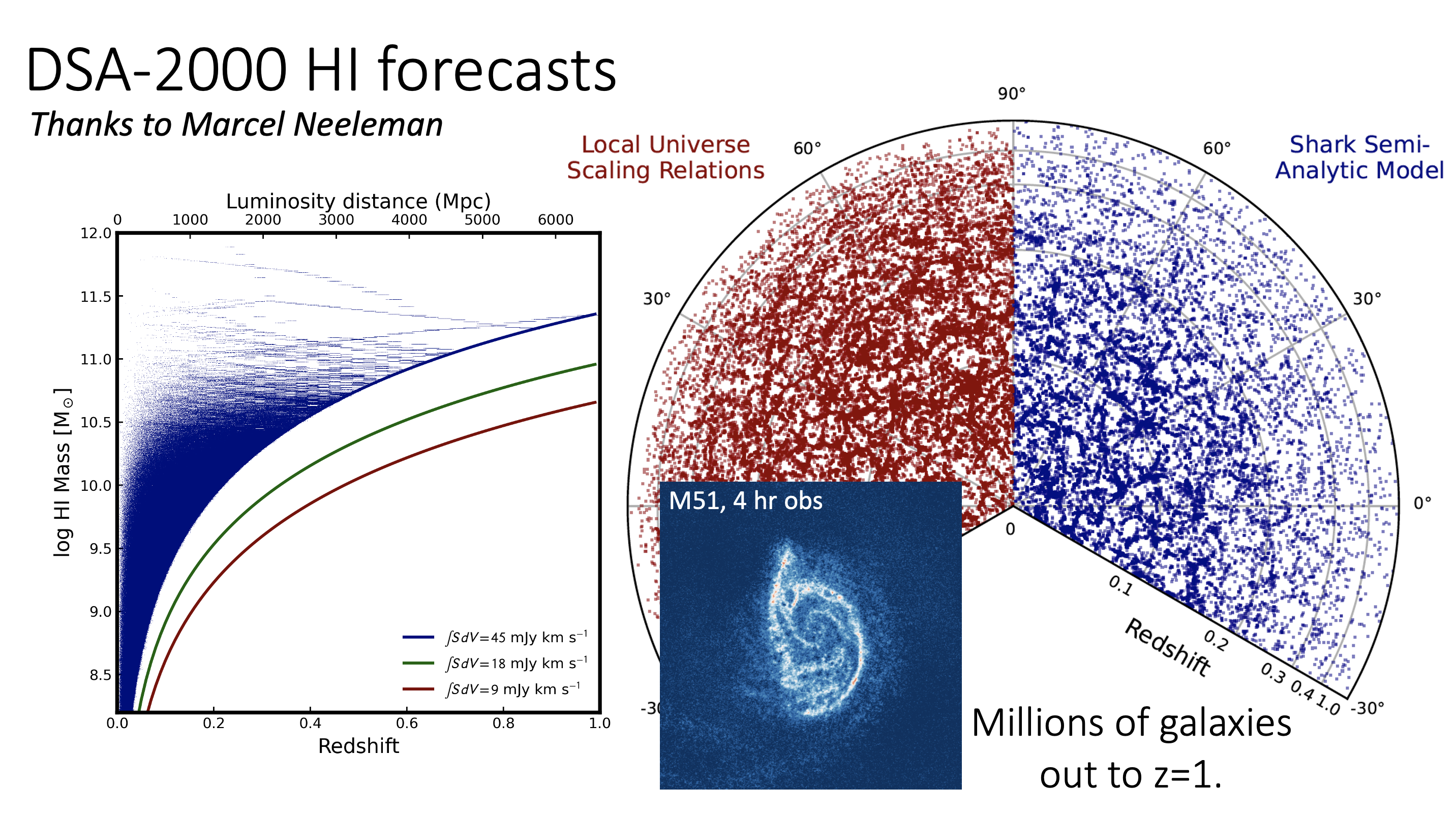
Checkmarks show an element of the baseline design that is both required and sufficient for the science case described above. Baseline design elements that are not relevant for this science case are left blank.
The limiting factor in the reference design for this science case is column density sensitivity: an HI column density sensitivity of across a spectral extent of is required to reach the edges of HI disks (e.g. (J. Wang et al. 2016c)), which implies a minimum spatial smooth to . A short baseline array to enhance column density sensitivity would benefit this science case, though it is not strictly necessary for the science case as described. The tuneable zoom bands will be of limited use for this science case because the DSA’s column density sensitivity is low compared to compact array configurations (e.g. CHORD, (Vanderlinde et al. 2019)).
| DSA-2000 baseline reference design | match to project | |
|---|---|---|
| Spatial resolution | 3.5 | smoothing needed |
| need for short–baseline array | N/A | beneficial |
8.8 Galactic neutral hydrogen and magnetic fields with DSA-2000
Susan E. Clark (Stanford)
Measurements of neutral hydrogen absorption probe the phase distribution of the interstellar medium. Measurements of Zeeman splitting in the 21-cm line in absorption probe the magnetic field strength in the cold neutral medium.
Understanding star formation and galactic evolution requires a physical model of the flow of matter and energy throughout the interstellar medium (ISM). The ISM is a multi-phase medium, spanning orders of magnitude in temperature and density (e.g., Ferrière 2001; Hacar et al. 2022). A complete physical understanding of the ISM requires measurements that probe this range of phases, as well as physical properties like the interstellar magnetic field.
Interstellar neutral hydrogen (HI) is traced by the 21-cm line in both emission and absorption (Peter M. W. Kalberla and Kerp 2009). Recent large-area surveys of the 21-cm line in emission have been enormously productive for understanding properties of the ISM (P. M. W. Kalberla and Haud 2015; Winkel et al. 2016; HI4PI Collaboration et al. 2016a; Peek et al. 2018). The addition of measurements of the 21-cm line in absorption enable estimates of the HI temperature and optical depth, and thus constrain the thermodynamic state of the ISM (Carl Heiles and Troland 2003; Claire E. Murray et al. 2018b, 2021; John M. Dickey et al. 2022a). These data are enabling new insights into the phase structure and density distribution of the ISM, as well as how gas transitions between phases in the ISM (Claire E. Murray et al. 2021; Snežana Stanimirović and Zweibel 2018; Lei and Clark 2022).
The role of the magnetic field in interstellar processes remains one of the most elusive parts of the picture. One of the key challenges is a paucity of observational measurements of the magnetic field strength in the neutral and molecular ISM. Measurements of starlight polarization and polarized dust emission probe the magnetic field in these phases, but only trace the plane-of-sky magnetic field orientation. Similarly, cold filamentary structures in diffuse neutral hydrogen trace the magnetic field orientation (S. E. Clark, Peek, and Putman 2014; S. E. Clark et al. 2015; P. M. W. Kalberla et al. 2016). These data can only be used to indirectly estimate the plane-of-sky magnetic field strength via statistical techniques that come with strong caveats and systematic uncertainties. Measurements of Faraday rotation can be used to estimate the line-of-sight magnetic field strength in molecular clouds, but rely on background subtraction techniques to isolate the contribution to the rotation measure from the molecular cloud, as well as models of the thermal electron density (Tahani et al. 2018, 2022). Zeeman measurements stand alone as the only tracer that directly measures the line-of-sight magnetic field strength in the neutral and molecular ISM (C. Heiles and Crutcher 2005).
Zeeman measurements of HI in absorption measure the line-of-sight magnetic field strength in the cold neutral medium of the ISM. Because these absorption measurements are made toward background radio galaxies, which are randomly distributed with respect to the Galactic HI, they provide an unbiased view of the magnetic field strength in the neutral medium. The state-of-the-art HI absorption Zeeman survey remains the Millenium Survey with Arecibo (Carl Heiles and Troland 2004, 2005). These measurements anchor much of what we know about the magnetic field in the diffuse ISM and the evolution of the magnetic field strength with gas density – a critical discriminant of the role of the magnetic field in star formation (Richard M. Crutcher et al. 2010; Richard M. Crutcher 2012; Tritsis et al. 2015; Pattle et al. 2022). However, as crucial and widely-used these data are, “the number of actual detections is, from a statistical standpoint, pitifully small" (S. Clark, Heiles, and Robishaw 2019). (See the Decadal 2020 White Paper by (S. Clark, Heiles, and Robishaw 2019) for more on this science case.) More high-sensitivity measurements are desperately needed, and would have an immediate and lasting impact on the field.
There is an opportunity for DSA-2000 to conduct a sensitive HI absorption line survey toward all bright background radio sources in the observable region. This would provide an unbiased survey of the phase composition of HI gas over much of the sky. If carefully calibrated measurements of Stokes V were also achieved, DSA-2000 would provide much-needed HI Zeeman measurements in absorption. This would potentially substantially bolster our understanding of the magnetic field strength distribution and evolution with gas density in the Galaxy, a measurement with wide-ranging consequences for ISM physics.
The proposed Zeeman splitting measurements would necessitate the addition of Stokes V measurements for the tuneable zoom band B channels. The 0.22 km s velocity resolution of tuneable zoom band B is sufficient to resolve CNM linewidths.
| DSA-2000 baseline reference design | match to project | |
|---|---|---|
| I only for all other channels | Add V for Zoom band B |
8.9 Galactic HI, OH and recombination line surveys – results and perspectives from the THOR survey
M. R. Rugel, H. Beuther, J. Stil, B. Winkel, E. Koch, J. Urquhart, K. Emig, J. Dawson, and R. Klessen
The evolution of molecular clouds in the Milky Way is a key missing piece in our understanding of how matter is processed in galaxies, and an essential ingredient of galaxy evolution models. In particular: How do molecular clouds form out of the atomic gas? What is the impact of stellar feedback on the evolution of the interstellar medium (ISM)? To address these questions, DSA-2000 will provide HI observations at high resolution and high sensitivity to study the atomic gas, observations of the OH 18 cm transitions and several radio recombination lines to observe molecular and ionized gas, as well as measurements of the continuum in full polarization to study magnetic fields. This contribution gives a summary of the VLA Galactic plane survey THOR (The HI/OH/Recombination line survey) and the follow-up THOR-GC, as well as delineating perspectives for future surveys with DSA-2000.
The mechanisms governing the formation of molecular gas out of the diffuse interstellar medium (ISM) occur in multiple gas phases, extend from kpc down to sub-pc scales, and involve a variety processes, e.g., supernova explosions, stellar feedback and galactic shear motions. Observational data on the formation of molecular clouds, especially investigations of the diffuse molecular and atomic material in our Galaxy, are lacking to constrain galaxy simulations and models of galaxy evolution. Particularly suited to study the atomic gas component are observations of the HI 21 cm line at 1.4 GHz, as well as the OH transitions at 18 cm to probe diffuse molecular gas. The last decades brought about several observational surveys of HI at high resolution and/or high sensitivity, such as the Canadian Galactic Plane Survey (CGPS; (A. R. Taylor et al. 2003)), the Southern Galactic Plane Survey (SGPS; (McClure-Griffiths et al. 2005)), the VLA Galactic Plane Survey (VGPS; (Stil et al. 2006)), the HI/OH/Recombination line survey (THOR; (Beuther et al. 2016)), the GALFA-HI survey (Peek et al. 2011) and the EBHIS/GASS/HI4PI surveys (HI4PI Collaboration et al. 2016b, and references therein). Over a similar period, studies have investigated HI in different phases between the cold and warm ISM with HI emission and absorption observations (e.g., C. Heiles and Troland 2003; Lee et al. 2012; C. E. Murray et al. 2015), as well as with HI self-absorption, e.g., D. Li and Goldsmith (2003), which also reported matching detections of the hyperfine splitting transitions of the OH molecule. OH transitions at 1612, 1665, 1667 and 1720 MHz can be sub-thermally excited and provide a probe of molecular gas in a variety of physical conditions. The hyperfine splitting levels of the OH ground state are also subject to inversion, resulting in maser emission in a variety of astronomical environments. First detected in the 1960s (e.g., Weinreb et al. 1963), these transitions gained attention in recent years in multiple surveys, also as potential tracer of molecular gas not traced by CO emission (CO-dark gas; e.g., Allen et al. 2012; Dawson et al. 2014; Allen, Hogg, and Engelke 2015; D. Xu et al. 2016; Di Li et al. 2018; Rugel et al. 2018; Busch et al. 2021; Dawson, Jones, Purcell, Walsh, Breen, Brown, Carretti, Cunningham, Dickey, Ellingsen, Gibson, Gomez, et al. 2022). Several larger surveys addressing various aspects of OH and HI have reported initial results or are ongoing, with existing telescopes (e.g., ODIN(plus) or THOR-GC with the VLA), with SKA-pathfinders in the southern hemisphere (e.g., GASKAP-HI, e.g., (John M. Dickey et al. 2022b); GASKAP-OH) or also by studying ground state transitions of OH in the far infrared with SOFIA (HyGAL, e.g., (Jacob et al. 2022)).
THOR: This contribution focusses on the THOR and THOR-GC surveys with the Karl G. Jansky Very Large Array (VLA), which simultaneously observed the HI, OH, and radio recombination lines (RRLs) lines, as well as the continuum emission in full polarization over a large portion of the first quadrant of the Milky Way (THOR; ; (Beuther et al. 2016)), and towards the Galactic Center and surroundings (THOR-GC; Rugel et al., in prep.). Main goal is to study how the evolution of the ISM leads to the formation of molecular clouds and to the formation of new stars. Both surveys provide maps of the atomic gas at a resolution comparable to existing surveys of dust and molecular gas across the Milky Way. The angular resolution of the data products range between 15 to 40 , in particular providing HI emission maps at 40 with an rms of 4 K at 1.5 km/s channel width. The THOR survey allows us to constrain the HI content of the cold neutral medium in star-forming regions and spiral arms (Bihr et al. 2015; Bialy et al. 2017; Y. Wang, Beuther, et al. 2020), and identify cold HI in molecular clouds through HISAs ((Y. Wang, Bihr, et al. 2020; Syed et al. 2020), Syed et al., in prep.). Spatial correlations between HI and CO emission, as well as global orientations of HI filaments have been used to investigate the imprints of feedback processes on the structure of gas in the Milky Way (Soler et al. 2019, 2020), and have led to the detection of a purely atomic filament (“Maggie” Soler et al. 2020; Syed et al. 2022). Additional studies focused on OH absorption in star forming regions and “quiescent” molecular clouds (Rugel et al. 2018), OH masers (Beuther et al. 2019), the detection of new supernova remnant candidates (Anderson et al. 2017), signatures of stellar feedback (Rugel et al. 2019), and the structure of magnetic fields with rotation measure synthesis ((Shanahan et al. 2019)). THOR is currently extended to other regions of the Galaxy with ODIN(plus), focussing on more nearby molecular clouds, e.g., Orion and Ophiuchus (Soler et al., in prep.), and to the Galactic Center (THOR-GC), which extends THOR to Galactic longitudes (Rugel et al., in prep.).
The high angular resolution is ideally suited for studying HI and OH absorption towards Galactic and extra-galactic background sources and provides a new all-sky survey of HI emission.
-
From the “Reference configuration summary (March 2023)”, we estimate a point-source sensitivity of 0.2 mJy/beam or a surface brightness sensitivity of 9 K @3.5 in a 1 km/s channel for 4 h of observations. Smoothing to 20 improves the surface brightness sensitivity to 2 K or better, at a point source sensitivity of 1 mJy/beam. For OH and HI absorption, this would imply a 5-sensitivity to optical depths of across the entire sky for continuum sources 100 mJy. It is highly complementary to on-going surveys of the southern sky (GASKAP-HI; (J. M. Dickey et al. 2013)).
-
The survey will provide an all-sky OH maser census at unprecedented sensitivity, tracing a variety of different astronomical sources, e.g., AGB-stars, star-forming regions and supernova remnants. With its cadence of one all-sky coverage every 4 months over 5 years, the DSA-2000 will be ideally suited to identify variable OH masers on time scales of months to years.
-
The wide bandwidth and high target sensitivity promise a deep view of the polarized continuum sky and a fine grid of rotation measures to constrain the magnetic field in the ISM.
-
We note the excellent multi-frequency synergies for compact continuum sources at 3.5 resolution with Galactic plane surveys such as MMGPS (2.0-2.8 GHz; (Padmanabh et al. 2023)) and GLOSTAR (4-8 GHz; (Brunthaler et al. 2021)).
-
If spectral lines are recorded in full-polarization mode, DSA-2000 will provide direct measurements of the line-of-sight magnetic field in molecular clouds and star-forming regions through Zeeman-splitting of OH.
-
Its all-sky maps will be an excellent starting point for detailed, multi-frequency follow-ups with future radio telescopes such as the SKA or the ngVLA.
Comparing the DSA-2000 baseline reference design to VLA studies such as THOR/THOR-GC:
-
High surface brightness sensitivity is crucial to study Galactic HI emission. Short spacings are necessary, particularly for HI: THOR/VGPS showed the importance of baselines smaller than 1 km (40 @1.4 GHz). Improving the resolution to 20 @1.4 GHz will require baselines 2 km. A separate compact array and/or a change in the current baseline configuration, which add baselines at these lengths, will dramatically improve the response of the DSA-2000 to diffuse Galactic HI emission.
-
“Zoom band B (bandwidth: 2.1 MHz or 450 km/s @1.4 GHz) may not be sufficiently wide for HI in some Galactic targets, in particular for regions with high velocities such as the Galactic center. Its high spectral resolution is beneficial for distinguishing cold, narrow HI components along the line of sight. Deep integrations of HI (h over 5 years) could be obtained with simultaneous HI observations for a subset of the NANOgrav fields. See also other contributions on HI in this series.
-
To cover the four OH hyperfine splitting transitions at 18 cm, we recommend to evaluate adding extra zoom bands at this or a later stage, potentially at lower spectral resolution (0.5 km/s) or restricted to, e.g., the Galactic plane, nearby galaxies, and the Gould Belt. If the setup remains unchanged, we suggest simultaneous OH observations for a subset of the NANOgrav fields, iterating the tuning between the 4 OH transitions. Also, “Zoom band A” could be tuned to the two OH main lines, although we notice the importance of the OH satellite lines to investigate the excitation.
-
Linear receivers require full-Stokes observations to measure Zeeman-splitting of OH.
-
Simultaneous observations of continuum in full polarization and limited coverage of radio recombination lines are possible with the current setup and we refer to other contributions in this series for a detailed discussion.
| DSA-2000 baseline reference design | match to project | |
|---|---|---|
| Spatial resolution | 3.5 | (short-baselines essential for HI) |
| low–resolution HI channels | 5600 channels from 0.7–1.45 GHz, | (potentially: RRLs if dv10 km s) |
| 134 kHz (28 km s at z=0, 56 km s at z=1) | ||
| tuneable zoom band A | 4096 channels, 8 kHz (1.8 km s) | (potentially: OH main lines) |
| tuneable zoom band B | 2048 channels, 1.05 kHz (0.22 km s) | (HI, potentially: all 4 OH lines) |
| (full-Stokes for Zeeman-splitting) | ||
| need for short–baseline array | N/A | |
| Cadence | 1 every 4 months | (potentially: variability of OH masers) |
| need for additional modes | N/A | 4 x “Zoom band B” for OH |
ToDo: Test image-plane deconvolution for Galactic HI emission.
8.10 Exploring OH with the DSA-2000
M. Rugel (Deutsches Zentrum für Astrophysik), N. Gupta (Inter-University Centre for Astronomy and Astrophysics), A. M. Jacob (Universität zu Köln), J. R. Dawson (Macquarie University, CSIRO Space & Astronomy), H. Beuther (Max Planck Institute for Astronomy), A. Hafner (The University of Sydney), B. Svoboda (National Radio Astronomy Observatory)
The conditions for molecular cloud formation vary with Galactic environment. Studying molecular gas in phases where molecules have just formed can reveal information on the molecular cloud formation process and the overall star formation efficiency in galaxies. Observationally, large fractions of molecular gas have been identified in the Milky Way, which are not detected by standard molecular gas tracers such as CO. Lines from hydrides such as hydroxyl (OH) are better suited for tracing the HI-to-H transition as they easily form once molecular hydrogen is present and since their cm transitions are readily excitable. We predict that simultaneous observations of the OH 1667 MHz lines with the DSA-2000 should be able to reveal OH in gas parcels of molecular gas. Here, we propose to search for weak OH absorption corresponding to the 1667 MHz line towards strong cm continuum sources to detect and map the galaxy-wide distribution of CO-dark gas.
8.10.1 Introduction
CO-dark gas pervades the multiphase interstellar medium (ISM) of the Milky Way, but it is elusive to widely surveyed molecular emission lines of gas in giant molecular clouds such as CO (Grenier, Casandjian, and Terrier 2005; Planck Collaboration et al. 2011; Pineda et al. 2013). As molecular hydrogen forms at lower column densities than typical clouds detected in CO, understanding the properties of CO-dark gas can be highly relevant for constraining not only the phase transition of atomic to molecular gas, but also the onset of self-gravitation of molecular clouds as shielding from increased dust and gas columns enables clouds to cool (Glover and Clark 2012). Moreover, it has been determined from both observations and theoretical predictions that CO-dark gas amounts to significant fractions of the molecular gas (Grenier, Casandjian, and Terrier 2005; Pineda et al. 2013; Busch et al. 2021; Wolfire, Hollenbach, and McKee 2010). Hence, deciphering its origin is critical for our understanding of galaxy formation.
Spectral line surveys including observations of the 18 cm ground state hyperfine structure lines of OH have established its use as a tracer of molecular gas in a variety of environments in our Galaxy and beyond (Goss 1968; Turner 1979; Nguyen et al. 2018; Rugel et al. 2018; Dawson, Jones, Purcell, Walsh, Breen, Brown, Carretti, Cunningham, Dickey, Ellingsen, Gibson, Gómez, et al. 2022; Hafner et al. 2023; N. Gupta et al. 2018; Balashev, Gupta, and Kosenko 2021; Busch 2023). Further, recent studies have found OH both in emission and absorption without CO emission counterparts or in regions of CO-dark gas (D. Xu et al. 2016; Di Li et al. 2018; Allen, Hogg, and Engelke 2015; Busch et al. 2021). OH in CO-dark environments occurs over a range of column densities, roughly between (Di Li et al. 2018; Busch et al. 2021), which corresponds to a molecular column density range of assuming an OH abundance of (R. M. Crutcher 1979; Weselak et al. 2010; Jacob et al. 2022; Rugel et al. 2025).
8.10.2 Revealing CO-dark gas with the DSA-2000
The DSA-2000 offers a unique opportunity to conduct highly sensitive observations of the OH hyperfine splitting transitions of the rotational ground state. We evaluate the benefits of a deep Galactic plane survey of the OH 1667 MHz line which can be conducted simultaneously with the DSA-2000 survey, and will illuminate OH’s ability to trace CO-dark gas as detailed below. For economic reasons and for limitations in the overall number of channels that can be correlated, we decided to focus this contribution solely on the OH 1667 MHz line, as it has the highest statistical weights and its absorption should be strongest among the four hyperfine splitting transitions (1612 MHz, 1665 MHz, 1667 MHz, and 1720 MHz).
Figure 8.14 shows the proposed survey area. To keep the overall data volume in reasonable limits we propose to limit the survey area to degree and degree around the Galactic midplane (5300 square degree, 17% of the DSA-2000 survey area). An inclusion of individual Gould belt clouds will be considered separately.
We use the sensitivity estimates for the DSA-2000, as reported in March 2023, of 0.5 Jy/beam for the continuum sensitivity over all epochs (80% of time usable) and 1.3 GHz bandwidth (65% of the useable) 10. The mean full width of half maximum (FWHM) of OH absorption features as found by Hafner et al. (2023) is adopted to be 1.5 km/s. Broad CO-dark OH layers as detected in Busch et al. (2021) are likely even broader. To sample 1.5 km/s by two channels, we can degrade the narrowest currently planned resolution of the DSA-2000 (1.05 kHz) by a factor of four. We calculate the sensitivity for a resolution of 0.76 km/s at 1667 MHz (4.2 kHz), which results in a line sensitivity of . Towards pulsar timing fields with a continuum sensitivity of 200 nJy/beam, we can reach a line sensitivity . For column density, we use with s for the 1667 MHz transition (e.g., Goss 1968; Turner and Heiles 1971; S. Stanimirović et al. 2003), and assume K. We estimate that when observing the 1667 MHz line across all epochs of the DSA-2000, we will reach a 5 RMS of in a 0.8 km/s channel for absorption towards sources with a continuum flux of Jy, or for sources mJy.
Based on the NVSS survey (Condon et al. 1998), we estimate at least one source per square degree with mJy, which will enable the study of spatial variations of CO-dark gas with OH. At a distance of 1 kpc this corresponds to an average probed spatial scale of 20 pc, and at the Galactic center (8.13 kpc) to 150 pc, which should be sufficient to distinguish between arm and inter-arm regions of large-scale spiral wave density perturbations in the Galaxy disk (although 3D dust maps indicate that the distribution of gas in our Galaxy is likely more flocculent than suggested by spiral arm determinations from longitude-velocity diagrams of HI or CO emission alone (Burton 1971; Reid et al. 2016; Peek, Tchernyshyov, and Miville-Deschenes 2022; Edenhofer et al. 2024). The number of strong cm-continuum sources is even higher in the Galactic plane, and could be enhanced by averaging over sources of extended emission. Stacking may further enhance the spatial grid of OH observations of CO-dark gas. Due to their deeper integration times, pulsar timing fields falling into the survey region ( 20; see Fig. 8.14) will result in a factor of two lower in noise, and provide an additional set of deep probes of OH 1667 MHz absorption towards extragalactic continuum background sources. All in all, the observations should result in a grid of OH absorption features corresponding to CO-dark gas both in Galactic longitude and latitude, allowing us to probe the distribution of CO-dark OH with Galactocentric radius and scale height.
To search for CO-dark gas, we propose to exclusively dedicate a subset of channels for a high-sensitivity search of OH absorption in the 1667 MHz transition. To maximize integration time, these channels should be allocated via an additional sub-band, separate from other high-resolution bands. Most adequately suited would be a copy of the (HI) zoomband B, a 1024 channel band with 1.05 kHz resolution, resulting in 0.2 km/s @1667 MHz, and providing an overall bandwidth of 205 km/s. While this spectral resolution is adequate for typically narrow molecular line widths, the main science goal can also be reached by slightly undersampling the OH transitions at 0.8 km/s, reducing the number of channels to 256.
The tuning of a 200-km/s-wide band would need to be adjusted for separate parts of the Galaxy: to 100 km/s; to 150 km/s; to 300 km/s. The latter section spans 600 km/s to cover all molecular gas towards the Galactic center, and it is necessary to cover that region with multiple passes, or by adjusting the band to more channels.
We note that OH has a total of four transitions within the coverage of the DSA-2000, at 1612 MHz, 1665 MHz, and 1720 MHz transitions. These lines are also prominent maser transitions which trace a variety of Galactic environments (Beuther et al. 2019). We do not include them in this proposal due to the limited number of channels of the radio camera backend. They may be covered with short observations by retuning the high-resolution HI zoom band in individual epochs of the all-sky DSA-2000 surveys to provide a unique census of interstellar masers.
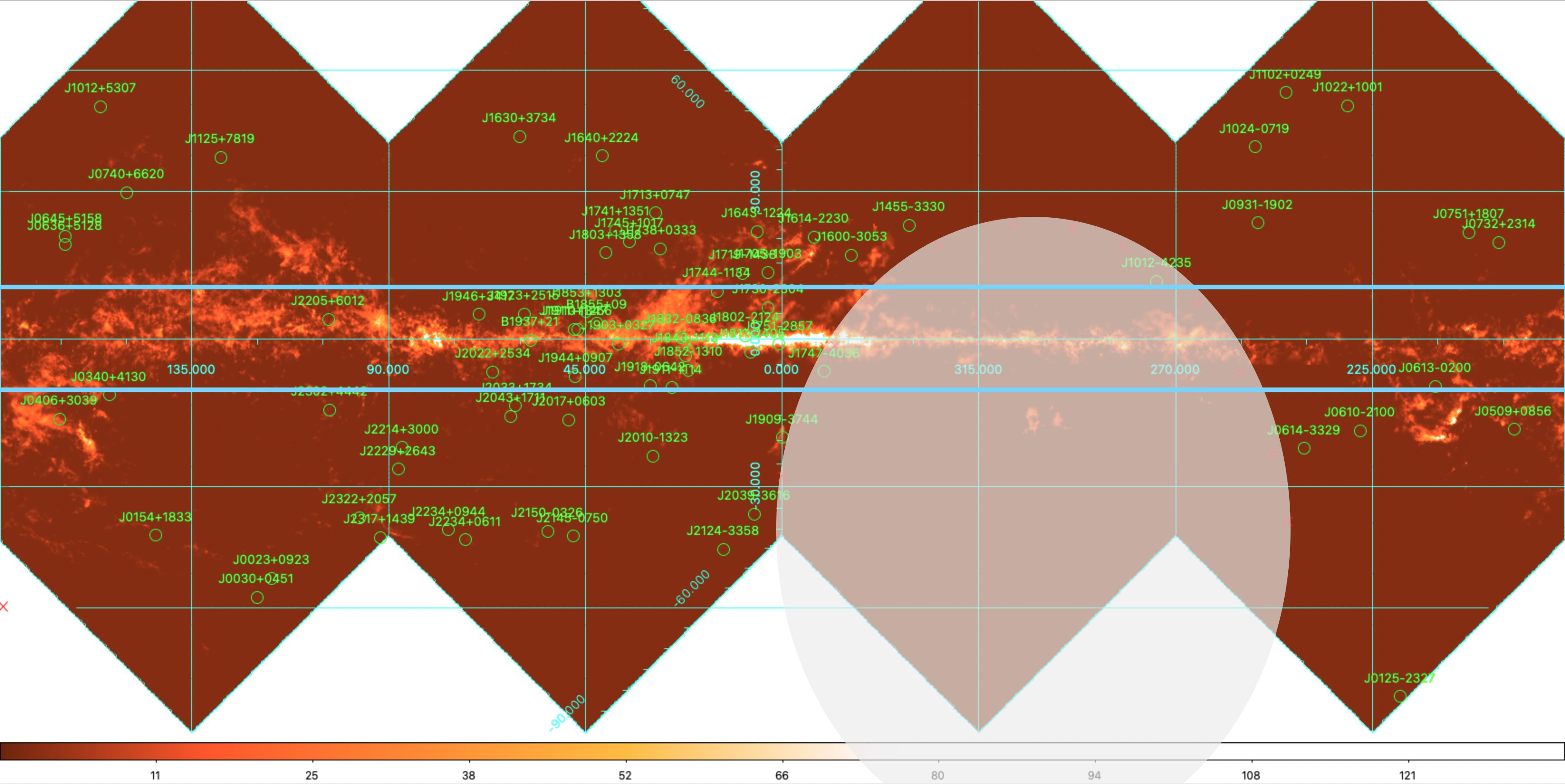
The DSA-2000 offers a unique opportunity for deep observations of the OH hyperfine splitting transitions of the rotational ground state. The proposed deep OH absorption observations have the potential to detect CO dark gas in different Galactic environments. The new contribution of the DSA-2000 to the discovery of CO-dark gas is the impressive sensitivity of the all-sky survey over its entire lifetime after combining 16 epochs. With the simultaneous OH 1667 MHz observations and the novel mix of survey speed and sensitivity, the DSA-2000 will provide a new view on the diffuse ISM in the Milky Way.
For the search of CO-dark gas, we propose a separate zoom band for the OH 1667 MHz line, which is always recording data when observing the Galactic plane, ideally using 1024 channels at 1.05 kHz resolution, with a minimum of 4.4 kHz (0.8 km/s) resolution and 256 channels to cover a bandwidth of 200 km/s.
Flares and reconnection-powered fast-radio transients from the late inspiral.” (In Prep.).